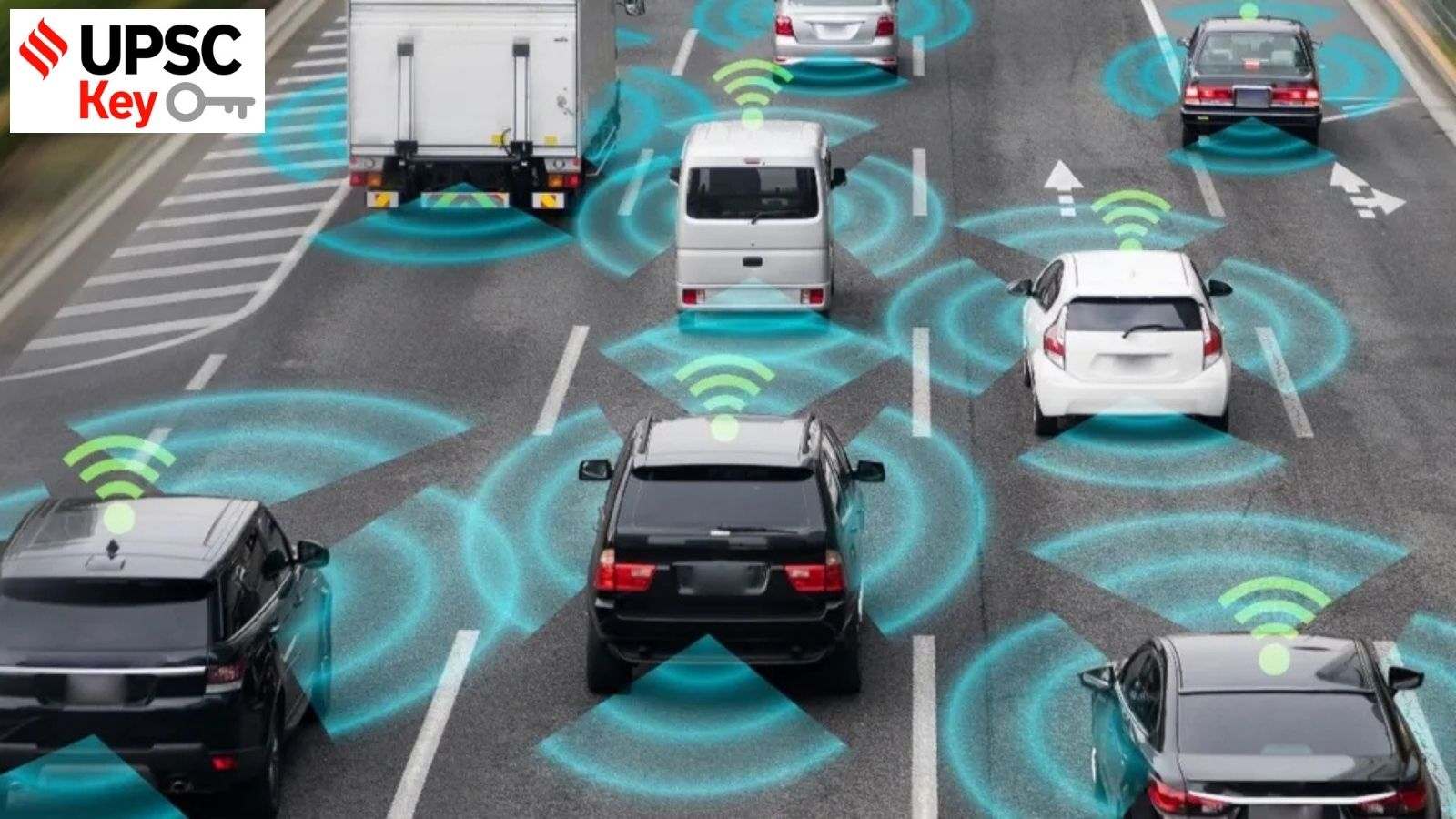
UPSC Key: ‘Talking’ cars, Himalayas’ hanging glacier threat, and Indus Waters Treaty
Mains Examination: General Studies-II, III: Government policies and interventions, Science and Technology.
— Road accidents are a multi-causal phenomenon and are the result of an interplay of various factors. What are those factors?
— How will the V2V system work, and how is it different from other safety devices?
— What are the initiatives taken by the government to prevent road accidents?
— The Ministry had published the draft Central Motor Vehicles (Amendment) Rules, 2026, on July 22 seeking objections and suggestions from the public on the V2V system within 30 days; now, they will be taken into consideration.
— The proposed changes to the Rules mark a significant transition in India’s vehicle manufacturing and road infrastructure by moving ahead of onboard safety mechanisms like advanced driver assistance systems (ADAS) and interconnecting two vehicles.
— The draft Rules propose mandating the minimum technical and safety features for V2V-fitted vehicles before they are rolled out on roads, while also setting a deadline for manufacturers to install the V2V system.
— According to the MoRTH notification, the vehicles of categories L (two- and three-wheelers), M (cars, buses), and N (goods vehicles) manufactured on or after October 1, 2027, will be required to comply with AIS-230 standards, if they are fitted with V2V system.
— It also says that vehicles of categories L, M and N, manufactured on or after October 1, 2028, will be required to be fitted with V2V communication systems, meeting specifications as per AIS-230.
— AIS-230, or Automotive Industry Standard-230, is a technical backbone for the V2V system, which specifies a list of requirements like radio performance, frequency stability, receiver sensitivity, cybersecurity and communication-security provisions, electromagnetic interference and compatibility requirements, Global Navigation Satellite System road safety applications, etc.
— For the V2V system, an On Board Unit (OBU) will be installed in vehicles so that it can exchange information with other vehicles wirelessly. It will use cellular Vehicle-to-Everything (C-V2X) technology in the 5.875 GHz to 5.925 GHz frequency band.
— On June 10, 2026, the Department of Telecommunications exempted the use of this frequency band from licensing requirements. Now, the original equipment manufacturers (OEMs) can use this spectrum to get V2V installed in new vehicles.
— The V2V-fitted vehicles will alert the driver about sudden braking, black spots, unsafe lane changes, obstacles like parked vehicles on roadsides, fog or any potential collision risk.
— The traditional safety features in vehicles — such as the camera-based ADAS — depend on the line of sight of a driver, that is, how far one can see the road. The V2V system, however, works beyond the line of sight such as blind corners or behind large trucks, and it alerts the driver by establishing contact with other vehicles. So, it is expected to complement ADAS and predict forward collision risk. The vehicles will continuously exchange real-time data including speed, position, direction, and acceleration.
— V2V is only a sub-category of V2X (Vehicle-to-Everything). V2X includes:
📍India has the most road accident deaths in the world. Can ‘talking cars’ curb these?
📍UPSC Prelims ‘SEE’ Snapshot : Talking cars, GDP rebasing and Nor’westers — quick look
(1) With reference to the Vehicle-to-Vehicle (V2V) safety technology, consider the following statements:
1. It is a wireless technology that will enable the vehicles to communicate or talk with one another to share real-time information.
2. V2V systems have a range of 300 metres and can detect vehicles in this range.
Preliminary Examination: Current events of National & International importance.
Mains Examination: General Studies-II: Effect of policies and politics of developed and developing countries on India’s interests.
What’s the ongoing story: The US says it will gain majority control over more than 65 billion barrels of Venezuelan oil — or 20% of its proven oil reserves — under an agreement with the South American country.
— Why did the US attack Venezuela and capture President Nicolás Maduro?
— What are the implications of the US capturing of Venezuelan President Nicolás Maduro?
— Read about the principle of non-intervention in international relations?
— What is the strategic significance of Venezuela’s oil reserves?
— US President Donald Trump said this “biggest oil deal in world history” will be implemented through a partnership involving private companies “at no cost to the American taxpayer”.
— Venezuela has the world’s largest proven oil reserves, estimated at about 300 billion barrels, but produces and sells only about 1% of the crude the world is using. After the US captured Venezuela’s President Nicolás Maduro in January, Trump declared that Washington would take control of Caracas’s oil sector and that American majors would invest billions of dollars to revive the Venezuelan oil industry.
— All these months later, it would seem he is getting his wish. The announcement represents an ambitious attempt to combine American capital and technology with Venezuela’s massive but dilapidated oil production infrastructure.
— The US is the largest oil producer in the world. It is also a top exporter of the black gold. So why does it want to have a high degree of control of Venezuelan crude?
— Some reasons are self-evident — energy market dominance, reducing international oil prices amid the Strait of Hormuz crisis and building up reserves. But a key reason is the very nature of Venezuelan oil — highly viscous, sticky and “sour”.
—At this stage, the precise legal and commercial structure of the US-Venezuela agreement remains unclear. While Trump said that the US would effectively obtain majority control over 65 billion barrels of Venezuelan oil reserves, Venezuela presented the pact as a major investment programme for reviving its petroleum industry.
— Venezuela has historically maintained strong state control over its oil industry. A deal giving foreign companies significant ownership or operational control of its oil producing assets could become politically contentious.
— Crude oil is not exactly a fungible commodity in practice because of the differences in quality of various types or grades of oil. And which type of crude is likely to be easily available in adequate volumes is a key factor in refinery configurations.
— As mentioned above, a key reason for the US interest is the grade of Venezuela’s oil. The bulk of Venezuelan crude is classified as “heavy sour” crude — “heavy” because it is thicker and denser than the lighter crude oil grades, and “sour” because of its high sulphur content. By contrast, the majority of US oil production is “light” and “sweet” — denoting low viscosity and sulphur content.
— However, much of the American refining infrastructure — particularly the US Gulf Coast refineries — were specifically engineered to process heavy crudes from Latin America and Canada.
— The US is also not on the best of terms with other countries that have significant heavy crude reserves, such as Iran and Russia. That was also the case with Venezuela, until January this year. Therefore, the US still has to import heavy sour crudes to feed these refineries, even as it exports massive volumes of its own “light sweet” oil.
— There are also geopolitical considerations. The Trump administration wants a reliable and nearby supply source after its war on Iran prompted Tehran to choke oil supplies through the Strait of Hormuz — the narrow waterway that used to see a fifth of the world’s energy flows in peacetime.
📍UPSC Issue at a Glance | US–Venezuela Crisis: What happened, why Venezuela, and how it matters for India
Statement-I: Recently, Venezuela has achieved a rapid recovery from its economic crisis and succeeded in preventing its people from fleeing/emigrating to other countries.
Statement-II: Venezuela has the world’s largest oil reserves.
Which one of the following is correct in respect of the above statements?
(a) Both Statement-I and Statement-II are correct and Statement-II explains Statement-I
(b) Both Statement-I and Statement-II are correct, but Statement-II does not explain Statement-I
Preliminary Examination: Indian and World Geography – Physical, Social, Economic Geography of India and the World.
Mains Examination: General Studies I: Geographical features and their location-changes in critical geographical features (including water-bodies and ice-caps) and in flora and fauna and the effects of such changes.
What’s the ongoing story: The devastating flooding in Nepal has similarities to at least four major incidents in India over the last decade-and-a-half, each involving a sudden release of large volumes of waters in the mountainous rivers.
— Understand the Himalayan cryosphere: What are glaciers, ice caps, ice sheets?
— What are hanging glaciers? How are they different from valley glaciers?
— How do they differ in terms of formation, location and stability?
— Why are the Himalayas particularly vulnerable to disasters?
— What causes a glacier to advance, retreat or become dynamically unstable?
— Understand the distinction between glacial retreat and glacial instability.
— How do Glacial Lake Outburst Floods (GLOFs) occur? Distinguish them from floods caused by cloudbursts, landslides, dam failures and sudden glacier/ice collapse.
— Map the Himalayan river systems and identify their source regions and major tributaries.
— How is climate change impacting Himalayan glaciers? Examine.
— Identify some major glacial and flood-related disasters in the Indian Himalayas in recent years. What common geographical features do they share?
— How can infrastructure development in the Himalayas be made more resilient to increasing climate-related hazards?
— But there are more warning bells for India. As rising temperatures and shifting regional precipitation patterns reduce the stability of the Himalayan glaciers, some of them could evolve into “hanging glaciers” — ice masses perched on steep slopes that can detach and trigger massive avalanches.
— An April 2026 study published in Nature magazine has found that there are as many as 219 hanging glaciers in the Alaknanda basin of the Garhwal Himalayas. Nearly a third of this unstable ice, according to the study, is concentrated in the Upper Alaknanda basin.
— The study — by Ashim Sattar of the School of Earth, Ocean and Climate Sciences, Indian Institute of Technology, Bhubaneswar and Nandu Krishnan of the Divecha Centre for Climate Change, Indian Institute of Science, Bengaluru, alongside two colleagues — flagged that Himalayan glaciers are increasingly exhibiting “geometric and dynamic instability” owing to rapid warming and climate variability.
— Unstable glaciers are essentially those whose velocity may change by an order of magnitude and more during a comparatively short period of time. The result is redistribution of ice, accompanied by geometric and structural-and-tectonic shifts.
Types of hanging glaciers. Credit: ‘Basin-scale inventory and exposure assessment of hanging glaciers, Central Himalaya’
— This instability then leads to the development of hanging glaciers on steep slopes. While these glaciers have been extensively studied in the Alps, basin-scale assessments in the Himalayas remain limited. Hanging glaciers pose a significant risk of break-offs.
— The break-offs from hanging glaciers can also trigger secondary hazards such as glacial lake outburst floods (GLOFs).
📍Nepal disaster: What is a glacier collapse and how does it happen?
📍Nepal flash floods: As glacial collapse emerges as likely trigger, is India prepared?
📍Why Nepal flash floods resemble 2021 Chamoli disaster, with greater impact
(1) How will the melting of Himalayan glaciers have a far-reaching impact on the water resources of India? (UPSC CSE, 2020)
(2) What is the phenomenon of cloudbursts? Explain. (UPSC CSE, 2024)
Preliminary Examination: Current events of national and international importance.
Mains Examination: General Studies-II: Bilateral, regional and global groupings and agreements involving India and/or affecting India’s interests, India and its neighbourhood.
What’s the ongoing story: India on Friday rejected the Hague-based Court of Arbitration’s decision on the “abeyance” of the Indus Waters Treaty and said that the court has “no jurisdiction whatsoever to pronounce on India’s sovereign decisions”.
— What is the dispute redressal mechanism laid down under the Indus Water Treaty?
— How is river water sharing determined in bilateral relationships?
— Know the significance of the Indus Waters Treaty in the context of India-Pakistan relations.
— The Court of Arbitration concluded that India’s decision on “abeyance” of the Treaty was not permissible under the Treaty or other applicable rules of international law. “The Court found that none of these grounds could justify suspension or termination of the Treaty. Accordingly, the Indus Waters Treaty remains fully in force, and India must observe its obligations under the Treaty, including those relating to the design and operation of its hydro-electric projects on the Western Rivers,” the court said.
— Responding to the court decision, the Ministry of External Affairs said on Monday: “Today, the illegally constituted so-called Court of Arbitration (CoA) has issued what it termed as an award concerning Interim Measures and Status of the Indus Waters Treaty. This so-called Court was constituted by the World Bank in patent breach of the terms of the Treaty and India categorically rejects its so-called award, just as it has firmly rejected all prior pronouncements by this illegally constituted body.”
— “India has never recognised the existence in law of this illegally-constituted and so-called Court of Arbitration, and has consistently maintained that the very establishment of this alleged arbitral body constitutes a grave violation of the Indus Waters Treaty. Accordingly, India has never appeared before this body and has refused to take any cognisance of its earlier pronouncements,” the MEA said.
— More than a year ago, after the Pahalgam terrorist attack in April, India decided to put the Indus Waters Treaty “in abeyance”. The decision flows directly from the Cabinet Committee on Security (CCS) decision of 23 April 2025, which states that “the Indus Waters Treaty of 1960 will be held in abeyance with immediate effect, until Pakistan credibly and irrevocably abjures its support for cross-border terrorism”.
— India has consistently maintained that the so-called Court of Arbitration (CoA) was illegally constituted and has never recognised its legal existence or jurisdiction. MEA had earlier said that the CoA’s proceedings are “illegal and per se void, and any proceedings, awards or decisions issued by it are null and void and without legal effect”.
— India and Pakistan signed the Indus Water Treaty on September 19, 1960 to ensure the distribution of waters of the Indus and its tributaries. It was signed in Karachi by then Prime Minister Jawaharlal Nehru and then Pakistan President Ayub Khan.
— A river, along with its tributaries, is called a river system. The Indus River system comprises six rivers: Indus, Jhelum, Chenab, Ravi, Beas, and Sutlej. The Indus and Sutlej are antecedent rivers, meaning they existed even before the formation of the Himalayas and cut deep gorges after originating in the Tibet region. The other four rivers – Jhelum, Chenab, Ravi and Beas – originate in India.
📍Knowledge Nugget | Indus Waters Treaty in Focus: What aspects need to be revisited?
📍India must uphold Indus Waters Treaty, court rules. What was Pakistan’s case?
📍Indus Waters Treaty: A year on, India’s case for freezing it and what it plans next
(3) With reference to the Indus river system, of the following four rivers, three of them pour into one of them which joins the Indus directly. Among the following, which one is such a river that joins the Indus direct? (UPSC CSE 2021)
Present an account of the Indus Water Treaty and examine its ecological, economic and political implications in the context of changing bilateral relations. (UPSC CSE 2016)
Mains Examination: General Studies-II, III: Government policies and interventions, Infrastructure: Energy.
What’s the ongoing story: India’s largest oil and gas producer Oil and Natural Gas Corporation (ONGC) plans to invest about Rs 1 lakh crore over five years on exploration activities in deepwater and ultra-deepwater fields in India’s offshore basins, its chairman said Monday.
— What are offshore, deep-sea, and ultra-deep-sea hydrocarbon reserves?
— What is the Samudra Manthan (National Offshore Exploration Scheme)?
— What are the key features of the National Offshore Exploration Scheme?
— Why does India remain heavily dependent on crude oil and natural gas imports?
— What is the significance of India’s Exclusive Economic Zone (EEZ) for offshore energy exploration?
— What are the challenges associated with Hydrocarbon exploration?
— Even as the state-owned energy giant remains focussed on its core upstream activities, it also plans to set up a crude oil and petroleum product trading unit in either Dubai or Singapore by the end of the year.
— According to ONGC Chairman and CEO Arun Kumar Singh, the upstream oil and gas major plans to drill 87 deepwater and ultra-deepwater wells till 2030-31, with the total investment required for this campaign estimated at about Rs 1 lakh crore.
— ONGC’s plans are consistent with the government’s push for boosting oil and gas exploration and production activities in Indian waters, for which it announced the Rs 84,000-crore ‘Samudra Manthan’ scheme, or the National Offshore Exploration Scheme, in July.
— The scheme will provide financial support for exploratory drilling in deepwater and ultra-deepwater areas and support building of common infrastructure for production of the discovered hydrocarbon, apart from funding offshore data acquisition and developing hydrocarbon manufacturing and services zones. The outlay is for implementation till financial year 2030-31.
— Given ONGC’s deep-sea exploration push, the scheme could take some burden off the company. ONGC plans to drill eight deepwater and ultra-deepwater wells in the current financial year, 10 in 2027-28, 20 in 2028-29, 22 in 2029-30, and 27 in 2030-31.
— The Centre expects the Samudra Manthan scheme to catalyse reserve accretion of over 600 million tonnes of oil and oil equivalent gas, while stimulating significant investments across the upstream oil and gas value chain.
— Hydrocarbon exploration is a capital-intensive and long-gestation activity, with a typical period of five to 10 years from the award of an exploration block to the commencement of commercial production. Further, existing oil and gas fields witness a natural production decline of around 6–7% every year, making continuous exploration and new discoveries essential to sustain domestic hydrocarbon production, as per the government.
— India is the world’s third-largest consumer of crude oil and also a major consumer of natural gas, but has a high degree of import dependency — over 88% for oil and about 50% in the case of natural gas. This makes the country’s economy vulnerable to global energy market volatility, and even poses supply risks, as has been witnessed during the ongoing West Asia crisis.
— Moreover, the country’s energy demand is on the rise, while domestic production is stagnant with numerous ageing fields witnessing natural production decline.
📍Government greenlights Rs 84,000-crore scheme to boost offshore oil & gas exploration, production
How many of the above activities are regulated by the Petroleum and Natural Gas Regulatory Board in our country?
Domestic chip design to receive big push through Rs 1.27 lakh crore Semicon 2.0
Mains Examination: General Studies III: Science and Technology- Developments and their Applications and Effects in Everyday Life.
What’s the ongoing story: The Centre on Monday notified the operational framework for its Rs 1.27 lakh crore Semicon 2.0 programme, putting the design of Indian chips and intellectual property at the front of an expanded semiconductor strategy that will also subsidise manufacturing equipment, raw materials, fabrication plants and advanced chip packaging.
— What is a semiconductor? Why are semiconductors important for the modern economy?
— Understand the difference between conductors, semiconductors and insulators.
— Why has India historically remained stronger in semiconductor design than in semiconductor manufacturing? Examine.
— What are the major challenges faced by India in developing a semiconductor ecosystem?
— How does Semicon 2.0 seek to expand upon the earlier semiconductor policy framework?
— Locate the major semiconductor manufacturing and assembly projects.
— Why are semiconductor manufacturing facilities concentrated in particular geographical locations? Examine
— What are the critical raw materials, components and infrastructure required for semiconductor manufacturing?
— The new mission, approved by the Union Cabinet in July, divides government support into six pillars, with at least three being entirely devoted to chip design. Incentives are being offered for designing chips needed for strategic purposes, the commercial market and domestically developed chips deployed at scale.
— For chips meant for areas of national importance and critical infrastructure, the government will identify technologies and building blocks, including intellectual property (IP) for compute, memory, radio frequency, power, networking and sensors, that it wants developed in India.
— Indian-owned and controlled companies can participate independently or with global companies, research organisations and academic institutions.
— The Centre for Development of Advanced Computing (C-DAC), under the IT Ministry, will issue requests for proposals and select developers through competitive bidding. The IP created under these projects will be jointly owned by the company and C-DAC.
— Beyond design, the scheme also attempts to build the largely imported upstream supply chain needed to operate semiconductor factories.
— Companies setting up R&D facilities for semiconductor equipment, plants making semiconductor-grade wafers, photomasks, photoresists, substrates, chemicals and gases, testing facilities, or units producing semiconductor equipment and components can receive capital expenditure support of 30%.
— Equipment manufacturers will additionally get a declining production-linked incentive of 10%, 8%, 6%, 4% and 2% over five years beginning FY 2028-29, on the value of their bill of materials sourced from domestic manufacturers. The combined support will be capped at 50% of eligible capital expenditure.
📍Semicon push: Regulatory norms for high-tech industries to be eased, says Goyal
(5) Which one of the following pairs of semiconductor plants in India and their locations is not correctly matched ?
(a) CG Power and Industrial Solutions Pvt. Ltd. in partnership with Renesas Electronics and STARS Microelectronics — Gujarat
India aims to become a semiconductor manufacturing hub. What are the challenges faced by the semiconductor industry in India? Mention the salient features of the India Semiconductor Mission. (UPSC CSE, 2025)
Preliminary Examination: Economic and Social Development – Sustainable Development, Poverty, Inclusion, Demographics, Social Sector Initiatives, etc.
Mains Examination: General Studies III: Indian Economy and issues relating to Planning, Mobilization of Resources, Growth, Development and Employment.
What’s the ongoing story: Offering a sliver of hope amid the uncertain global environment marred by the prolonged West Asia war, the Indian economy exhibited continued resilience by posting a real GDP growth rate of 7.8% in the April-June quarter.
— What is the difference between real GDP and nominal GDP? Why is real GDP used to measure economic growth?
— How is India’s GDP calculated? Identify the major expenditure components of GDP.
— Understand the primary, secondary and tertiary sectors of the Indian economy.
— How do manufacturing and services contribute to India’s economic growth?
— What is Gross Fixed Capital Formation (GFCF)? Why is it important for economic growth?
— How does investment influence economic growth and employment?
— What is the relationship between consumption, investment and economic growth?
— What does the Index of Industrial Production (IIP) measure? How is it different from GDP?
— Understand the use-based classification of industrial goods under IIP.
— What does the recent divergence between consumer goods and capital goods growth indicate about the Indian economy?
— While agricultural growth remained subdued, manufacturing and services surged to bolster growth beyond even the 7% estimate by the Reserve Bank of India.
— A sharp surge of nearly 12% in gross fixed capital formation — the proxy for investments in the economy — also provided the required push to the overall growth along with a firm growth in private consumption.
— A strong manufacturing and services growth along with a sharp rise in investments helped propel the growth rate to 7.8% in Q1. While the manufacturing sector grew by 9.2% in April-June, up from 8.3% in the same quarter last year, the tertiary sector – or services – expanded 10%, higher than 8% a year ago.
— Agriculture recorded a modest growth of 3.6% in Q1 as against 4.4% in the corresponding quarter a year ago. But, the CEA said the impact for the farm sector has fared better than what was expected in June when the monsoon shortfall was high.
— “By and large the developments on this have been incrementally for the better, both with respect to output and with respect to inflation and on the food front,” he said.
— As 2026-27 progresses, the growth-inflation mix is likely to become less favourable, with growth moderating and inflation rising. Crisil expects GDP growth of 7 per cent and inflation of 5.1 per cent
— The moderation in growth reflects a more challenging external environment, marked by disruptions from the conflict in West Asia, unresolved tariff issues with the US, weather-related risks and a strong base effect in the second half.
— The two exogenous factors that worked in India’s favour last year, low crude oil prices and a normal monsoon, are unlikely to provide similar support this year.
📍Economy remains resilient, but the road ahead is likely to be less forgiving than last year
📍India’s industrial production index saw strong growth, but it hides weak consumer demand
📍Why India is expecting GDP surprise after best Q1 for loan growth in over a decade
(6) With reference to the sectors of the Indian economy, consider the following pairs (UPSC CSE, 2024)
(7) Which of the following activities constitute a real sector in the economy? (UPSC CSE, 2022)
What’s the ongoing story: India enters its next employment decade with notable achievements. The government has expanded the foundations of work through infrastructure development, formalisation, financial inclusion, skilling and encouragement to entrepreneurship.
— What is employment? How is it different from unemployment and labour force participation?
— Understand the concepts of Labour Force Participation Rate (LFPR), Worker Population Ratio (WPR) and Unemployment Rate (UR).
— What is the difference between formal and informal employment?
— What are the major challenges associated with informal employment in India?
— What is disguised unemployment? How is it different from seasonal and structural unemployment?
— How can India create more productive and better-paying jobs?
— Understand the concept of NEET (Not in Employment, Education or Training).
— Why does higher female labour force participation not necessarily translate into better employment outcomes for women?
— Examine the factors influencing women’s participation in paid work.
— The Reserve Bank of India’s KLEMS productivity database provisionally estimates that employment rose from 47.15 crore in 2014-15 to 64.33 crore in 2023-24. The question is how this base can now produce more formal jobs, higher productivity, better wages and career progression.
— NITI Aayog’s report, Reimagining Skilling for Viksit Bharat@2047, released on August 18, — places the challenge within a blueprint for demand-led, industry-linked and outcome-oriented skilling.
— It estimates that 9 crore young Indians were neither in education, employment nor training, excluding those seeking jobs, and that about 88 per cent were engaged in domestic duties. It is inaccurate to describe all of them as unemployed.
— But it’s also true that millions of young women remain outside paid work because unpaid care, safety, mobility, social norms and limited local opportunities restrict choice.
— Women will be the decisive measure of the next employment transformation. Female labour force participation in usual status rose from 23.3 per cent in 2017-18 to 41.7 per cent in 2023-24.
— Women hold 56 per cent of Jan Dhan accounts, receive about two-thirds of MUDRA loans and number over 10 crore in self-help groups. Tap water, clean cooking fuel and sanitation reduce drudgery, while housing ownership strengthens assets.
— This must be matched by affordable childcare, safe transport, working women’s hostels, flexible formal work, digital access and quality jobs closer to home.
📍What the young want, and why creating good jobs is no longer optional
(8) With reference to casual workers employed in India, consider the following statements: (UPSC CSE, 2022)
1. All casual workers are entitled for Employees Provident Fund coverage.
2. All casual workers are entitled for regular working hours and overtime payment.
3. The government can by a notification specify that an establishment or industry shall pay wages only through its bank account.
Singapore diplomat, Myanmar activist & Bangladeshi aid giver win Magsaysay awards
— A Singaporean lawyer and diplomat who led an international conference that adopted the United Nations Convention on the Law of the Sea, a Myanmar activist whose group documents human rights atrocities and a former Bangladeshi teacher who has helped provide aid to her country’s poorest were named Monday as the winners of this year’s Ramon Magsaysay Awards.
— Regarded as Asia’s version of the Nobel Prize and named after a popular Philippine president, who died in a 1957 plane crash, the awards honor “greatness of spirit” through selfless service to people across Asia.
— The winners of the award, first given in 1958, will be recognized at the Metropolitan Theatre in Manila on Nov. 15 with a medallion, inscribed certificate and an undisclosed cash prize.
— Singaporean lawyer and diplomat Tommy Koh, 88, was recognized for promoting international dialogue and the rule of law. He is best known for presiding over a U.N. conference of more than 150 countries, which adopted the U.N. Convention on the Law of the Sea in 1982.
— Bo Kyi, the 61-year-old winner from Myanmar, has twice been arrested in the past and spent seven years in prison for a life spent in defense of democracy and resistance against widespread human rights violations by Myanmar’s military.
— Runa Khan, 67, of Bangladesh won the award for “her profound empathy for the poorest of the poor in her country.”
Navy Chief: INS Nipun will enhance our critical underwater capabilities
— INS Nipun will significantly enhance the Navy’s niche underwater capabilities required for multi-domain operations, Chief of Naval Staff Admiral Krishna Swaminathan said on Monday. — He emphasised that this dedicated Diving Support and Submarine Rescue Vessel adds specialised capability for complex underwater operations and to respond to emergencies in one of the world’s most “challenging and mysterious environments”. The Navy Chief was speaking at the commissioning ceremony of INS Nipun in Mumbai.
— INS Nipun is the second Diving Support Vessel (DSV) of the Nistar Class and is a strong addition to the Navy’s deep-sea diving and underwater support capabilities.
— INS Nipun is capable of supporting saturation, air and heliox diving and is equipped with remotely operated underwater systems for inspection and intervention. Its specialised diving complex, dynamic positioning capability and associated life-support and medical facilities enable the conduct of sustained and complex operations at sea.
After seven-month hiatus, ISRO to launch key satellite on Sept 4
— The Indian Space Research Organisation (ISRO) on Monday announced that the earth observation satellite EOS-05 will be launched via GSLV F17 on September 4 at 02:55 am from Sriharikota.
— The satellite, with a 10-year mission life, is designed to image large areas of interest at frequent intervals for purposes such as monitoring natural disasters or keeping track of agriculture or forestry.
— This is India’s first earth observation satellite in a higher geosynchronous orbit. Most earth observation satellites are placed in low earth orbit.
Tata Advanced Systems to co-produce US Javelin missile system in India
— The US’ Javelin anti-tank missile system – a shoulder-launched, fire-and-forget weapon – will be co-produced in-country. A pact was signed to this effect between Tata Advanced Systems Limited and American defence contractors Raytheon and Lockheed Martin, the companies said in a statement on Monday.
— This will ‘support future in-country production of the Javelin missile system while providing unique opportunities (for India) and strengthen regional stability in the Indo-Pacific’, the three companies said.
— What this means is that the sub-assembly kits and GEUs, or guidance electronic units, i.e., the on-board computer that guides the missile to its target once fired, will be produced separately in the US and then shipped to India for assembly and integration.
— The Javelin first entered service with the US military in 1996. It is an anti-tank guided munition with a standard effective range of 2.5 km. A single person can carry this missile system and fire it from their shoulder. Alternatively, it can also be fired from a remote launcher mounted on an unmanned ground vehicle.
How India’s top thermal power producer is making more profits from renewables
— Despite surging commodity prices, the profits of India’s largest power producer, state-owned NTPC Ltd, have grown at a faster clip compared with its revenues in each of the last three years. The reason — getting paid for backing up the growing share of renewable power generation.
— In its annual general meeting Thursday, NTPC chairman and managing director Gurdeep Singh attributed this to fixed charges of thermal power plants, which he said contribute to the profitability of the state-owned power operator. Fixed charges are the payments received by thermal power generators for keeping its power plants available to generate electricity, irrespective of how much power they actually produce.
— This highlights a key feature of India’s changing power mix: rising renewable generation can reduce thermal power generation without reducing the payments made to thermal generators.
Original Source
This content was distilled for a focused reading experience. All rights belong to The Indian Express.
Read original publication