UPSC subject-wise quiz: Polity and Governance (Week 185)
Listen 00:00 0.5x 0.75x 1x 1.25x 1.5x 2x AI Narration This audio is AI generated.
UPSC Essentials brings to you its initiative of daily subject-wise quizzes. These quizzes are designed to help you revise some of the most important topics from the static part of the syllabus. Attempt today’s subject quiz on Polity and Governance to check your progress.
Consider the following statements with reference to the right to access the Internet in India:
1. The right to access and use the Internet is a fundamental right of every individual.
2. The Supreme Court has held that the fundamental right to access the Internet is absolute and cannot be subject to restrictions in the interest of public order or child safety.
Which one of the following is correct in respect of the above statements?
(a) Both Statement 1 and Statement 2 are correct and Statement 2 is the correct explanation for Statement 1.
(b) Both Statement 1 and Statement 2 are correct and Statement 2 is not the correct explanation for Statement 1.
Relevance: This question is relevant to the UPSC Prelims 2027 syllabus under Indian Polity, particularly Fundamental Rights and constitutional limitations on individual freedoms. It also connects constitutional principles with contemporary issues of digital rights, public order and online safety.
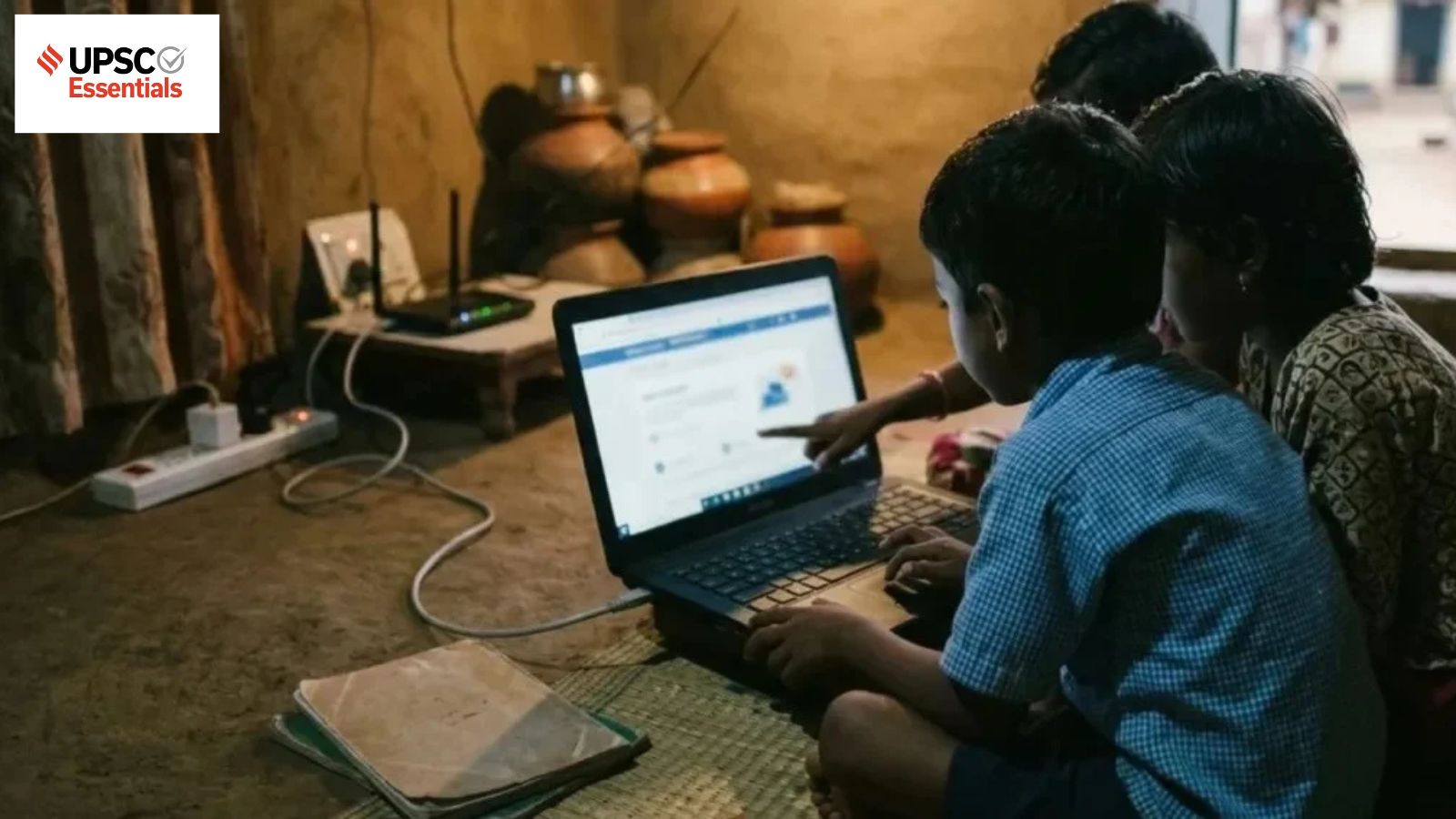
— The Supreme Court on October 15 held that “the right to access and use the internet is a fundamental right of every individual.” A bench of Justices J B Pardiwala and K V Chandran added that children, “irrespective of their age, enjoy the same rights”, and that “the safety of our children and their freedom are not at odds with each other. Our children are entitled to both. Hence, statement 1 is correct.
— Internet-related rights are not absolute. Restrictions may be imposed subject to constitutional requirements, including legality, necessity and proportionality, where applicable. Hence, statement 2 is not correct.
— In 2024, a two-judge bench of the Supreme Court comprising Justices D Y Chandrachud and J B Pardiwala held that viewing, possessing, and not reporting the possession of any child pornographic material constitute offences under the stringent Protection of Children from Sexual Offences (POCSO) Act and the Information Technology (IT) Act, even if this is not disseminated further.
— It overturned a Madras High Court order that had quashed the chargesheet against an accused, holding that downloading and privately viewing such material, without publishing or transmitting it, was not an offence. Just Rights for Children Alliance, a coalition of NGOs, challenged the Madras HC order before the court and sought directions to intermediaries on reporting such material.
— The Supreme Court in later orders noted platforms’ lapses in complying with those directions, and that news reports showed paid promotion of child sexual exploitation and abuse material (CSEAM) through redirect links.
— While ruling on compliance with its earlier orders, the court considered a trend “across the globe” of limiting children’s access to social media “in the name of their safety”. The bench said it “decided consciously not to endorse the same.”
With reference to the peace bond, consider the following statements:
1. It is a legal undertaking to maintain public peace for a specified period.
2. The BNSS does not provide for the procedure for the peace bond.
3. Signing a peace bond provides immunity from subsequent arrest.
Relevance: This question is relevant to the UPSC Prelims 2027 syllabus under Indian Polity and Governance. It is important for understanding the legal framework for preventing breaches of peace and maintaining public tranquility.
— Under Sections 2(1)(d) and 2(1)(e) of the BNSS, a ‘bail bond’ is an undertaking for release with surety, while a ‘bond’ is a personal undertaking for release without surety.
— The BNSS also stipulates bonds for keeping peace and good behaviour, the procedure for which is laid out in Sections 125 to 143 of Chapter IX of the BNSS. Hence, statement 2 is not correct.
— A peace bond is a legal undertaking to maintain public peace for a specified period. It is a preventive measure intended to address an apprehended breach of peace, rather than punishment following conviction. Hence, statement 1 is correct.
— Signing a peace bond does not provide immunity from subsequent arrest. Under Section 170 of the BNSS, police can make a fresh preventive arrest if they know of a plan to commit a cognisable offence and believe it cannot otherwise be prevented. Hence, statement 3 is not correct.
— Separately, Section 141(1)(b) provides consequences for breaching an existing peace bond executed under Section 136. If the Magistrate is satisfied that the breach has been proved, and records the grounds for that finding, they may order arrest and detention until the bond period expires.
1. Article 16(4) of the Constitution of India allows the State to create reservations for appointments or posts in public services.
2. A person who converts from a Hindu social order to a non-Hindu social order can claim affirmative action under Article 16(4) of the Constitution.
Relevance: This question is relevant to the UPSC Prelims 2027 syllabus under Indian Polity, particularly Fundamental Rights and the Right to Equality. It links to contemporary debates on social justice, backward-class identification and equality of opportunity.
— The Supreme Court upheld the Madras High Court’s ruling that a person converting from Hinduism to Islam cannot claim reservation under the Backward Class (Muslim) category solely on the basis of conversion. A bench of Justices Prashant Kumar Mishra and S Chandrashekhar upheld the High Court’s decision striking down a 2024 state government order that allowed such converts to claim the status.
— It held: “A person who converts from a Hindu social order to a non-Hindu social order cannot claim affirmative action under Article 16(4) of the Constitution merely on the basis of the social backwardness associated with his pre-conversion status; the backwardness suffered in the antecedent social order cannot, by itself, be carried forward so as to confer upon him the status of a backward class in the religion to which he has converted.” Hence, statement 2 is not correct.
— Article 16(4) of the Constitution of India allows the State to create reservations for appointments or posts in public services. Hence, statement 1 is correct.
— The Constitution (Scheduled Castes) Order, 1950, issued under Article 341, sets out the legal framework governing SC status. Paragraph 3 of the order states: “No person who professes a religion different from the Hindu, the Sikh or the Buddhist religion shall be deemed to be member of a Scheduled Caste.”
The “Form 6”, with reference to the Election Commission, refers to:
(a) An application for deletion of a name from the electoral roll.
(b) An application for shifting residence from one constituency to another.
(d) An application for inclusion in the electoral rolls and is meant for people who have never voted before.
Relevance: This question is relevant to the UPSC Prelims 2027 syllabus under Indian Polity and Governance, particularly the electoral process and the functioning of the Election Commission of India. It tests knowledge of electoral registration procedures and the forms used for inclusion, deletion, shifting and correction of entries in electoral rolls.
— The Delhi High Court last week considered this question in a petition by two voters, who raised Form 6 for new voters in relation to the SIR exercise. While the bench comprising Justice Dinesh Mehta and Aditi Choudhary said the concern was “misplaced”, voters elsewhere have also earlier petitioned over the query, including in the Supreme Court.
— Issued by the Election Commission of India (ECI), Form 6 is an application for inclusion in the electoral rolls and is meant for people who have never voted before.
— In the case of voters who shifted homes and therefore could not be enumerated at their old addresses, resulting in their names being dropped from the rolls during the SIR process, the ECI provided the recourse of using Form 6. The form carries a declaration that an applicant is seeking enrolment for the first time.
— However, petitioners point out that Section 31 of the Representation of the People Act of 1950 penalises any person with imprisonment of one year or a fine, or both, who makes “a statement or declaration in writing which is false and which he either knows or believes to be false or does not believe to be true.” The other concern is that the process treats an existing elector as a new one, as it does not restore the earlier enrolment.
Consider the following statements about the Election Commission:
1. The Election Commission of India (ECI) is a permanent constitutional body.
2. It was established in accordance with the Constitution on 26th November 1949.
3. The Election Commissioners, other than the Chief Election Commissioner, have the same status, salary and perks as those available to the Comptroller and Auditor General of India (CAG) of India.
Relevance: This question is relevant to the UPSC Prelims 2027 syllabus under Indian Polity and Governance, particularly constitutional bodies. It tests knowledge of Article 324, the establishment of the Election Commission of India, and the constitutional and statutory provisions governing its composition and service conditions.
— The Election Commission of India (ECI) is a permanent constitutional body. According to its website, it was established “in accordance with the Constitution on 25th January 1950.” Hence, statement 1 is correct and statement 2 is not correct.
— The Constitution gave it the “superintendence, direction and control of the entire process for conduct of elections to Parliament and Legislature of every State and to the offices of President and Vice-President of India,” the ECI website says.
— Originally, the Commission had only a Chief Election Commissioner (CEC). It now consists of the CEC and two Election Commissioners (ECs). The President appoints them, and they serve six years or until age 65, whichever comes first.
— The Election Commissioners have the same status, salary and perks as available to Supreme Court judges. Similarly, the CEC can only be impeached through Parliament, like a Supreme Court judge. Hence, statement 3 is not correct.
Daily Subject-wise quiz — History, Culture, and Social Issues (Week 166)
Daily subject-wise quiz — Environment and Geography (Week 184)
Original Source
This content was distilled for a focused reading experience. All rights belong to The Indian Express.
Read original publication