UPSC Daily Quiz: Environment and Geography (Week 171)
With reference to the ‘desert rain frog’, consider the following statements:
1. The species is found only in a narrow strip of coastal dunes stretching across parts of Namibia and South Africa.
2. It is listed as critically endangered on the IUCN Red List.
3. One of the reasons for its population decline is diamond mining.
4. The species spends most of its life burrowed beneath the sand.
Which one of the following conclusions based on the above statements is correct?
(b) There are three correct statements, that include statements 1 and 4.
Relevance: Species in the news are a recurring theme in Environment and Ecology. UPSC frequently asks questions on the habitat, geographic distribution, conservation status (IUCN Red List), endemic species, and threats to wildlife, especially those highlighted in recent scientific studies or conservation reports.
— The desert rain frog (Breviceps macrops), whose high-pitched defensive squeak turned it into one of the internet’s most-loved amphibians, has now been listed as Vulnerable on the International Union for Conservation of Nature (IUCN) Red List. Hence, statement 2 is not correct.
— The desert rain frog is found nowhere else on Earth except a narrow strip of coastal sand dunes stretching across parts of Namibia and South Africa. The species spends most of its life burrowed beneath the sand, emerging mainly to feed and breathe. Hence, statements 1 and 4 are correct.
— Diamond mining, along with proposed energy developments, is shrinking and degrading the sand dunes the frog depends on for survival. Because the species occupies such a specialised habitat, it has very little room to adapt if that environment is destroyed. Hence, statement 3 is correct.
— Illegal wildlife trade has already affected several rare amphibian species around the world, prompting conservationists to remain cautious whenever an animal suddenly becomes an online celebrity.
1. Every avian generation makes choices about which songs to continue singing, which to improve upon and which to drop altogether.
2. During their critical song-learning phase of development, young songbirds imitate the adult males in their group who are successful in courtship or have elaborately ornamented plumage.
Which one of the following is correct in respect of the above statements?
(a) Both Statement 1 and Statement 2 are correct and Statement 2 is the correct explanation for Statement 1.
(b) Both Statement 1 and Statement 2 are correct and Statement 2 is not the correct explanation for Statement 1.
Relevance: Birdsong and animal behaviour are important from the perspective of Ecology and Environment, especially concepts such as animal communication, behavioural ecology, learning, adaptation, sexual selection, and cultural transmission in animals.
— Like human language, birdsong is dynamic. Every avian generation makes choices about which songs to continue singing, which to improve upon and which to drop altogether. A single Bachman’s sparrow might learn only 48 of the songs used by its community, and for decades researchers have been trying to figure out how baby sparrows choose which songs to adopt. Hence, statement 1 is correct.
— During their critical song-learning phase of development, young songbirds imitate the adult males in their group who are successful in courtship or have elaborately ornamented plumage. Hence, statement 2 is correct.
Why Statement 2 explains Statement 1: The generational “choices” indicated in Statement 1 are not intentional decisions, but rather result from juveniles selectively copying the songs of successful males. Songs associated with reproductively successful males are passed down to the next generation, whilst less successful song variants gradually disappear. Thus, selective imitation is the process driving the cultural evolution of birdsong indicated in Statement 1.
With reference to the waterfalls and the associated countries, consider the following pairs:
Relevance: Major waterfalls of the world are an important topic under World Geography. UPSC can ask map-based questions on the location of waterfalls, rivers, mountain ranges, and associated countries.
— Tugela Falls (South Africa): Often at the centre of debates over the world’s tallest waterfall, Tugela Falls has a total drop of approximately 411 metres (1,350 feet). Located within the Drakensberg Mountains, it consists of a series of falls that tumble down sheer basalt cliffs. The surrounding hiking trails offer pleasing views of the landscape. Hence, pair 1 is not correct.
— Olo’upena Falls (United States): Dropping approximately 900 metres (2,953 feet), Olo’upena Falls cascades down one of the world’s tallest sea cliffs on the Hawaiian island of Molokai. Because of its inaccessible location, the waterfall is best viewed from the air or by boat.
— Yumbilla Falls (Peru): With a height of about 896 metres (2,940 feet), Yumbilla Falls is among Peru’s greatest natural treasures. The waterfall descends through multiple tiers, surrounded by lush vegetation and is increasingly gaining recognition among adventure travellers. Hence, pair 3 is not correct.
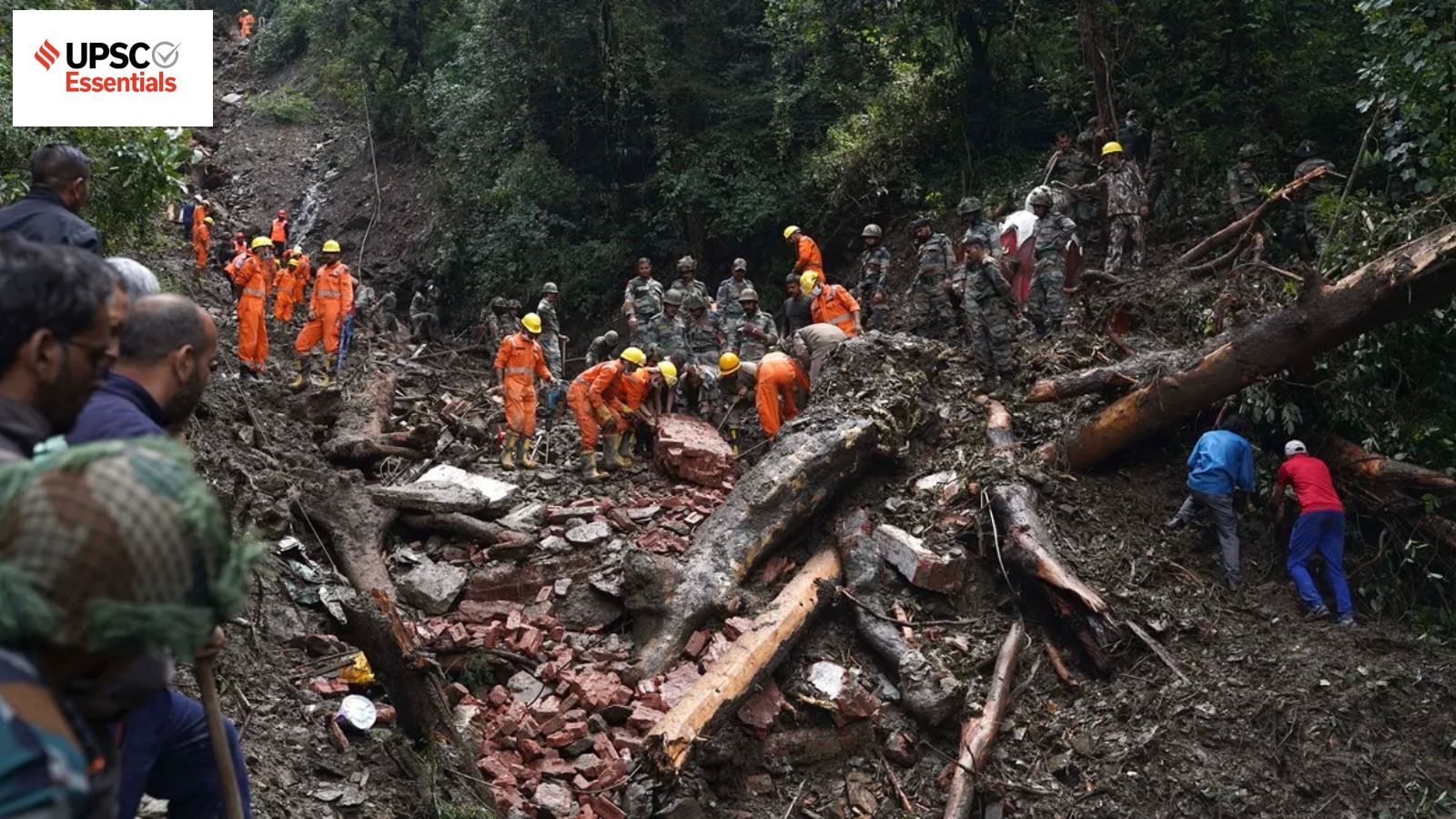
Relevance: Landslides are an important topic under Geography, Disaster Management, and Environment. UPSC can ask questions on the causes, triggering factors, vulnerability of the Himalayan and Western Ghats regions, and early warning systems, especially in the context of recent extreme rainfall events and landslide disasters.
— The landslides in recent days in the Western Ghats and other parts of India have reignited discussions on the need for an early warning system for such events. Such systems already work effectively in many countries. Two well-publicised successful cases come from Switzerland, where separate instances from 2023 and 2025 saw hundreds of people evacuated from a hazardous area a few days before disaster struck.
— About 13% of India’s total landmass, covering about 0.42 million square km, is known to be prone to landslides, according to the National Disaster Management Authority. The risk is highest in the Himalayan region and along the Western Ghats.
— Recently, Professor Dericks Praise Shukla and his team at IIT Mandi have unveiled their own landslide early warning system, which is in the process of getting validated with ongoing events in the Himalayan region. Over the last year, their models were validated against about 80 actual landslides in the region. Since rainfall is one of the most common triggers, the team uses highly localised rainfall forecasts to model the probability of a landslide at these sites. Several other relevant factors like soil conditions, rock stability, extent of slope, and population density have to be fed into the model.
— Factors that trigger landslides include rainfall, rock stability, soil type and condition, seismic activity, erosion, and deforestation.
1. Hydrogen is a high-energy-density fuel in comparison to diesel.
2. Hydrogen trains require high maintenance in comparison to diesel trains.
3. India does not have a hydrogen storage and refuelling facility.
(b) There are two correct statements, that include statement 1.
Relevance: Hydrogen fuel-cell technology is an important topic under Science and Technology, Energy, and Environment. UPSC may ask conceptual questions on hydrogen production, storage, fuel-cell technology, energy density, and the National Green Hydrogen Mission.
— The Jind-Sonipat hydrogen train will be powered by hydrogen fuel. The train will use a 1,200 KW hydrogen fuel cell propulsion system, which will generate power to operate the train. This hydrogen train is a converted version of a Diesel Electric Multiple Unit (DEMU) rake.
— Hydrogen is a high-energy-density fuel (120 MJ/Kg) in comparison to diesel (43 MJ/Kg), with low maintenance and a manageable Carbon footprint. In the proposed hybrid power system, the primary energy source is a Proton Exchange Membrane Fuel Cell (PEMFC) and the secondary energy source will be a battery bank to meet the average and peak power requirements. Hence, statement 1 is correct and statement 2 is not correct.
— According to the Ministry of Railways, hydrogen fuel cell technology generates electricity through a chemical reaction involving hydrogen. The process produces only water vapour as an emission, making it a cleaner alternative to conventional fossil fuel-based traction systems.
Daily Subject-wise quiz — History, Culture, and Social Issues (Week 159)
Daily subject-wise quiz — Environment and Geography (Week 170)
Original Source
This content was distilled for a focused reading experience. All rights belong to The Indian Express.
Read original publication