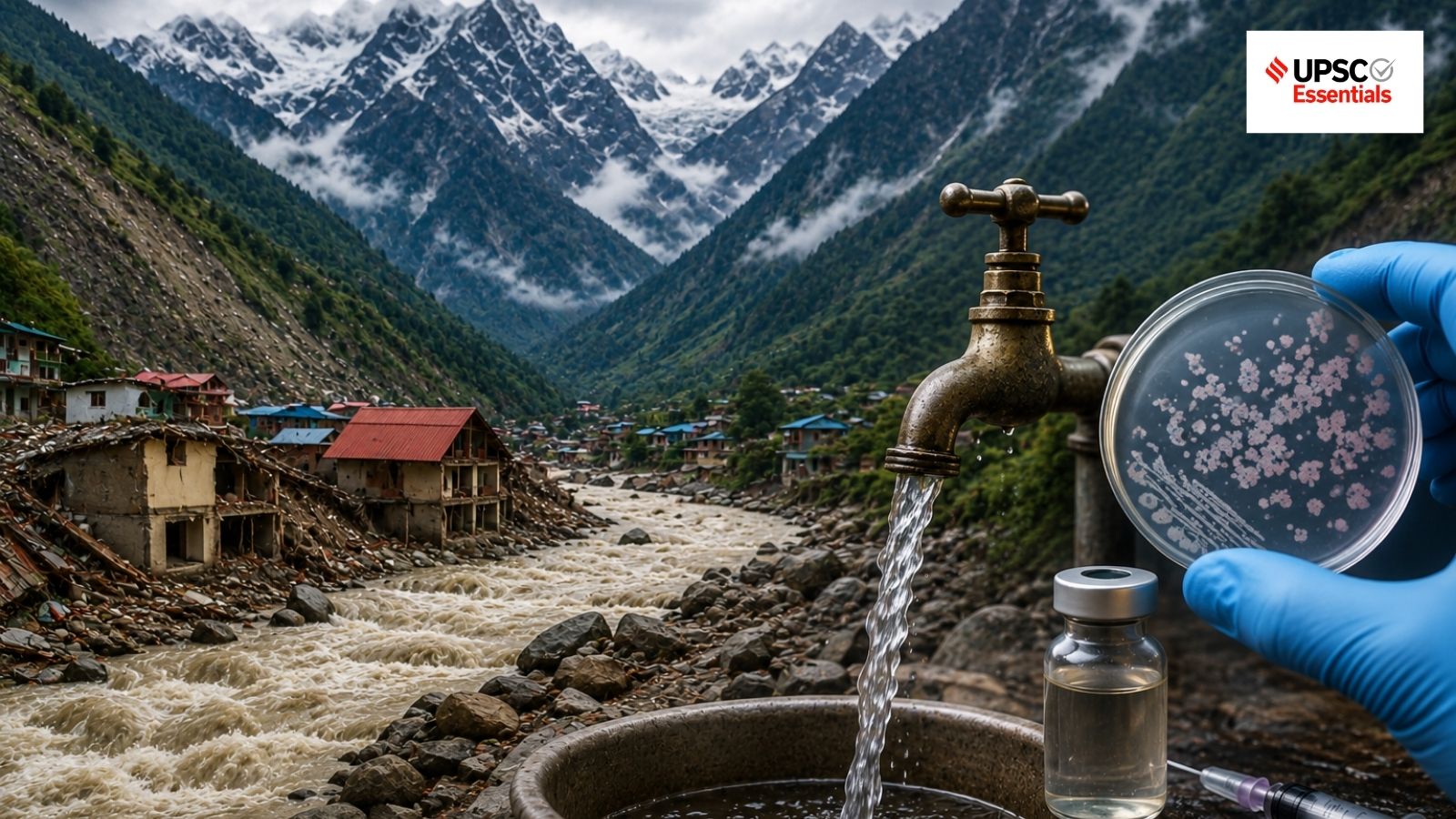
UPSC Mains 2027: Natural hazards and typhoid control in India
The Himalayan region is increasingly exposed to cascading natural hazards arising from the interaction of glacial processes, steep terrain and extreme weather events. Discuss the factors responsible for this vulnerability and suggest measures to strengthen disaster resilience.
“The control of vaccine-preventable diseases cannot rely primarily on treatment.” Discuss this statement in the context of typhoid control in India.
QUESTION 1: The Himalayan region is increasingly exposed to cascading natural hazards arising from the interaction of glacial processes, steep terrain and extreme weather events. Discuss the factors responsible for this vulnerability and suggest measures to strengthen disaster resilience.
Relevance: The topic is relevant to GS 3: Disaster Management, Environment and Climate Change, with a focus on Himalayan vulnerability and cascading hazards. The question tests the ability to suggest multi-dimensional disaster-risk reduction and resilience measures.
Note: This is not a model UPSC answer. It only provides you with a thought process which you may incorporate into the answers.
— The Himalayas are a fragile and tectonically active mountain range where climate change, extreme weather, and human interference can combine to cause cascading calamities.
— Recent incidents in Nepal, like the Kedarnath (2013), Chamoli (2021), and South Lhonak (2023) calamities, highlight this susceptibility.
You may incorporate some of the following points in your answer:
— Steep slopes, small valleys, and fast-flowing rivers increase the catastrophic potential of unexpected water outbursts. Landslides, avalanches, and earthquakes can quickly destabilise already vulnerable terrain.
— Glacier retreat and changing snow conditions can both contribute to the formation and growth of glacial lakes. The collapse of glaciers, moraine dams, or glacial lakes can result in GLOFs, debris flows, and flash floods.
— A single trigger, such as glacier collapse, heavy rainfall, or a landslip, might set off a series of events. Floodwaters carrying rocks, silt, and ice undermine river banks and slopes, causing secondary landslides and worsening downstream damage. The 2023 South Lhonak event exemplified this cascade effect.
— Rising temperatures and shifting precipitation patterns are transforming the Himalayan cryosphere, increasing vulnerability to extreme events. Climate change may exacerbate the underlying susceptibility, but linking an individual tragedy directly to climate change requires more analysis.
— Rapid infrastructure development, hydroelectric projects, tunnelling, road building, and heavy tourist traffic can all enhance vulnerability in fragile environments. The concentration of settlements and infrastructure along narrow river valleys increases disaster losses.
— Increase monitoring of high-risk glacial lakes, landslides, and river flows; incorporate weather stations, river gauges, satellite monitoring, and new technologies like environmental seismology.
— Restrict development and settlements in high-risk floodplains, unstable slopes, and other hazard-prone areas.
— Dams, hydroelectric projects, highways, and bridges must undergo thorough cumulative and multi-hazard risk assessments before construction.
— Creating location-specific evacuation plans, emergency exercises, and dependable last-mile warning systems for vulnerable areas.
— Himalayan risks transcend political lines; India, Nepal, Bhutan, and China require ongoing exchange of hydrological, weather, climatic, and glacial-lake data, as well as collaborative scientific research and emergency drills. Conclusion:
— The Himalayan challenge is more than just averting specific risks; it is about ending the cycle of cascading calamities. A combination of scientific monitoring, early warning, risk-sensitive development, community preparedness, and cross-border cooperation can considerably boost resilience while allowing for long-term growth in the region.
(Sources: ‘Needles in haystacks’: An expert explains the challenge of early warnings in the Himalayas, Why Nepal flash floods resemble 2021 Chamoli disaster, with greater impact, Nepal floods: The red flags in dam-building in the Himalayas, Why the Nepal floods are a warning for the Himalayas, and India)
How do glacial processes, steep slopes and extreme weather interact?
How can early warning, risk mapping and resilient infrastructure reduce vulnerability?
Discuss how the contradiction between ‘rapid infrastructure development’ and ‘disaster-risk reduction’ in ecologically-sensitive areas of India can be managed, with suitable examples. (2026)
Dam failures are always catastrophic, especially on the downstream side, resulting in a colossal loss of life and property. Analyze the various causes of dam failures. Give two examples of large dam failures. (2023)
QUESTION 2: “The control of vaccine-preventable diseases cannot rely primarily on treatment.” Discuss this statement in the context of typhoid control in India.
Relevance: The topic is relevant to GS 3: Science and Technology and Health, particularly infectious diseases and public-health management. The topic also connects vaccination with sanitation, disease surveillance, diagnostics and antimicrobial resistance. The question tests the shift from a treatment-oriented to a prevention-oriented public-health approach.
— Despite being a bacterial disease that may be prevented with a vaccination, typhoid remains a major public health concern in India.
— Relying solely on treatment is problematic because diagnosis is sometimes imprecise, medications are frequently administered empirically, and rising antimicrobial resistance makes infections more difficult to treat.
— The Widal test cannot reliably confirm acute typhoid, although blood culture has a low sensitivity and is influenced by previous antibiotic usage. This can result in empirical or inappropriate antibiotic therapy.
— Vaccination can lower the incidence of infection, hence reducing the need for medications. India has the ability to manufacture typhoid conjugate vaccines (TCVs), including a WHO-prequalified TCV developed in India.
— Typhoid is linked to contaminated food and water, therefore safe water, sanitation, food safety, and hygiene remain critical components of prevention.
— India must shift to prevention-led typhoid control rather than viewing vaccine and treatment as options. This should include:
— Increased use of TCVs as part of India’s public health agenda.
— Increased diagnostic capability, including reliable fast or point-of-care diagnostics.
— Increased monitoring of suspected and culture-confirmed cases, antibiotic exposure, and antimicrobial susceptibility profiles.
— Improving WASH, food safety, and hygiene to prevent transmission.
— Antimicrobial stewardship ensures that antibiotics are used rationally and correctly. Conclusion:
— The typhoid challenge reveals that curative care cannot replace disease prevention. Vaccination, clean water, and sanitation can all help to minimise disease incidence, while improved diagnostics and antimicrobial stewardship can guarantee that antibiotics continue to be effective for individuals who require them.
(Sources: Typhoid control needs more vaccine, less antibiotic, Why typhoid fever should be treated early as disease becomes stubborn, Typhoid patient had intestinal bleeding after misusing antibiotics: Why is antimicrobial resistance rising?)
How can prevention reduce dependence on antibiotics and help address antimicrobial resistance?
What is the basic principle behind vaccine development? How do vaccines work? What approaches were adopted by the Indian vaccine manufacturers to produce COVID-19 vaccines? (2022)
Original Source
This content was distilled for a focused reading experience. All rights belong to The Indian Express.
Read original publication