UPSC Mains Answer Practice — GS 3 (Week 177)
Listen 00:00 0.5x 0.75x 1x 1.25x 1.5x 2x AI Narration This audio is AI generated.
UPSC Essentials brings to you its initiative for the practice of Mains answer writing. It covers essential topics from both the static and dynamic portions of the UPSC Civil Services syllabus across various GS papers. The questions are carefully selected on the basis of their relevance to the UPSC examination and current developments, helping aspirants focus on themes that matter most for Mains. This answer-writing practice is designed as a value addition to your UPSC CSE Mains preparation. Attempt today’s GS-3 questions and check your progress.
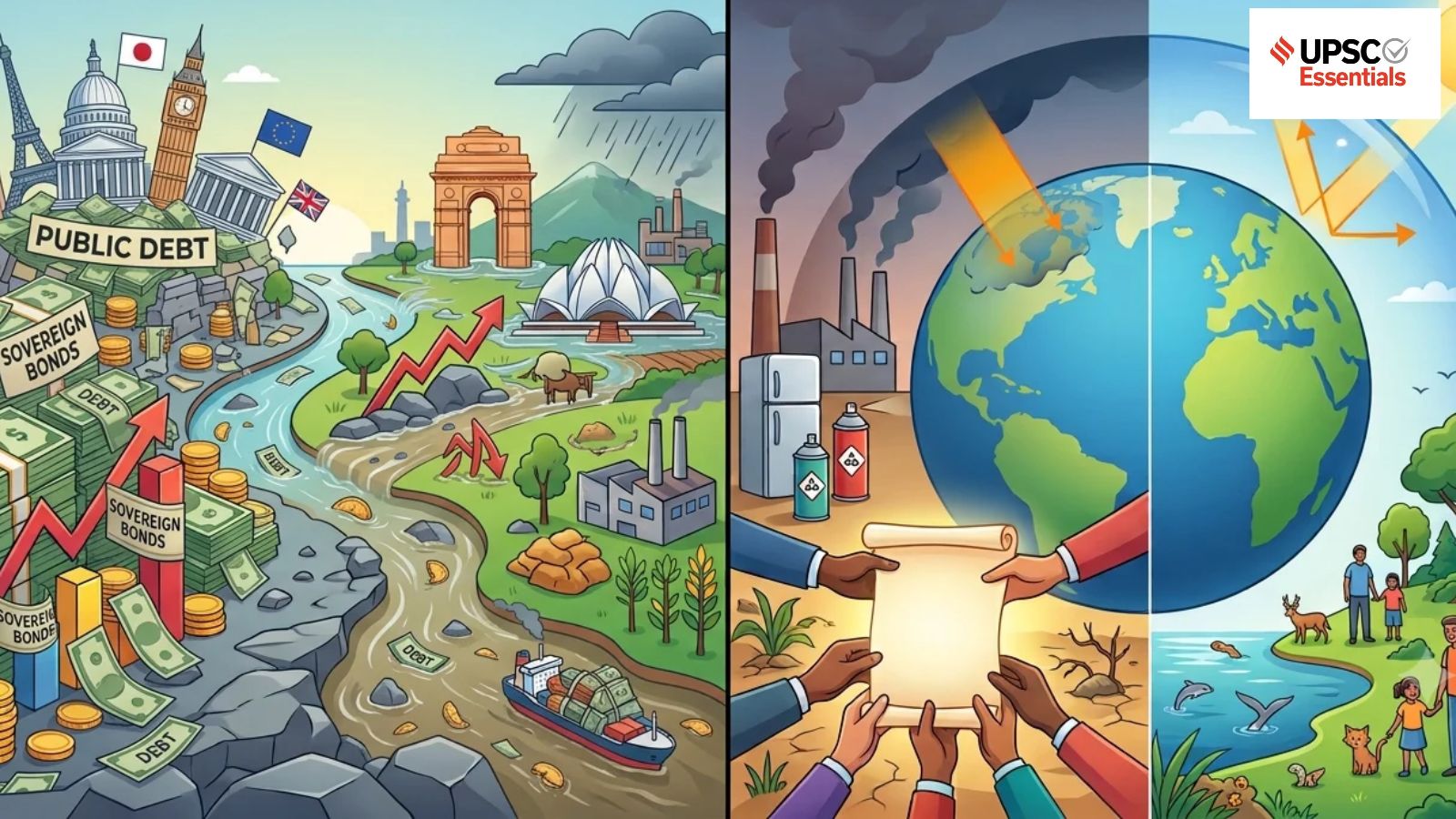
Rising public debt in advanced economies can have significant spillover effects on developing countries. Explain the transmission mechanisms and examine their implications for India.
Discuss the role of the Montreal Protocol and its Kigali Amendment in addressing global environmental challenges. What lessons do they offer for the implementation of multilateral environmental agreements?
QUESTION 1: Rising public debt in advanced economies can have significant spillover effects on developing countries. Explain the transmission mechanisms and examine their implications for India.
Relevance: The question is relevant to the Indian economy, public finance and macroeconomic stability. It examines how fiscal developments in advanced economies influence capital flows, exchange rates and borrowing costs in developing countries.
Note: This is not a model UPSC answer. It only provides you with a thought process which you may incorporate into the answers.
— The International Monetary Fund (IMF) has cautioned that rising public debt and borrowing costs in affluent nations may tighten global financial conditions and reduce poor countries’ budgetary headroom.
— With global public debt expected to approach 100% of GDP by 2030, these spillovers would present issues for emerging economies like India.
You may incorporate some of the following points in your answer:
— Heavy government borrowing in industrialised nations can raise bond yields, increasing the global cost of capital. Higher borrowing prices for Indian government and business bonds may increase debt servicing costs and discourage investment.
— Higher borrowing costs can make lending more expensive for both firms and consumers. Reduced private investment can limit industrial growth, infrastructural development, and job creation.
— Global financial tightening may raise India’s interest rates and make fresh borrowing more expensive. The government may have to make difficult choices between debt servicing and spending on infrastructure, healthcare, education, and social protection.
— High debt payment costs may force industrialised nations to cut public spending or raise taxes, reducing global demand. Slowing growth in major export markets may have an impact on India’s merchandise and services exports, manufacturing activity, and employment.
— India cannot influence fiscal changes in advanced economies, but it may mitigate its risk through smart fiscal management, resilient domestic financial markets, and increased productive capacity.
— Macroeconomic stability and sustained growth are required to withstand global financial spillovers.
(Sources: Wealthy countries’ debt could be hurting economies like India. Here’s what IMF suggests, Why global money isn’t cheap any more, and how this impacts India, Higher yields in US test India’s macro resilience, On countries becoming more debt-ridden, and why that has far-reaching consequences)
What policy measures can India adopt to strengthen its resilience to global financial shocks while sustaining inclusive economic growth?
What are the challenges before the Indian economy when the world is moving away from free trade and multilateralism to protectionism and bilateralism? How can these challenges be met? (2025)
Examine the pattern and trend of public expenditure on social services in the post-reforms period in India. To what extent this has been in consonance with achieving the objective of inclusive growth? (2024)
QUESTION 2: Discuss the role of the Montreal Protocol and its Kigali Amendment in addressing global environmental challenges. What lessons do they offer for the implementation of multilateral environmental agreements?
Relevance: The question is relevant to climate change, environmental pollution and international cooperation for environmental protection. It examines the role of multilateral environmental agreements in addressing ozone depletion and global warming.
— The 1987 Montreal Protocol stands as a landmark global treaty originally established to eliminate ozone-depleting chemicals.
— With the addition of the 2016 Kigali Amendment, its scope expanded to systematically reduce hydrofluorocarbons (HFCs)—potent climate-warming gases widely used in cooling technologies—effectively aligning ozone preservation with climate change mitigation.
— The Montreal Protocol has enabled the phase-out of approximately 99% of controlled ozone-depleting compounds, helping to restore the ozone layer and reduce exposure to harmful UV radiation.
— HFCs do not degrade the ozone layer, but they can have a significant global warming potential. The Kigali Amendment intends to cut their production and consumption, thereby avoiding up to 0.5 degrees Celsius of global warming by 2100.
— The agreements urge industry to research alternative refrigerants, increase appliance efficiency, and use environmentally friendly technologies.
— The Multilateral Fund offers financial support to poor nations to cover the additional expenses of compliance, such as technology conversion and technical training.
— Through fixed timelines and progressive regulatory updates, this framework delivers long-term operational and policy predictability for both governments and commercial sectors.
— Implementation plans should take into account each country’s unique capacities and developmental demands.
— Adequate funding and access to greener technology are required by developing countries to achieve their obligations.
— Regular scientific and technology assessments enable agreements to respond to new challenges.
— Early involvement with manufacturers and other stakeholders promotes compliance and innovation. Conclusion:
— The Montreal Protocol and Kigali Amendment show that long-term international cooperation, backed by enforceable pledges, scientific proof, and financial backing, can overcome global environmental concerns.
— India’s major goal is to satisfy its HFC phasedown commitments while expanding inexpensive, energy-efficient, and climate-friendly cooling.
(Sources: The Kigali Amendment at 10: Why India’s cooling choices matter, Can India cool down without heating up? Experts Explain why sustainability is key, Explained: Ozone pact in climate fight)
What lessons can India draw from these agreements to strengthen international cooperation on climate action?
Discuss the aim and goals of Kunming-Montreal global biodiversity framework. Mention India’s commitments and initiatives to achieve the goals and targets of this framework giving suitable examples. (2026)
Write a review on India’s climate commitments under the Paris Agreement (2015) and mention how these have been further strengthened in COP26 (2021). In this direction, how has the first Nationally Determined Contribution intended by India been updated in 2022? (2025)
Original Source
This content was distilled for a focused reading experience. All rights belong to The Indian Express.
Read original publication