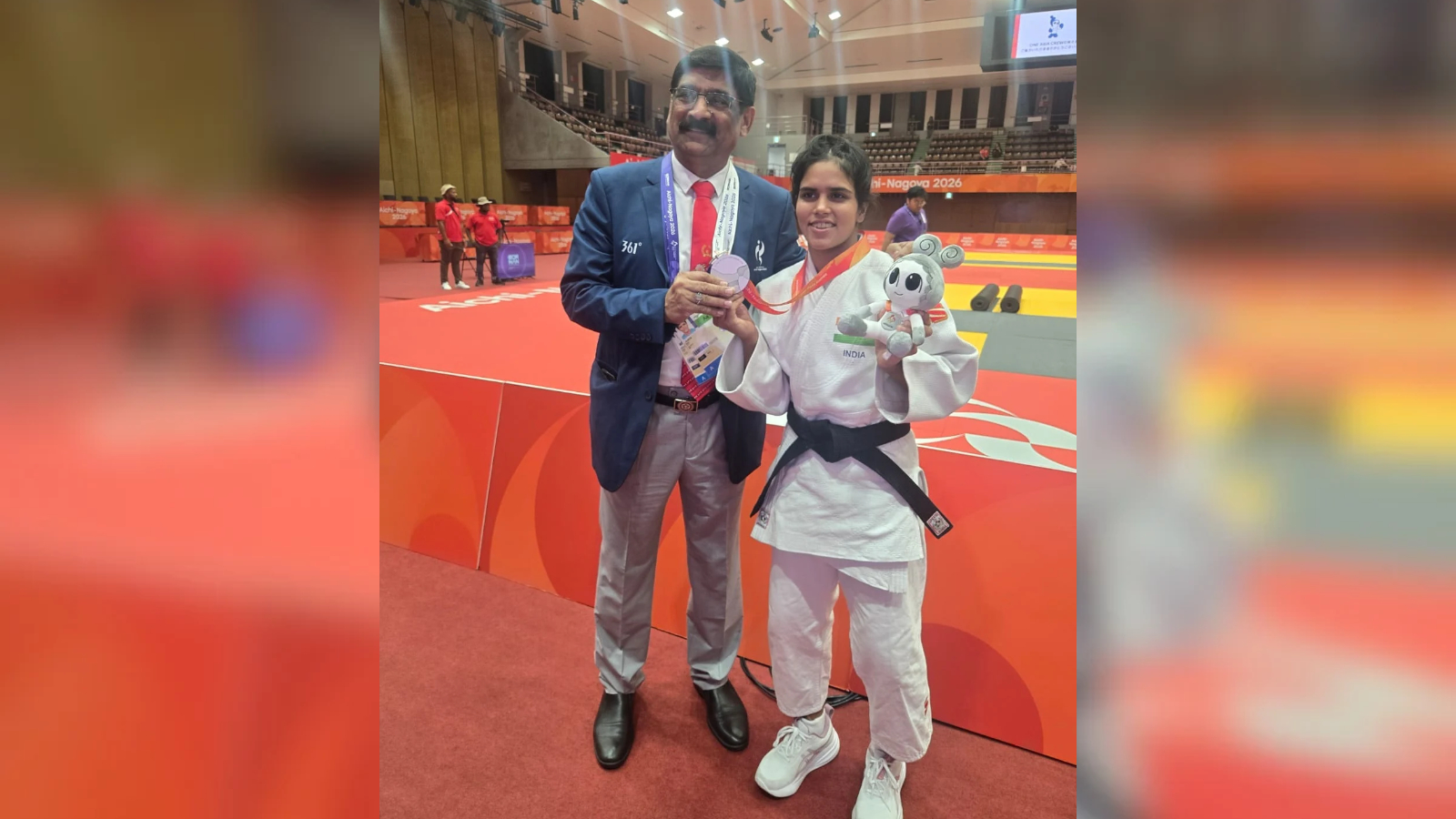
Asian Para Games: Kokila Kaushik answers 'karma' taunts with judo silver medal
Listen 00:00 0.5x 0.75x 1x 1.25x 1.5x 2x AI Narration This audio is AI generated.
Krishan Kumar Kaushik remembers the day a fellow teacher made an unsolicited remark about his daughter Kokila Kaushik being visually impaired. Kokila was born with a genetic vision disability and Krishan Kumar, a father of three, would often hear such taunts. On Monday afternoon, as his daughter won the silver medal in the women’s J2-52 kg category at the Asian Para Games, Kaushik Senior clicked pictures from the stands to send to his school teachers’ group.
Kokila’s medal was the first silver for an Indian woman para judoka at the Asian Games. She had bagged bronze in Hangzhou three years back.
Kokila too recalls the days when her classmates and acquaintances would taunt her. “People would talk negatively about my vision. But I would not pay heed to them. This silver medal is a message for all to believe in each human being’s ability,” Kokila tells this paper.
With two of her cousins also suffering from the same genetic disorder, a young Kokila grew up in Hisar’s Azad Colony locality, attending school with elder sister Safalta and younger brother Kushal. When she turned seven, the doctors at PGIMS Rohtak told the family that Kokila’s vision disorder could not be treated. Seven years post that, Kokila enrolled at a judo academy at the Mahavir Stadium under coach Brijendra, following her elder sister’s footsteps.
ALSO READ | Polio at 9 months, gold at 38: Mona Agarwal thanks grandmother for keeping faith
“As a toddler, Kokila would not go to other family members and was very shy. When she was two, we got her diagnosed and the doctors told us that her detailed check-up can only be done at the age of seven. They eventually said her vision disorder cannot be cured. She attended school with her siblings and would barely secure passing marks. Later, when we enrolled her for judo, she was fascinated by it,” recalls the father.
Kokila competed in the Nationals for the first time in 2018. She started training under coach Munawar Anjar Ali Siddiqui, who is also the founder of the Indian Blind and Para Judo Association, at the Indian Para Judo Academy in Lucknow. She claimed a silver medal at the Commonwealth Judo Championships in 2019. Four years later, Kokila bagged the bronze medal in the women’s 48kg J2 category at the Hangzhou Asiad with a 10-0 win over Chinese Taipei’s Lee Kai-lin. The win also handed her a quota for the Paris Paralympics.
Coach Siddiqui remembers the first time he saw the Haryana judoka. “When she joined the academy in Lucknow in 2018, we first made her learn the techniques with our inputs from outside the mat. She had good shoulder strength and learnt the Seoi-Nage technique with ease. While we worked on her fitness, we also focused on the gripping and throw-down techniques,” he says.
In Paris, where she became the first Indian para judoka to compete at the Paralympics, Kokila reached the quarterfinals before she lost against Kazakhstan’s Akmaral Nauatbek. The defeat was followed by another one against Ukraine’s Yuliya Ivanytska in the repechage round. Post Paris, Kokila won the silver medal in IBSA Asian Championships in Astana last year, apart from winning the title in ISBA Grand Prix in Egypt.
The 23-year-old also won the bronze medal in IBSA Judo World Cup in Tbilisi this year with a golden-score win over Paris 2024 bronze medallist Cahide Eke of Turkey. “The key in recent years has been Kokila getting to fight against some top-ranked judokas from Asia and the world. It has meant that she understood the importance of counter attacks and adjusting according to the opponent’s strength,” shares Siddiqui.
On Monday, Kokila produced a golden-score victory over reigning world champion Yi Liu of China. In the final, she suffered a loss by Ippon in 21 seconds against Kyrgyzstan’s Aibike Ulanbek Kyzy.
Siddiqui believes Kokila will learn from this experience. “She has worked a lot on her Seoi-Nage technique and we saw her using it while sitting against Liu. Prior to the final, the bronze bout went on for 25 minutes and sometimes the long wait can make a judoka a bit unsettled in the first few seconds of the bout. She almost got out of position before Kyzy tried for Ippon and won the final,” the coach says.
Original Source
This content was distilled for a focused reading experience. All rights belong to The Indian Express.
Read original publication