Chorbagan: From a den of bandits to an enclave of Kolkata’s elite
Listen 00:00 0.5x 0.75x 1x 1.25x 1.5x 2x AI Narration This audio is AI generated.
Once a jungle that offered cover to thieves and bandits, Chorbagan underwent a remarkable transformation, evolving into an enclave of wealthy Bengali families in the 18th and 19th centuries.
Centred around what is now Muktaram Babu Street in north-central Kolkata, the neighbourhood would later become known for some of the city’s oldest and most revered Durga Pujas.
On October 17, however, a stampede at the community Durga Puja in the neighbourhood claimed at least 19 lives and left several others injured.
Local narratives suggest that pilgrims carrying offerings to the Ganga once passed through a dense jungle, or bagan, where they were often attacked by bandits and thugs. This is believed to be the origin of the neighbourhood’s name, Chorbagan.
Between 1876 and 1881, however, Chorbagan began to change as the area was developed into a residential colony.
Among the families that moved into the neighbourhood were the Mullicks, Tagores, Seths, and Basaks. Wealthy and influential, they spent lavishly on building their mansions, many of which reflected European architectural styles.
In Bengali Culture Over a Thousand Years (2018), author Ghulam Murshid writes: “Among the rich native residents who built homes influenced by Western architecture around the middle of the 19th century, the most notable were Rajendralal Mullick, the Tagores of Jorasanko, Prasanna Kumar Thakur, the Mitra family in Shyamnazar…”
Cotton goes on to note how residents leased the front portions of their properties to artisans, who paid substantial rents and could also help defend the household in times of danger. The inner courtyard, meanwhile, could be accessed only through a narrow, winding lane that could be barricaded at short notice.
Such arrangements also offered shade and respite from the summer heat. Cotton writes: “Hundreds of mansions with surroundings such as these may be seen to this day, and the legacy of congestion and insanitation, which they represent, has been the despair of municipal reformers since the time of Wellesley.”
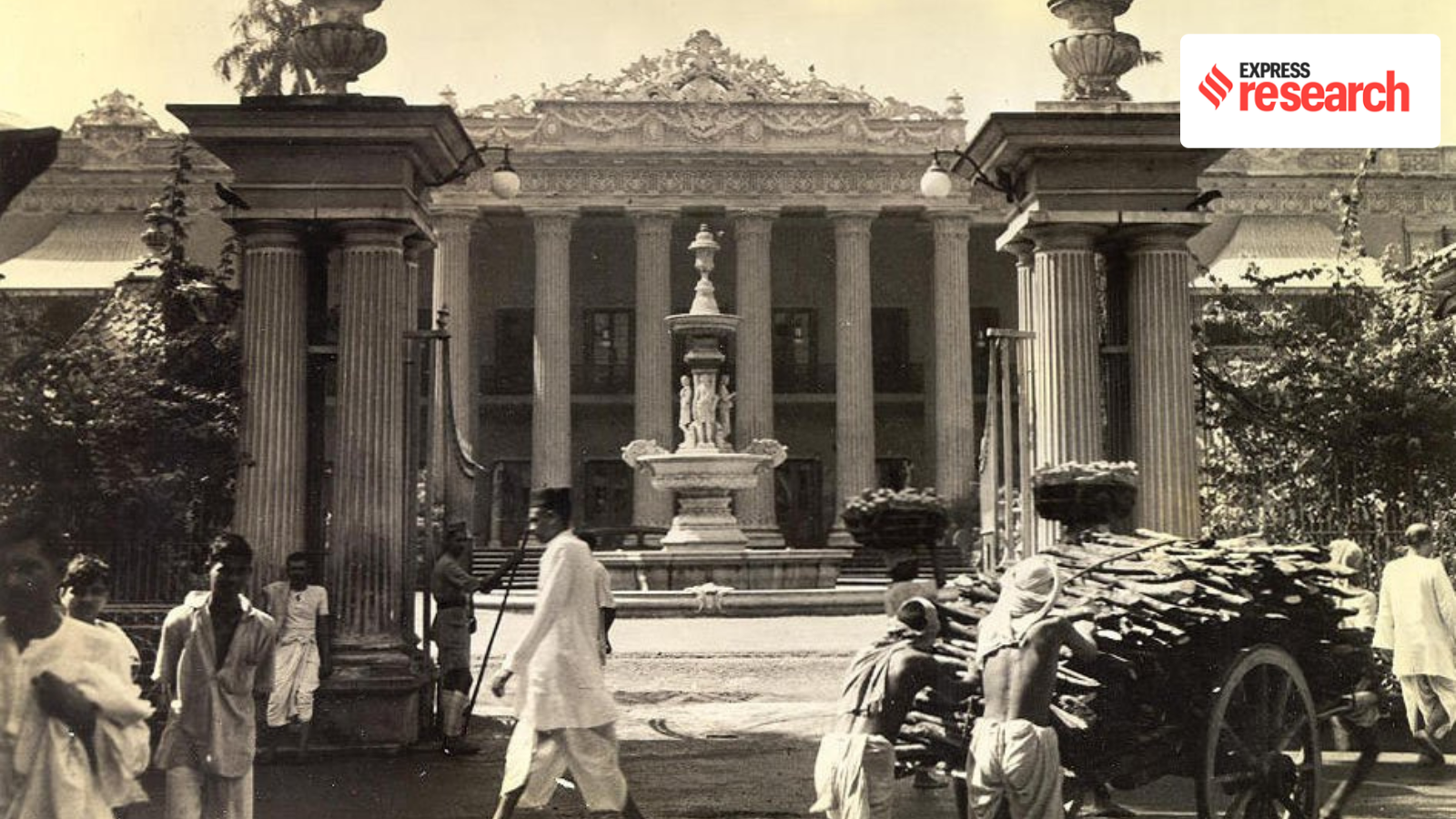
The mansions themselves were inspired by European architecture, with two storeys, continuous verandas, Tuscan pillars, and sculptures adorning their front gardens. Several of these historic homes continue to host long-standing Durga Puja celebrations, often in their courtyards or thakurdalans.
“Rajendro Mullick was an ornithologist, a botanist and an art collector, with a keen eye for Western art and architecture, and all his interests had to be incorporated into the magnificent residence he wanted to build,” notes Monolina Bhattacharyya in Bengal and Italy: Transcultural Encounters From the Mid-19th to the Early 21st Century (2024).
Spread across approximately 6.4 acres, the property encompasses the mansion, an adjoining garden, an aviary, a zoo, and cattle sheds. Built of brick and mortar and adorned with elaborate marble decorations, the residence remains a striking testament to the family’s wealth.
Bhattacharyya writes: “Today part of the mansion is used as a museum which houses Rajendro Mullick’s art collection, to which the family added over generations. The remaining parts are used for residential purposes.”
Almost matching the Marble Palace was the late 19th-century residence of Horendranath Seal, a prosperous entrepreneur. The building was later converted into Lohia Maternity Hospital.
Today, Chorbagan is a bustling neighbourhood of fruit and vegetable vendors, sweet shops, and residents going about their daily lives. Early mornings occasionally bring heritage enthusiasts to its streets, while the holiday season draws tourists keen to explore its historic buildings. Durga Puja remains a major part of the locality’s cultural life, with both household and community celebrations marked by great fanfare.
While many household pujas date back several decades, the community celebrations are particularly renowned for their artistic excellence.
Tragedy, however, has cast a shadow over this historic neighbourhood.
Original Source
This content was distilled for a focused reading experience. All rights belong to The Indian Express.
Read original publication