6 key takeaways from Mohan Bhagwat speech: Caution against stirs, foreign ‘plot’; pitch for unity
Listen 00:00 0.5x 0.75x 1x 1.25x 1.5x 2x AI Narration This audio is AI generated.
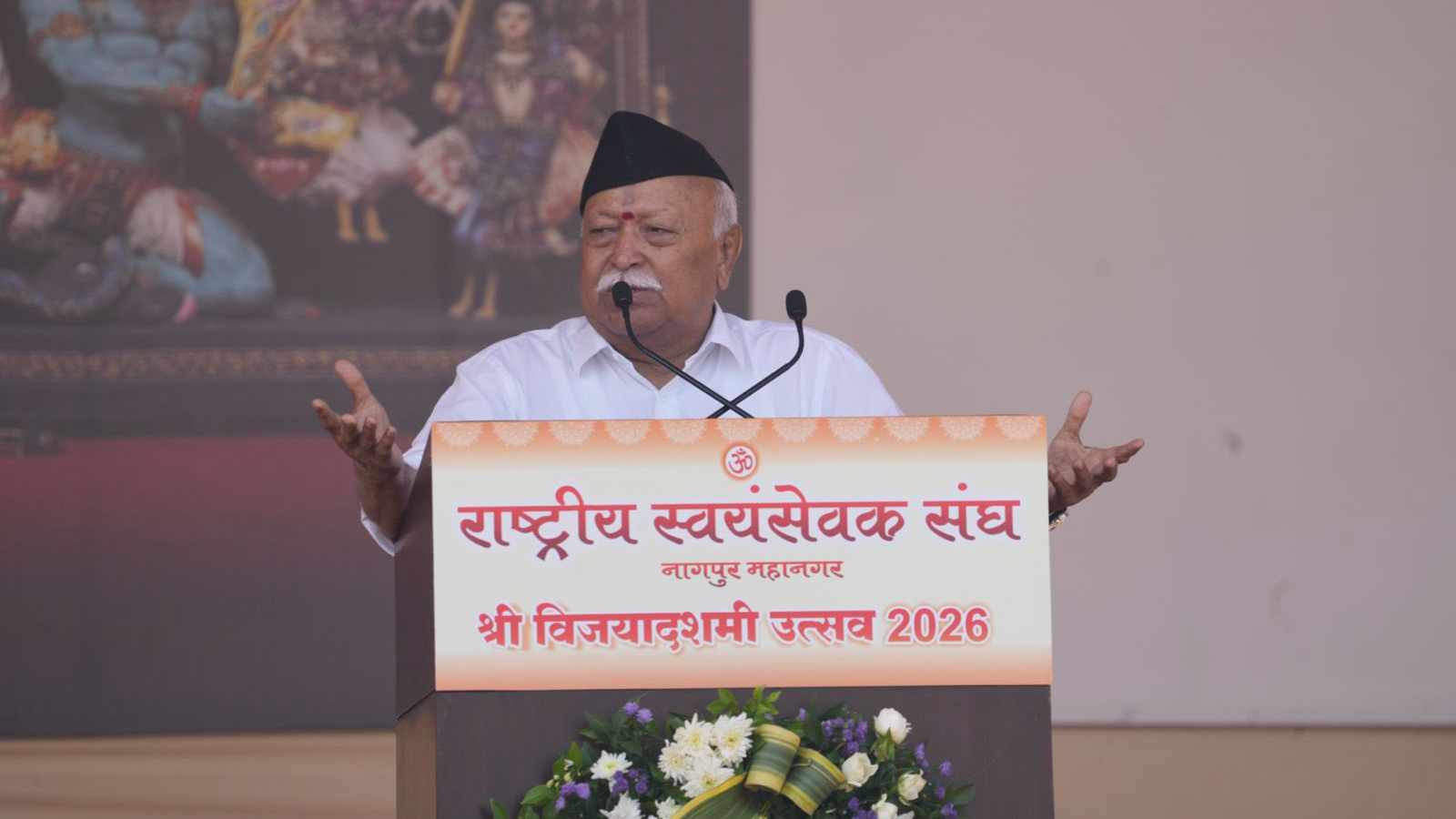
In his Vijayadashami address, RSS chief Mohan Bhagwat on Tuesday called for vigilance against agitations that “seek to fan hatred for systems, ideologies and individuals within the country”. Addressing the annual event in Nagpur, which marked the Sangh’s 101st foundation day, he also alleged a “global conspiracy” at a time when the Opposition parties as well as students and youths led by the Cockroach Janta Party (CJP) have been holding protests against Chief Election Commissioner (CEC) Gyanesh Kumar and the Special Intensive Revision (SIR) row.
Bhagwat said when “a movement becomes a tool of politics, driven by hostility and antagonism towards an individual, a group, or an ideology, forces seeking to undermine Bharat take advantage of the situation,” hinting at the recent protests that have taken place in Delhi and other parts of India. He however made it clear that there will not be a “regime change” in the country.
“Deepening the differences of opinion and turning them into mutual hostility, evoke a feeling of victimhood in the context of various problems, and thereby creating faithlessness towards the systems of the country, and creating an atmosphere of discord, intense discontent, separatism, disorder, and chaos in the country is their modus operandi,” he said.
The RSS chief also said: “It is clear that we must protect our mutual goodwill by remaining alert and safeguarding ourselves against the intellectual confusion created by such divisive tendencies. We must remain vigilant, avoid being disturbed or provoked in any way and with our aspiration and goal of seeing Bharat attain the status of Vishwaguru always firmly in our minds, continue striving in our efforts.”
Bhagwat hinted at the possibility of a global conspiracy behind the protests, saying, “Global powers that wish to keep India subdued also occasionally play their part in this process.” He also referred to recent protests and unrest in France, Albania, Bangladesh and Nepal to claim that such agitations were leading to instability in different parts of the world.
Bhagwat framed the national song Vande Mataram as an instrument of unity in Bengal when Lord Curzon divided it on the community lines, saying the British had to revoke the decision. The same, however, did not happen in 1947 as people got consumed by hatred and forgot national unity.
“When Lord Curzon sought to partition Bengal along communal lines, to drive apart Muslims from Hindus, the society firmly opposed the division of one land – one people on communal grounds. The British government was compelled to withdraw their proposal for partition. It was during that period when Vande Mataram emerged as a symbol of that very unity and patriotism. The partition was defeated,” Bhagwat said.
“Why, then, could the same outcome not be achieved in 1947? Because those who wanted to divide us and keep us embroiled in conflict instilled in our minds the notion that because we are distinct, we are separate; because we appear different, we must indeed be different and apart. Under the influence of communal and extremist ideologies, we too came to believe that since we appear different, we are, in reality, not one but separate from one another,” the RSS chief said.
“Driven by the obsession with separatism, combined with the lust for political dominance, and the pursuit of selfish interests, we gradually began to reject the very foundations that had held us together as one. A mindset of appeasement continued to embolden this divisive mentality. Ultimately, the country was partitioned,” he said.
Bhagwat underlined that “we brought upon ourselves enduring unrest along the borders and within the country, mutual distrust, insecurity, and constant strife over even the smallest of issues”. He said: “Vande Mataram which defeated the divisive conspiracy of the division of Bengal continues to be a powerful source of the same inspiration of unity even today. It is our national song, and there should be no hesitation or objection to sing it in its entirety.”
Bhagwat said “the root of the problems that trouble and terrify the world today lie in its incomplete outlook on life”. He, however, added that Indians should learn the value of effort from the world: “Otherwise, when it comes to human effort and endeavour, we too have much to learn from the rest of the world. Along with learning from others, it is essential that we should clearly understand and embrace the distinct nature of our national identity, preserve our unity and quality, and devote ourselves to collective, organised endeavour.”
In his speech, Bhagwat said, “There are ongoing attempts to cast doubt on the goodwill of Sangh and the sincerity of its intentions by citing certain undesirable and/or unexpected incidents occurring here and there, with which the Sangh has neither any connection nor any association or support”.
He claimed that “the work of the Sangh is founded on pure, selfless, and virtuous love”, adding that his recent foreign visits were aimed at offering a “correct picture” of India and the Sangh abroad.
Bhagwat said the Preamble to the Constitution envisaged India as “a society that, despite its immense diversity, is bound together by a deep sense of emotional unity”. “Even though we possessed the profound realisation that gives rise to this emotional bond, as well as the world’s most sublime philosophy… our conduct, unfortunately, became completely different from it and sank to a very low level. As a result, we fell so far from the exalted position of Vishwaguru—that we were compelled to endure centuries of foreign subjugation,” he said.
“Through Herculean efforts and countless sacrifices, we have freed ourselves from those difficult times and have once again embarked upon the path of unity and progress.”
Combining Hindutva and social justice, Bhagwat began his speech by paying tributes to Sant Ravidas — a 15th-16th century saint highly regarded among Dalits in Punjab and UP, both poll-bound states — and Swami Shraddhanand, an Arya Samaj leader who was instrumental in the Shuddhi (“reconversion”) movement.
Original Source
This content was distilled for a focused reading experience. All rights belong to The Indian Express.
Read original publication