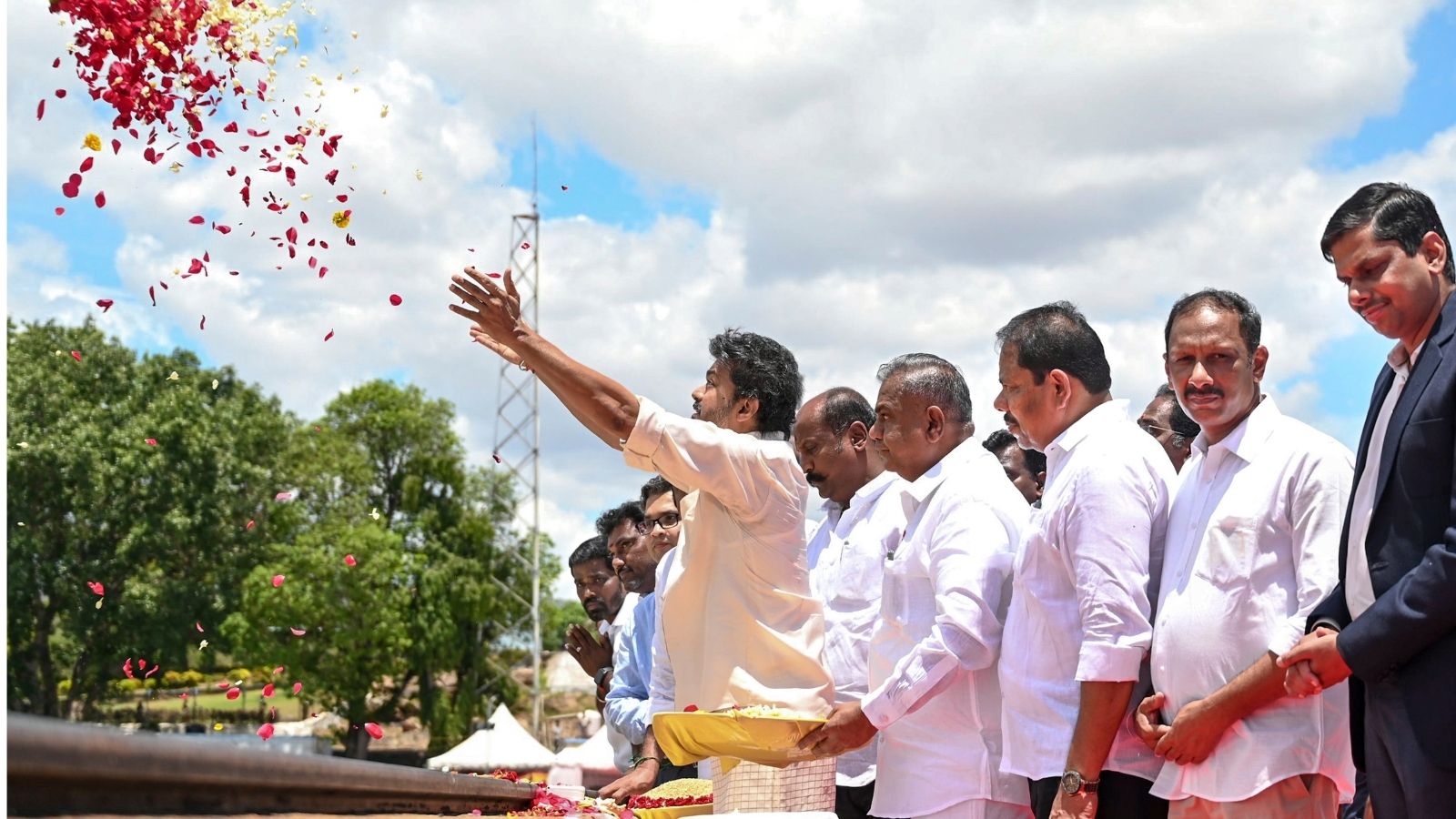
Vijay opens Mettur dam after 80-day ‘delay’. Question is, for how long?
At 11.30 am on Tuesday, after an 80-day wait, the sluice gates of the Stanley Reservoir at Mettur opened and Cauvery water began flowing towards the delta, an annual passage that, for generations of farmers, has marked the beginning of an agricultural season.
Chief Minister C Joseph Vijay released the water for samba cultivation, scattering flowers and grains into the current as it gushed from the reservoir. The initial discharge of 3,000 cusecs was to be gradually increased to 7,000 cusecs by Tuesday evening.
The government has initially planned the release only for 45 days, until October 15, with the discharge to be regulated according to water availability and irrigation requirements.
At 8 am on Tuesday, the reservoir stood at 91.56 feet against its full level of 120 feet. Storage was 54.45 thousand million cubic feet (tmc ft), a little over half its capacity of 93.47 tmc ft. Inflow had declined to 10,857 cusecs from 11,501 cusecs. The numbers explain both the significance of Tuesday’s opening and the anxiety surrounding it.
Mettur is not merely another reservoir in Tamil Nadu’s irrigation network. Water released here travels downstream to sustain agriculture across the Cauvery delta, historically regarded as the state’s rice bowl. About 16.05 lakh acres in 12 districts – Tiruchi, Thanjavur, Tiruvarur, Cuddalore, Nagapattinam, Erode, Pudukkottai, Ariyalur, Perambalur, Karur, Mayiladuthurai and Namakkal – benefit from the release.
It is only the fourth time that a delta irrigation release has begun in September, after similar delays in 2002, 2012 and 2016. In the dam’s 93-year history, water has been released on June 12 only 20 times and before that date on 11 occasions. Tuesday marked the 62nd instance of a delayed opening.
Farmers who met Vijay at Mettur urged him to extend the release beyond the announced 45 days and sought measures to divert surplus Mettur water to water bodies in the Thalaivasal region.
The government said the release would be closely managed. The Agriculture and Farmers Welfare, Water Resources, and Revenue and Disaster Management departments have been asked to coordinate with district administrations. Joint teams involving Water Resources, Revenue, Police and electricity officials will monitor illegal pumping and unauthorised extraction. Farmers have also been advised to use medium-duration paddy varieties and water-saving techniques, including direct seeding.
The government attributed the difficult water position to the southwest monsoon deficit and the impact of El Niño. It also reiterated that Tamil Nadu would continue legal and administrative efforts to secure its share of Cauvery water from Karnataka under the Cauvery Water Disputes Tribunal’s final award and the Supreme Court’s 2018 judgment.
The political and agricultural importance of Mettur is inseparable from its history. Construction began in 1925 and was completed in 1934, with about 17,000 workers involved. Several villages were evacuated for the reservoir. When its waters retreat sufficiently, remnants of the submerged landscape – including an old church and the Nandhi of the Jalagandeeswarar temple – become visible again.
The dam, 1,700 metres long, was built across the Cauvery for irrigation and hydroelectric generation. It receives water from its own catchment as well as flows associated with the Kabini and Krishna Raja Sagar reservoirs in Karnataka.
There is another geography tied to Mettur. Canal releases, normally beginning on August 1, irrigate nearly 45,000 acres in Salem, Namakkal and Erode. A separate Rs 565-crore surplus-water scheme, launched in 2020, was designed to carry excess water when the reservoir reaches 120 feet to lakes and tanks in Mettur, Omalur, Edappadi and Sankari. By 2025, surplus water had been pumped to 60 lakes, though the project remains incomplete.
Tuesday’s ceremony also brought crowds along the roughly 40-km route from Salem airport to Mettur. TVK workers and residents had begun gathering from 8 am, and more than 3,800 police personnel were deployed for the CM’s visit.
After opening the gates, Vijay met farmers, inspected a Water Resources Department exhibition and visited the dam powerhouse before leaving Mettur around 2 pm.
The opening of the sluice gates comes weeks after Vijay attempted to open direct political talks with Karnataka over the Cauvery dispute. After the proposed talks did not materialise, the CM offered his most detailed defence yet of an initiative that drew criticism from opposition parties and ultimately failed to materialise.
Replying to a special calling attention motion in the Assembly on the Cauvery water-sharing dispute and Karnataka’s proposed Mekedatu balancing reservoir, Vijay said his government had never intended to dilute Tamil Nadu’s long-held legal position but believed there was value in testing whether dialogue could create even the smallest opening in one of India’s most intractable inter-state disputes.
Original Source
This content was distilled for a focused reading experience. All rights belong to The Indian Express.
Read original publication