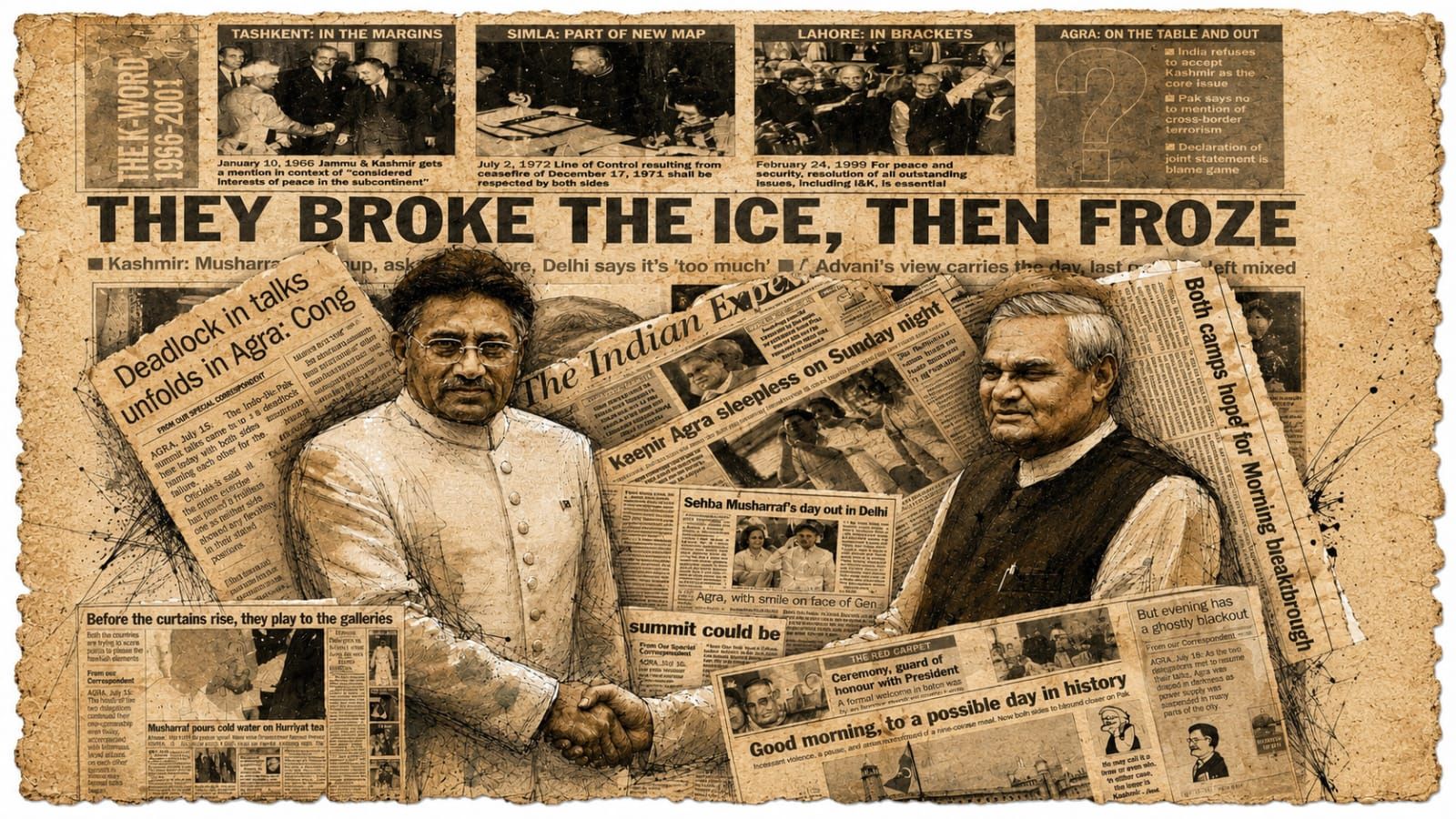
Two men in a room: 25 years of Agra Summit, and what lies ahead for India, Pakistan
“Ab aage kya karna chahiye (What should we do next)?” On May 23, 2001, at one of their periodic lunches, Prime Minister Atal Bihari Vajpayee asked the question of his Home Minister L K Advani and External Affairs and Defence Minister Jaswant Singh.
The question was in reference to Pakistan. It had been two years since the Kargil War and the main instigator, General Pervez Musharraf, was in power in Pakistan.
Two months later, this invitation would result in the Agra Summit that lasted from July 14 to 16, 2001. The Summit marked a fleeting moment when it looked like the two countries would finally solve some of their problems by talking across a table. But it ended in spectacular fashion, with Musharraf cutting short his visit, followed by one of the lowest points for India-Pakistan relations.
Now, 25 years later, with official engagement between the two countries at a complete halt, except for sporadic Track-II level talks, the Summit holds valuable lessons — on both the possibilities and futility of dialogue when the mistrust runs as deep as it does between the two nations.
The Summit, say those closely involved with the talks and others who watched it from the sidelines, was audacious in its ambition — and that, perhaps, proved to be its undoing. They also say that chances of another meeting of the kind are remote, given the “political risk” involved.
T C A Raghavan, then Director in Jaswant Singh’s office who later served as India’s envoy to Pakistan (June 2013-December 2015), agrees. “It was a missed opportunity, but it was also an underprepared summit. Not in terms of work put in… a lot of very great detail was gone into. But it was in an echo chamber.”
At the same time, says Raghavan, there was no doubting the significance of the Summit. “What strikes me is how big a step it was in inviting Musharraf to India, the fact that a step like that could be taken then, in the aftermath of two seismic events in 1999 (the Kargil War and the Kandahar hijacking) is really quite extraordinary,” says Raghavan, the author of the book The People Next Door: The Curious History of India’s Relations with Pakistan.
Katju, incidentally, played a key role during both the Kargil War and as a negotiator during the December 1999 IC-814 Kandahar hijacking.
In his book Anger Management: The Troubled Diplomatic Relationship Between India and Pakistan, Bisaria says the mention of talks at the time took even the top officials by surprise.
Writing about the day the invite went out to Musharraf, he says, “When the discussion was brought to the Cabinet Committee on Security, a couple of MEA officers, Vivek Katju and Raminder Jassal (then MEA spokesperson), waited in my office… Jaswant Singh walked in and informed them of the ‘well thought out decision’ to invite Pakistan’s dictator. ‘Good grief,’ said Jassal, reflecting the anti-Musharraf mood prevalent in the baffled foreign office… India had, in essence, reversed its decision on not engaging with Pakistan.”
Another reason it was seen as a big move by Vajpayee was that his earlier Lahore bus yatra initiative of 1999 had ended in the “betrayal” of the Kargil War. With the Kandahar hijacking of IC-814 following soon after in December 1999, the Vajpayee government was emphatic that it would not resume talks unless Pakistan stopped aiding and abetting cross-border terrorism.
The first hints, however, of the BJP veteran’s desire for peace had come first in November 2000 when, on the eve of Ramzan, he announced a unilateral six-month ceasefire on counter-insurgency operations in Jammu and Kashmir. On January 1, 2001, the first day of the New Year, Vajpayee wrote about re-engaging with Pakistan in musings penned during a break in Kumarakom, Kerala. The PM’s remark to his colleagues in May that year about what they should do next — “ab aage kya karna chahiye?” — came just before the six-month ceasefire was to end.
Recalling the conversation in his autobiography My Country, My Life, Advani said that in response to Vajpayee’s question, he had said, “Atalji, why don’t you invite the General to come to India for talks? It does not matter if your Lahore initiative failed. It was highly appreciated both at home and abroad. Similarly, your invitation to him will be welcomed as an act of statesmanship.”
Advani wrote that the venue initially proposed was Goa, but Vajpayee suggested Agra.
On June 19, came the announcement – India would host Musharraf from July 14 to 16, including a welcome in Delhi, a retreat in Agra, and a visit to Ajmer Sharif.
A series of unilateral confidence-building announcements by India followed: 20 scholarships for Pakistani students at Indian technical institutions; month-long invites to Pakistani poets, academics, writers and artists; release of Pakistani prisoners; and a reduction in tariffs.
Before leaving for India, Musharraf, till then designated as Chief Executive of the Islamic Republic of Pakistan, anointed himself “President”. When he landed in Delhi, he was met by then Indian President K R Narayanan at the Rashtrapati Bhawan.
In Delhi, Musharraf’s first halt along with wife Sehba was a visit to Naherwali Gali in Old Delhi on July 14. It was his family’s home till 1947, and Musharraf was four when they left it for Pakistan. The President next went to Raj Ghat and the Gandhi memorial nearby.
This was the first indication of what the General was thinking. Later, it would be on this issue that the talks would collapse.
In Agra, the Pakistani team stayed at the newly-built Oberoi Amarvilas Hotel, while Indians led by Vajpayee camped at Jaypee Palace, which was also the official venue for the talks. Vajpayee was accompanied by his entire CCS — apart from Advani and Jaswant Singh, Finance Minister Yashwant Sinha and Commerce Minister Murasoli Maran. Also present were National Security Advisor Brajesh Mishra, India’s High Commissioner to Pakistan Vijay Nambiar, Katju in his capacity as Joint Secretary, and Information Minister Sushma Swaraj.
On July 15, as the bilateral meeting with Musharraf started, Vajpayee laid out India’s goals in “precise” terms, wrote Advani — a detailed exchange of views, including on J&K and cross-border terrorism, the issue of terrorists taking refuge in gurdwaras in Pakistan, as well as the upkeep of Hindu temples and treatment of Hindu pilgrims in the country.
Indicating how Musharraf was playing to a larger audience, Bisaria recalled in his book that Musharraf launched into an exposition of his plans “to bring grassroots democracy to Pakistan”. Bisaria wrote that he raised this with Vajpayee, particularly the irony of Pakistan’s dictator explaining democracy to Indian leadership.
Jaswant Singh and Pakistani Foreign Minister Abdul Sattar were to frame a joint statement on July 15. Singh wrote in his book A Call to Honour that there was some good-natured banter between them, and after some back and forth over a draft, where both made some changes, they decided to take it to their leaders.
Advani recalled in his book that when they discussed the issue on the evening of the 15th, “I noticed that there was no reference to cross-border terrorism (in the draft)… ‘This cannot be accepted’, I said. My view was unanimously endorsed by all present.” Advani said they also noticed the “absence of any reference to the Simla accord (1972) and the Lahore declaration (1999)”.
In his autobiography Relentless, Yashwant Sinha recalls how things went wrong. “Jaswant Singh had made some changes in his own hand to the typed copy of the draft and had given a photocopy of the amended draft to Sattar. Another copy was brought by him to Vajpayee’s room where the rest of us had assembled,” Sinha wrote.
Advani, he says, pointed out the absence of cross-border terrorism and Sinha said there were no references to the Simla Agreement. “All this was pointed out to Jaswant Singh as politely as possible, with a request to include these in the draft,” Sinha wrote.
A miffed Jaswant Singh said this amounted to no-confidence in him and stormed out of the meeting. On Advani’s request, Sinha says he went to Jaswant Singh’s room to mollify him, “only to find him in a very glum mood. I tried to reason with him by explaining that there was nothing personal in our approach; we had the highest respect for his abilities and the points we had made were merely suggestions. It was at this stage that the joint secretary in the MEA who oversaw the Pakistan desk, Vivek Katju, walked into the room with a piece of paper to show to Jaswant Singh”.
“Singh’s mood remained sour and he told Katju that he was not interested in looking at the paper and that perhaps Katju could show it to someone else in the delegation instead. Being the quintessential civil servant, Katju replied, ‘Sir, you are my minister and I can only report to you.’ Jaswant Singh did cool down later but by then the negotiations with Pakistan were already in disarray.”
Advani wrote that “efforts continued at the official level to rework it (the draft) until 4.30 am on 16 July”.
On July 16 morning, just ahead of a scheduled meeting with Vajpayee, Musharraf held a breakfast roundtable with editors of the Indian media, which was broadcast with a brief delay. Jaswant Singh wrote in his book that the President came across as “too belligerent”.
Bisaria said they quickly typed out a note to brief the PM on what Musharraf had just said. “My arrival interrupted the conversation as both leaders looked up. Musharraf had been talking and Vajpayee was listening, apparently with great interest. I handed over the paper to the boss… After I left the room, Vajpayee looked at the paper and then read out from it to Musharraf, saying edgily that his behaviour was not helping the talks… I was playfully accused by some colleagues of torpedoing the Agra initiative.”
In his book, Jaswant Singh wrote, “General Musharraf seemed not to understand the debilitating impact Kargil had had on the atmospherics and also not grasp the essence of what Prime Minister Vajpayee had offered – a new beginning.”
Some last-minute efforts were still made. “Musharraf asked for a last meeting with Vajpayee to see if he could save the failing Summit. To Vajpayee, this move had echoes of Bhutto’s gambit in Simla in 1972, when he asked for a last call on Indira Gandhi, at a time when the Simla agreement had been deadlocked,” Bisaria wrote.
Musharraf left for Islamabad, without visiting Ajmer Sharif. Jaswant Singh, asked if the Indian government prevented him from visiting the shrine, replied: “Meri kya aukaat ki main unhe Garib Nawaaz ke paas jaane se rokun (Who am I to stop the Musharrafs from visiting the Dargah)?”
In his version of what transpired, Musharraf wrote in his autobiography In The Line of Fire, published in September 2006, “I met Prime Minister Vajpayee at about 11 o’clock at night in an extremely somber mood. I told him bluntly that there seemed to be someone above the two of us who had the power to overrule us. I also said that both of us had been humiliated. He just sat there, speechless.”
“He saw a clear trajectory. The Simla Agreement made India-Pakistan issues bilateral, leaving out the UN and US from it. The Lahore Declaration upheld it but also added the new element of terrorism. Vajpayee wanted an Agra Declaration to take the process forward to normalise ties with Pakistan bilaterally despite the Kargil experience.”
PM Modi’s first two years in power were marked by overtures towards Pakistan, including the invitation to then PM Nawaz Sharif for his swearing-in in 2014, and his surprise visit to Lahore in December 2015. However, with successive terrorist attacks, in Pathankot, Uri, Pulwama and Pahalgam, the government has hardened its line.
In recent weeks and months, there has been some engagement at the Track-II level and RSS leaders have also spoken about the need for an engagement.
On whether talks can happen between India and Pakistan now, Raghavan says, “It doesn’t seem very likely, but I always say that with India-Pakistan you cannot predict because things never follow a linear course. Anything can happen any time.”
However, he adds, he does not give much credence to the Track-II talks. “The issues are not people-to-people. The issues are intergovernmental… At a common sense level, obviously everyone will say that there has to be engagement.”
Bisaria, who was India’s envoy to Pakistan during the Pulwama terror attack and the Balakot surgical strike in February 2019, and was withdrawn after the abrogation of Art 370 in August 2019, adds that climbing back will take a long time. “The longer we go without spectacular terrorism of the Pulwama-Pahalgam level, the greater the chances of some reconciliation. Right now, the trust level is so low that post-Sindoor, the feeling was that the next attack was coming very soon.”
However, Bisaria says he “certainly advocates a line of communication with the Pakistan Army – covert or overt – to test whether there is a reasonable guarantee, and a reasonable appetite on the other side, for rapprochement”.
Asked about the possibility of another Summit like Agra, Bisaria says: “The Indian political leadership now sees the political cost of a peace initiative as too high. The examples cited are Vajpayee in 1999 repaid with Kargil; Vajpayee again engaging Musharraf at Agra in 2001 and still not succeeding; Manmohan Singh seeing the cost in the 2008 Mumbai terror attack and never risking a Pakistan visit; and Modi paying the price for the 2015 Lahore visit with the Pathankot attack. So politically, it appears too risky – the fear of being caught in a ruse yet again.”
If a Summit happens now, Bisaria says, “it will happen only with a sufficient guarantee — direct or indirect, overt or covert — that this time it is for real: that Pakistan wants a genuine conversation and no one will sabotage it with an attack.”
Original Source
This content was distilled for a focused reading experience. All rights belong to The Indian Express.
Read original publication