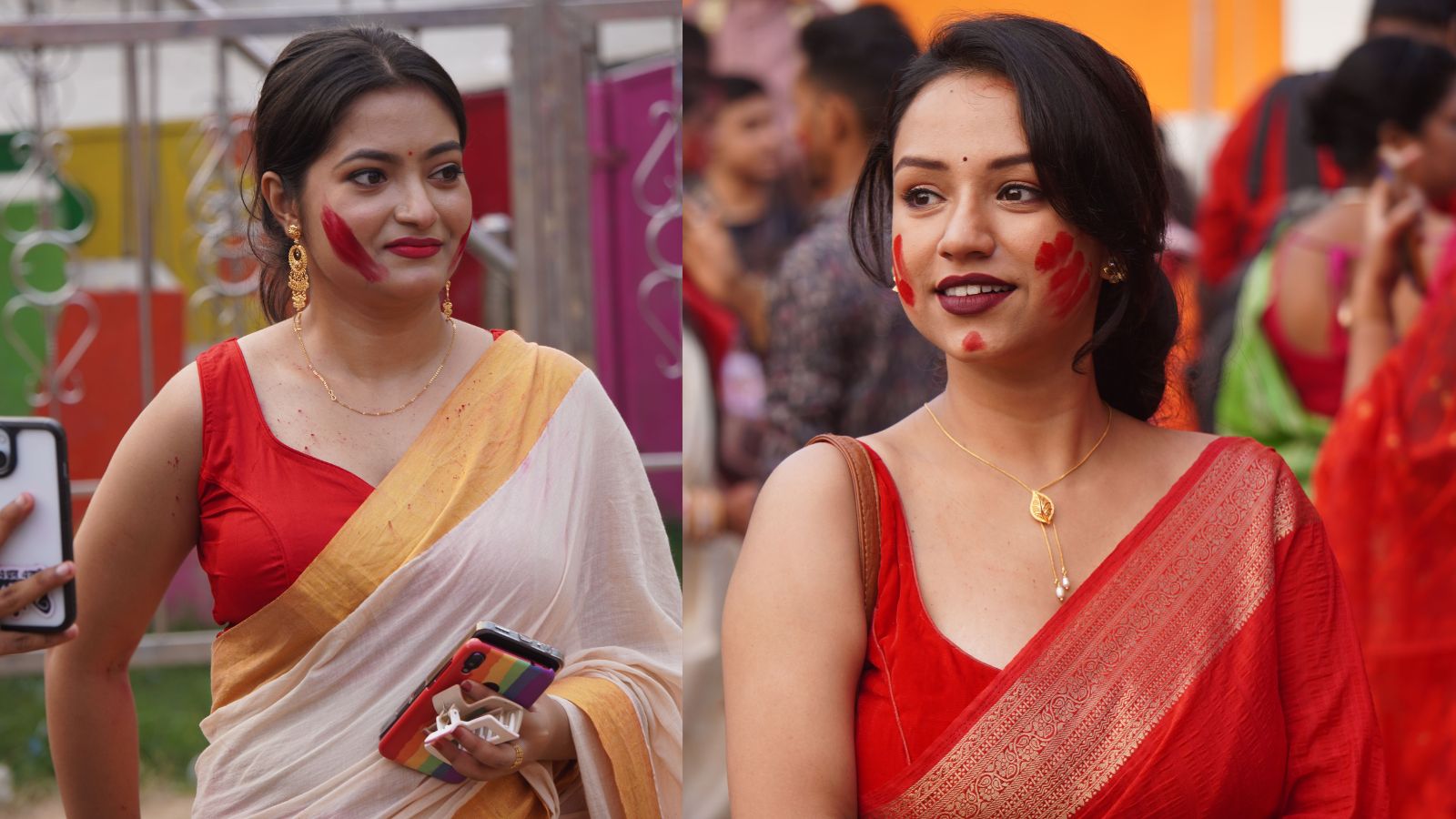
Sindur Khela: What the Durga Puja ritual means to unmarried women
Listen 00:00 0.5x 0.75x 1x 1.25x 1.5x 2x AI Narration This audio is AI generated.
As women gently smear vermilion on each other’s faces and exchange Shubho Bijoya wishes, Sindur Khela brings Dashami to a vibrant and emotional close. Traditionally observed by married women as they bid farewell to Ma Durga, the ritual has grown more inclusive in recent years, welcoming unmarried women and younger generations. For many, the ritual is not about rejecting tradition, but about finding themselves within it, offering a heartfelt celebration of devotion, sisterhood, and cultural belonging.
For Sristi Rai, who lives in Delhi, the ritual celebrates womanhood and the strength Goddess Durga represents. The 26-year-old says her connection with the Goddess is not defined by her marital status.
“To me, Sindur Khela is not merely a ritual reserved for married women; it is a celebration of womanhood, strength, love, and the divine feminine that lives within every woman. I may not be married, but my connection with Goddess Durga does not depend on marital status,” she explains. “Devotion cannot be measured by a wedding ring, nor can a woman’s connection with the divine be defined by whether she is married,” she adds.
For unmarried Bengali women who choose to participate, the ritual also carries a deeply personal connection to their cultural roots.
Swapnasree Saha sees Sindur Khela as an opportunity to reconnect with her heritage and celebrate the bonds between women. While the ritual has traditionally been associated with married women and their wishes for a long and happy married life, she believes its emotional significance extends beyond that framework.
“To me, it represents women celebrating women, embracing their identities, and sharing happiness without inhibition. As Bengalis, our festivals are deeply rooted in emotion, and Sindur Khela captures that beautifully. I love how it brings together generations of women and creates a sense of belonging. For me, the essence of the ritual lies in the love, strength, and collective joy that women share,” she says.
Susmita Pakrasi shares Swapnasree’s view. For her, taking part in Sindur Khela is a way of celebrating Ma Durga and Bengal’s cultural heritage. “As an unmarried woman, I participated in Sindur Khela because I see it as more than just a ritual associated with married women. It is a celebration of Maa Durga, womanhood, sisterhood, and the cultural heritage of Bengal,” she says.
“I believe that devotion and celebration should not be restricted by marital status,” she says.
Asmita Raj Yadav, a PR consultant who is not a Bengali, also participates in Sindur Khela because she has always been drawn to India’s vibrant customs and traditions.
Growing up in a culturally and spiritually rich city like Prayagraj in Uttar Pradesh, she spent her childhood visiting Durga Puja pandals with her parents and participating in religious gatherings. Last year, she visited the Bengali Tola in Prayagraj during Durga Puja. Although she always wanted to experience Sindur Khela, the emotional weight of bidding goodbye to Ma Durga during Visarjan often left her a little overwhelmed.
Seeing women in red-and-white sarees celebrate together, despite the sadness of bidding farewell to the Goddess, made the experience particularly memorable for her.
“I was especially moved by how the farewell to Ma Durga, despite being an emotional moment, was celebrated with so much happiness, warmth, and positivity. For me, Sindur Khela was not just about witnessing a Bengali tradition but about exploring and embracing the cultural diversity that makes India so beautiful,” Asmita says.
Durga Puja’s significance lies in a daughter’s homecoming. Sristi believes this reminds us that a woman’s identity extends beyond the roles she assumes through marriage and motherhood.
“Ma Durga returns to her maternal home, reminding us that before a woman becomes someone’s wife, daughter-in-law, or mother, she is a daughter, a soul, and a force of her own,” she says.
For Sristi, the ritual is more than just an exchange of vermilion. “I see women celebrating one another, wishing each other strength, happiness, protection, and a life filled with love. I see a colour that carries the warmth of tradition, the tenderness of relationships, and the timeless spirit of Shakti,” she says.
Sristi believes that the spirit of worship should not be reduced to whether someone follows every convention. “To me, Ma Durga belongs to every heart that finds courage in her, every woman who discovers strength through her, and every soul that celebrates her with sincerity,” she says.
Perhaps that is what makes their participation meaningful: the desire to remain connected to a cherished tradition while seeing themselves reflected in it, too.
Original Source
This content was distilled for a focused reading experience. All rights belong to The Indian Express.
Read original publication