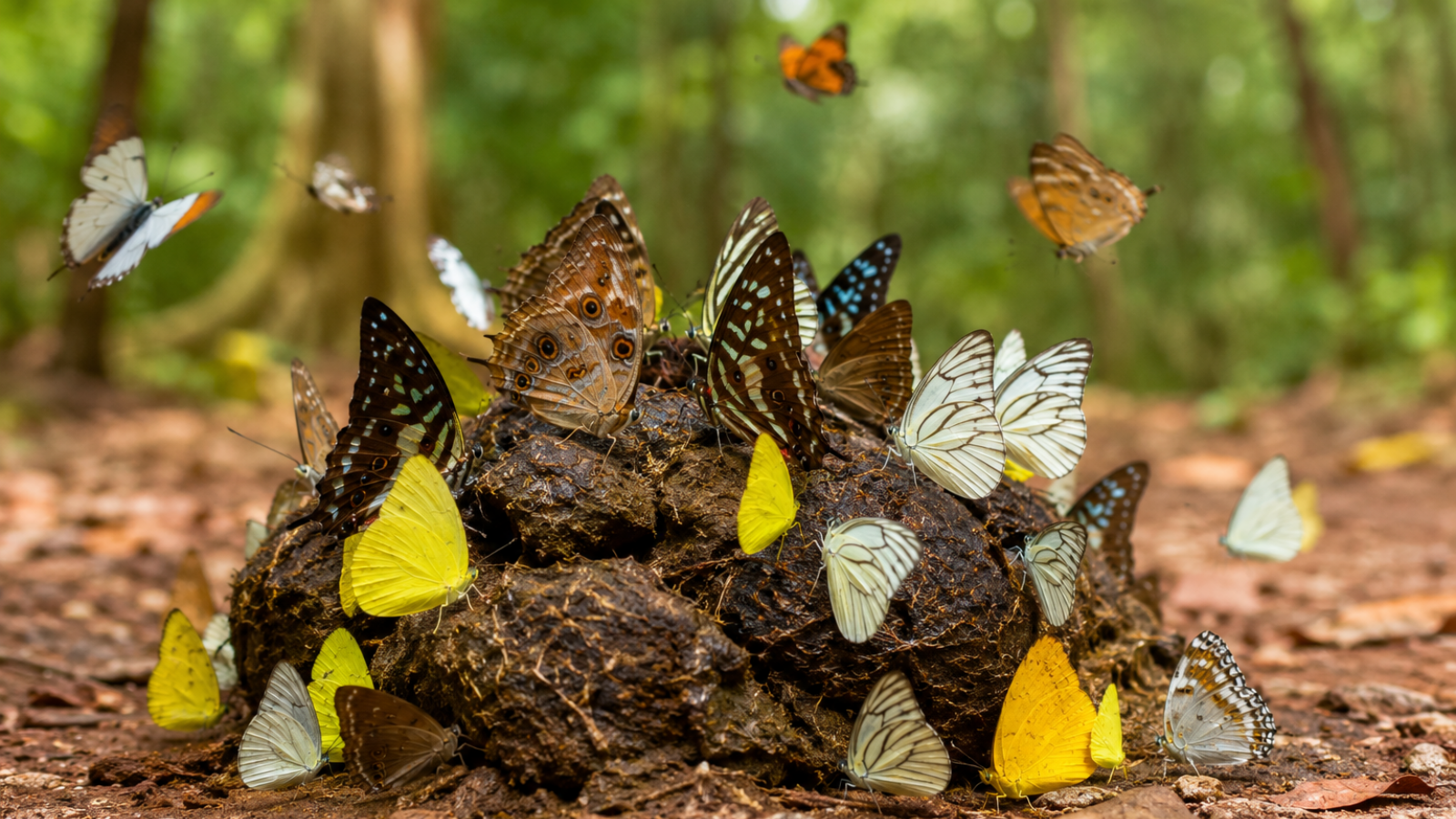
What Are Butterflies Doing on Cow Dung? It’s Not What You Think
But they are not there for the smell—or because butterflies have suddenly developed a taste for poop. This behaviour is called puddling, and animal dung can provide butterflies with nutrients they don’t get in sufficient quantities from nectar.
Nectar is an important source of sugars for adult butterflies, but it does not provide all the nutrients they need. Moist soil, dung, urine and other organic material can contain minerals and other nutrients, particularly sodium and nitrogen.
Butterflies use their straw-like mouthpart, called a proboscis, to suck up the liquid from these surfaces. This is why they are often seen around damp patches rather than dry dung.
The behaviour is particularly common among males. Research suggests the nutrients they obtain through puddling can be important for nutrition and reproduction. In some species, males can transfer nutrients to females during mating in a package known as a nuptial gift.
A post shared by Belvai Butterfly & Biodiversity Park (@ssbutterflypark)
India has documented examples of butterflies using animal waste as a source of nutrients.
A 2023 study conducted over two years in the Western Ghats recorded 26 butterfly species from five families puddling on elephant dung. Published in the journal Food Webs, it suggested that elephant dung may provide mineral supplementation that could contribute to butterflies’ fitness and reproductive physiology.
Field observations from India have also recorded butterflies puddling on animal urine and bird excreta, along with damp soil and other mineral-rich surfaces.
In Arunachal Pradesh, researchers have even documented butterflies feeding on unusual sources including dung, carrion and ash. Their observations found that these materials can provide nutrients such as amino acids and minerals that are not readily available from nectar.
If you spot a large group of butterflies on a patch of dung, they are not necessarily all chasing the same food in the way birds might gather around a feeding spot.
The moisture and concentration of nutrients at a particular site can make it attractive to multiple butterflies. Research has found that different butterfly species can have different preferences for puddling substrates, with sodium concentration being one important factor influencing those choices.
Temperature can matter too. Research on the Common Mormon (Papilio polytes) in India found that puddling activity was strongly influenced by temperature, with the butterflies showing a preference for particular temperature conditions.
So the next time you see a colourful cluster of butterflies around animal dung, look a little closer. They are not abandoning flowers for something disgusting. They are making a surprisingly efficient nutritional stop—using a resource most other creatures would happily ignore.
‘Butterfly’ has been trending on Google for the past 24 hours.
Original Source
This content was distilled for a focused reading experience. All rights belong to The Indian Express.
Read original publication