‘Right to free movement’: Orissa High Court says puja pandals can’t fully block roads
Listen 00:00 0.5x 0.75x 1x 1.25x 1.5x 2x AI Narration This audio is AI generated.
The Orissa High Court has held that religious pandals cannot completely obstruct public roads, emphasising the need to balance religious freedom with public movement and safety. While declining to stop Ganesh and Durga Puja celebrations, the court directed the government to ensure access to homes, passage for emergency vehicles, and compliance with sound limits and time restrictions.
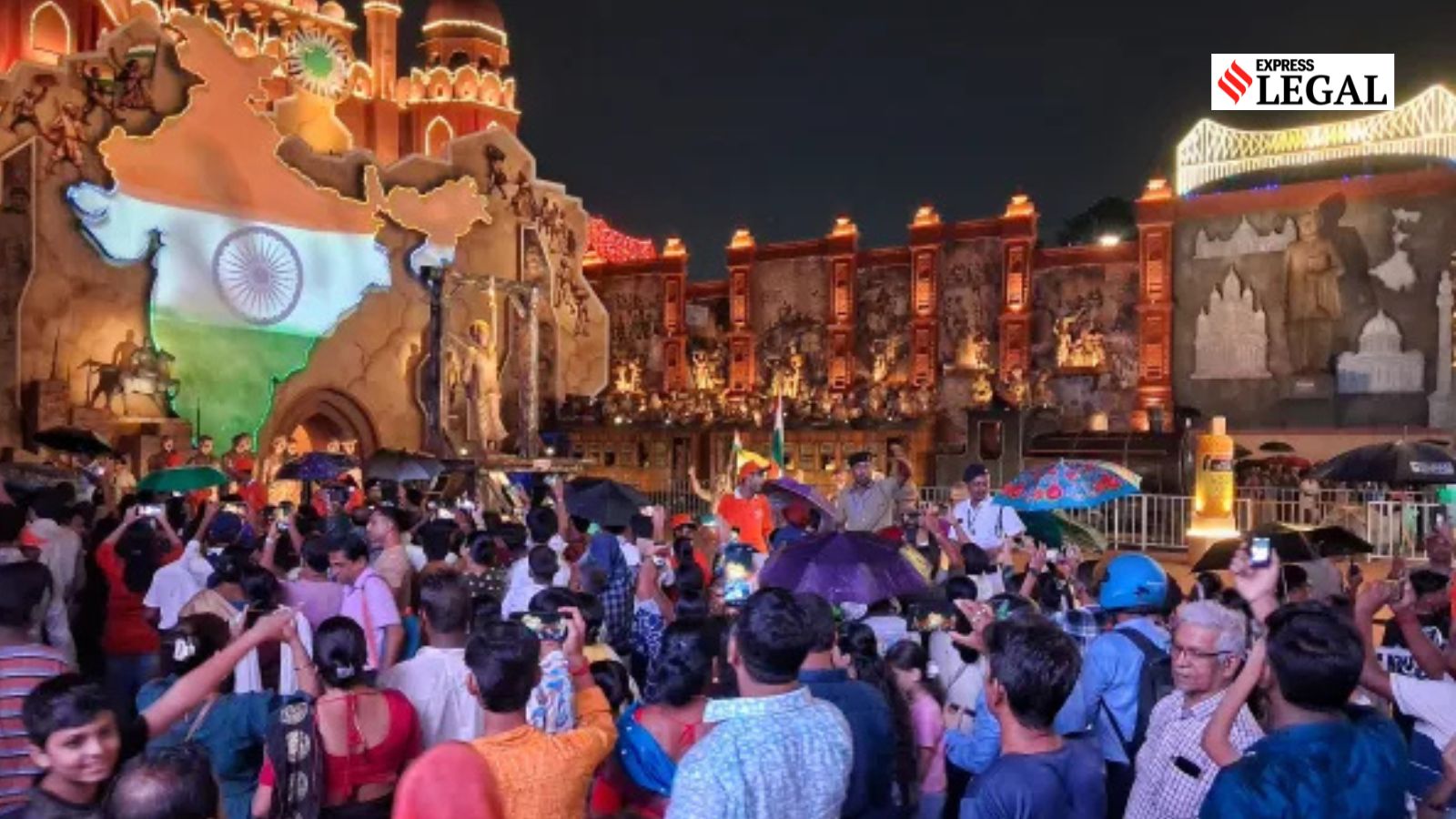
A bench of Chief Justice Harish Tandon and Justice M S Sahoo noted on October 16 that the celebration of Durga Puja or Ganesh Puja, or that involving any other idol, by a large gathering is one of the integral parts of our culture and the tradition, and it is carried out temporarily by erecting pandals on public roads.
“Even if the pandals are constructed on a public place, there should be adequate space left for the movement of vehicles or at least the movement of an ambulance and/or a fire engine in case of any emergency to avoid any public disorder or disharmony in a large section of the society,” the court held.
The court held that when an individual’s fundamental rights overlap with those of a larger section of society, the law must give primacy to the larger public interest. It said religious festivals cannot be completely stopped merely on the ground that they may obstruct vehicular movement or access to homes.
The case concerns a PIL filed by Sarat Kumar Gajendra before the high court, challenging the installation of temporary religious pandals on a public road for Ganesh Puja and Durga Puja. The petitioner’s house was around 50 metres from the location where the pandals were erected. He alleged that the structures completely blocked the road, making it difficult for him to access his house.
The state government, in its response before the court, maintained that the roads were not entirely blocked and that a passage of 22 feet had been left open to ensure vehicular movement. The petitioner disputed this claim.
The proceedings also saw several local residents approach the court to intervene in the matter, supporting the continuation of the community religious celebrations.
The petitioner sought the court’s intervention over the alleged obstruction caused by the pandals. The dispute required the court to consider the right to practise religion under Article 25 of the Constitution, alongside the public’s right to movement and access to their homes, as well as the need to ensure the passage of emergency vehicles.
Noting that fundamental rights are inherent and ingrained in every citizen of the country, the court said that they are nevertheless subject to reasonable restrictions imposed by the sovereign through its legislative powers.
“The religious activities, its rituals and its mode of performance through a community is all along being a part of the tradition, the culture and the mode of life which this country enjoins holding of the festivals ordained in a particular religion is always considered amongst the community or a section of the community bringing them together and propagating peace, welfare, harmony and affection amongst the peoples,” the order remarked.
It noted that the right to practise and profess religion under Article 25 of the Constitution is not absolute. It is subject to restrictions relating to public order, morality and health, as well as other fundamental rights guaranteed under Part III of the Constitution.
“There is no scintilla of doubt in our mind that if the fundamental right of a person is overlapping the fundamental rights of a large section of the society, the law respects the larger interest over an individual interest,” the court observed.
The bench observed that while granting permission for religious festivals, the government must ensure that temporary structures are of appropriate dimensions and do not excessively restrict public movement. Adequate distance and space must be maintained for vehicular access.
The court directed the government to ensure compliance with permissible sound limits and prescribed deadlines for religious celebrations. It also said a congenial religious environment should be maintained at the temporary pandals, without allowing activities inconsistent with their religious purpose.
The bench noted that the state had mentioned that a 22-foot passage remained open for vehicular movement. It declined to issue a mandamus to stop the religious ceremonies, while stressing that the government must ensure that movement is not completely disrupted and residents are not denied access to their homes.
Original Source
This content was distilled for a focused reading experience. All rights belong to The Indian Express.
Read original publication