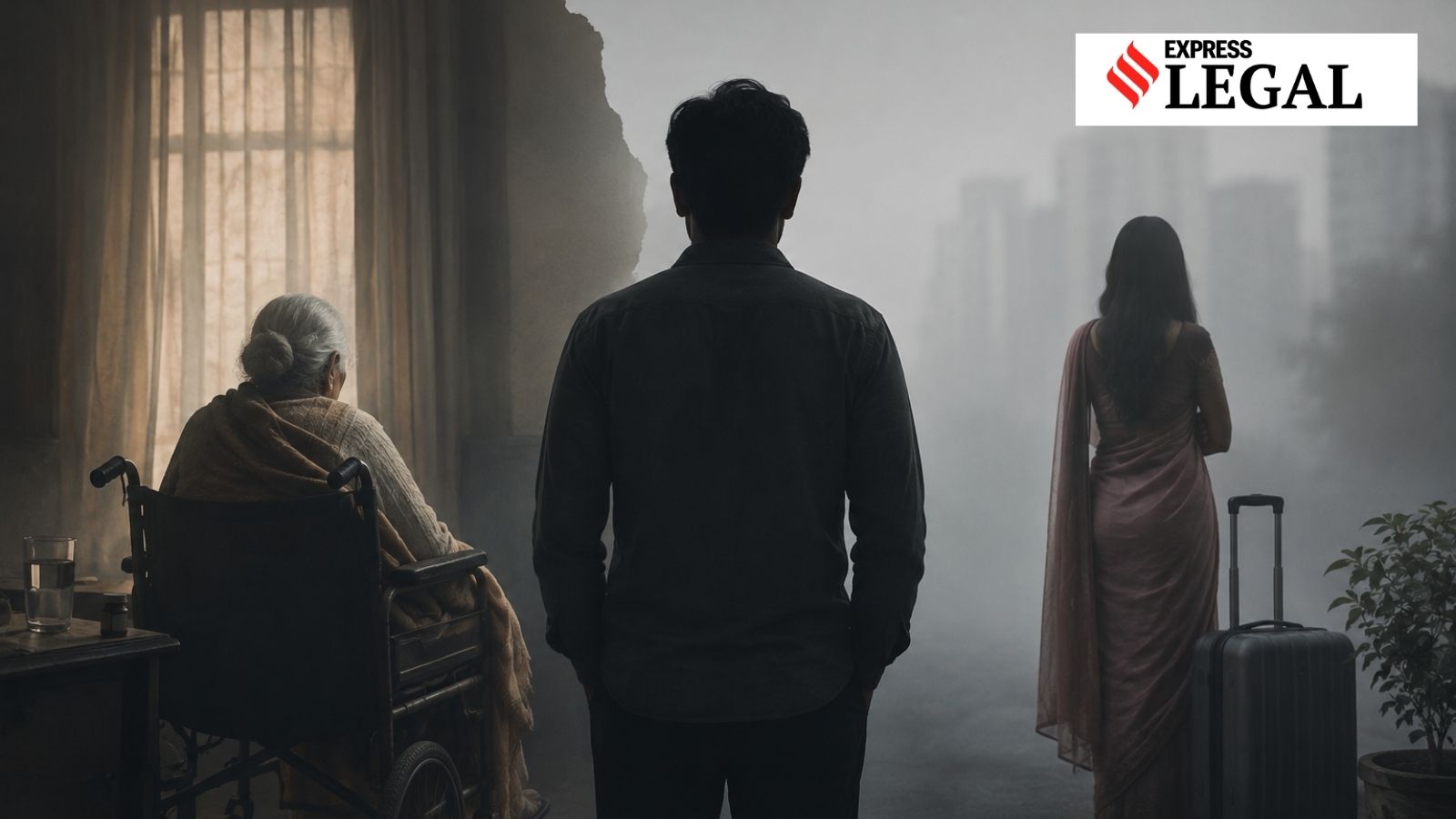
‘Can’t force spouse to leave aged parents’: Chhattisgarh High Court grants divorce
The court noted that while “marriage creates a new family, it does not by itself extinguish” the moral and legal responsibilities a person owes towards aged or infirm parents.
Justice Naresh Kumar Chandravanshi further observed that a marriage does not confer upon either spouse an “unfettered” right to compel the other to abandon his pre-existing responsibilities towards his family.
“A matrimonial relationship does not confer upon either spouse an unfettered right to compel the other to renounce or abandon pre-existing familial responsibilities. Marriage creates a new family, but it does not, by itself, extinguish the moral and legal responsibilities which a person may owe towards aged or infirm parents,” the August 30 order read.
The court was hearing the husband’s appeal against the trial court’s order of February 2025, which had dismissed his divorce petition on the ground of cruelty.
The couple married in December 2014 and had a son the next year. The husband alleged that after their marriage, the wife began fighting frequently, abused and assaulted him and his family members, and did not take care of his marriage and other responsibilities. He further alleged that she insisted upon living separately from his mother and threatened him and his family members with false criminal cases.
The husband also claimed that the wife was cheating on him with another man and that he had discovered objectionable call recordings and chats between them.
The wife, however, has denied all the allegations and claimed that the husband was suspicious of her character and frequently harassed her mentally and physically. She denied having any illicit relationship and also denied the allegations regarding assault, taking jewellery and cash, and desertion. The couple allegedly stated living separately after 2019.
The district judge held that the husband failed to prove that he had been subjected to cruelty by the wife and dismissed the divorce petition. Aggrieved, he filed this appeal challenging the district court’s order.
The wife, represented by advocate Vijay Shankar Mishra, argued that although she and her mother had admitted that she wanted the husband to shift to a larger house on the main road, this did not mean that she had demanded that he leave his mother. He submitted that the trial court had rightly dismissed the divorce petition after considering the evidence.
The court clarified that the insistence of a spouse for a separate matrimonial home, by itself, cannot be considered as cruelty and pointed out that a spouse may legally seek separate residence where there is a reasonable and justifiable basis, particularly where the environment of the home is unsafe.
“The question, therefore, is not whether a wife can ever ask her husband to reside separately from his parents, but whether, in the facts and circumstances of the particular case, the persistent insistence was justified or whether it constituted an unreasonable attempt to compel the husband to sever or substantially alter his relationship with his parents,” it added.
It was noted by the court that the wife’s mother made an important admission that the legal proceedings were initiated only after the husband sent the divorce notice and that, had the notice not been sent, they would not have initiated such criminal cases against the son-in-law.
The high court held that mental cruelty cannot ordinarily be determined by picking one particular incident. “The matrimonial relationship has to be examined as a whole, keeping in view the conduct of the parties, the circumstances in which the conduct occurred, its continuity and its impact upon the mind of the spouse alleging cruelty,” it added.
The court also added that ordinary wear and tear of married life or isolated quarrels would not constitute cruelty but pointed out that where the conduct complained of is persistent and is such as to make the continuance of married life reasonably difficult, the same may amount to mental cruelty.
Original Source
This content was distilled for a focused reading experience. All rights belong to The Indian Express.
Read original publication