‘Papers can’t show encroachment’: Calcutta High Court orders survey in property dispute
Justice Uday Kumar was hearing the plea of a woman whose request for appointment of a survey commissioner to measure the area of dispute was rejected by the trial court on the ground that documents alone were sufficient to decide the case and a survey investigation was “entirely unnecessary”.
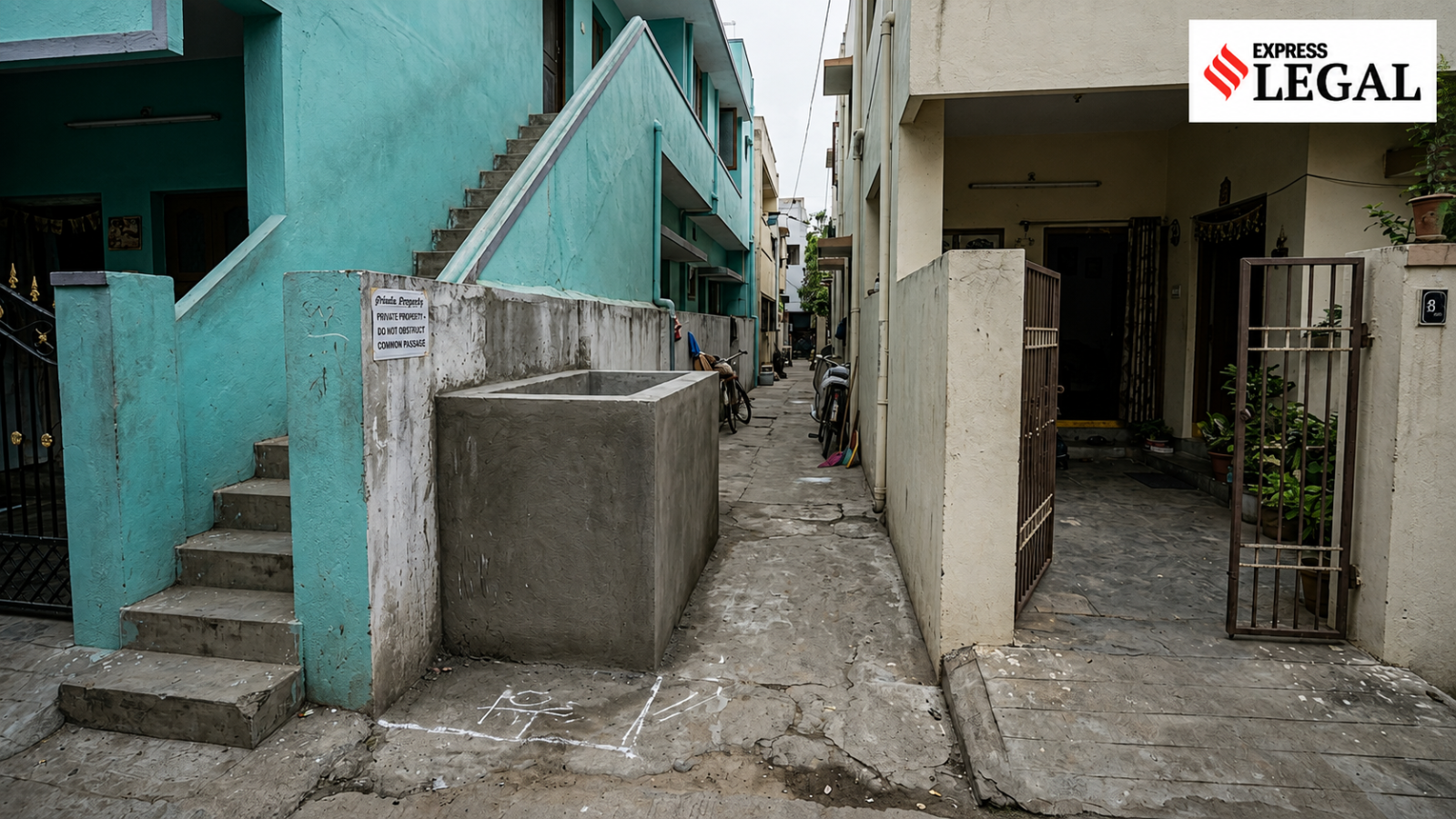
The high court in August 28 order noted that in a property cases where dispute was about encroachment and overlapping boundaries, oral evidence was subjective as the “witnesses speak from memory or partisan perspective, whereas physical objects, walls, drains, water reservoirs, and pathways have fixed geographical locations” and that only documents were not enough to decide if a wall or a water tank is obstructing a common passage.
The woman alleged that she had inherited the house from her parents and was its absolute owner. The woman claimed that a ‘common passage’ attached to the north-east corner property was the “sole and exclusive pathway” for entry to and exit from the woman’s house. It came on record that the property of the defendants was situated on the western side of the common passage.
The woman contended that on August 14, 2012, the defendants allegedly started obstructing and encroaching the common passage by blocking it and trying “amalgamating” it into their own property. Specifically, the woman claimed that the defendants constructed an unauthorised water reservoir by directly encroaching upon a portion of the common passage, along with other structural violations.
Eventually, the woman filed a police report against the defendant before ultimately filing a civil case. In the case, the woman filed a plea and sough a survey commission to be appointed for local investigation, to “inspect the locale, take measurements, and submit a scientific report detailing the exact physical features, the precise location of the alleged water reservoir, and the status of encroachment” of the common passage.
However, the trial court, by its order on February 1, 2025, rejected the woman’s plea and stated that “a survey investigation is entirely unnecessary where the primary dispute centres around the existence or non-existence of a common passage, which can be proved through cogent documentary evidence”.
Advocates Jayanta Kr Mondal and Sayantan Rakshit, appearing for the woman argued that “a survey-knowing commissioner acts as the ‘eyes and ears’ of the court and shutting out scientific investigation in an encroachment dispute cuts at the very root of a fair trial, as the existence of paper title does not obviate the necessity of establishing physical spot-level boundaries and overlapping encroachments through an independent scientific survey report.”
Advocates Sounak Bhattacharya and Sounak Mandal, representing the defendants, contended that a commission could not be allowed to be utilised as a tool for “fishing out” evidence to correct the weaknesses in the woman’s case, especially when title and existence of property should be established independently by the woman through convincing primary documents.
The high court noted that, “the wheels of civil jurisprudence are engineered to secure the substantive rights of litigants through a predictable, structured, and expeditious process. However, when a simple lis instituted at the dawn of a decade languishes interminably at the pre-trial threshold, it tests the patience of the litigating public and undermines the very foundational ethos of speedy justice.”
The high court observed that even though documents prove legal ownership, “they do not automatically map out ground-level spatial coordinates or physical encroachments, making a scientific survey commission bridges this vital chasm between paper title and physical reality”.
Noting the “agonisingly slow progress” of the case, the court stated that a litigant could not be allowed to use procedural laws as a “handle” to cause delay. At the same time, the high court was of the view that the remedy for delay caused by the woman was not the “outright denial of vital scientific evidence that goes to the root of the matter”.
The high court held that the trial court had “fundamentally erred” in holding that because the existence of a common passage can be proved through documents, a survey investigation is wholly redundant and questioned that “how can a court measure a 3-foot passage or determine if an inch-by-inch encroachment has occurred merely by reading a 1982 sale deed?”.
Accordingly, the high court set aside the judgment of the trial court and directed the trial court to appoint “a competent, survey-knowing advocate commissioner” within two weeks for holding a comprehensive local investigation. The trial court was also ordered to finish the trial of the case “preferably within a period of six months”.
Original Source
This content was distilled for a focused reading experience. All rights belong to The Indian Express.
Read original publication