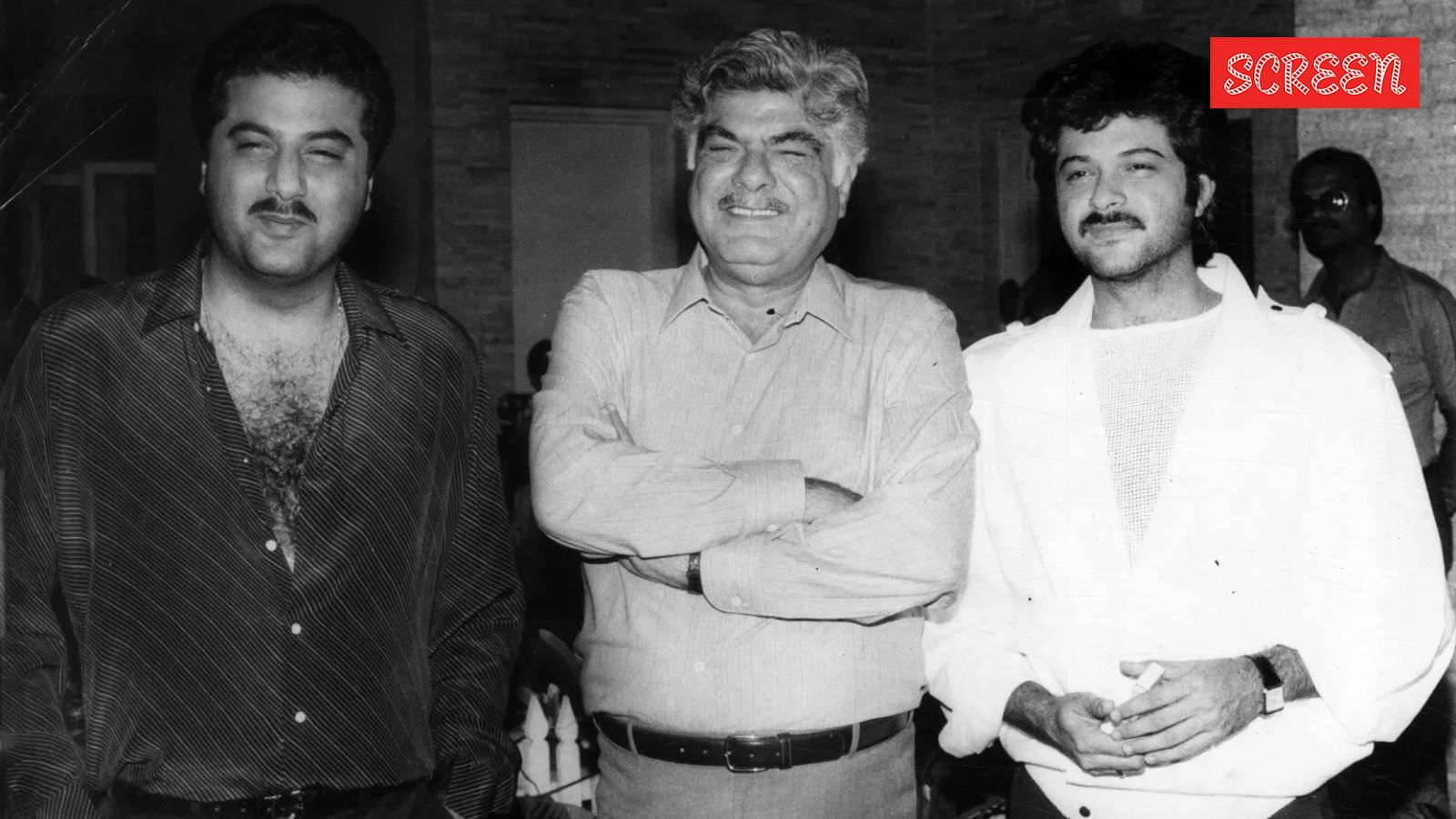
Anil Kapoor’s dad never gave a hit, family lived in Raj Kapoor’s servant quarters: ‘A sh*thole’
Today, the Kapoor surname is synonymous with Bollywood. Boney Kapoor has produced several notable Hindi films, Anil Kapoor remains among its biggest stars, and the family’s legacy now spans multiple generations. But long before all this, there was a one-room kholi in Mumbai’s Tilak Nagar where the entire Kapoor family lived together. There were common toilets, mounting debts, and a producer who never quite found commercial success despite spending decades in the film industry.
Surinder Kapoor was born in Peshawar and moved to Mumbai after the Partition. Looking for work, he reached out to his cousin, Prithviraj Kapoor, who invited him to the city.
In a 2009 interview with Rediff, Surinder recalled that films were never part of his original plan. But Prithviraj Kapoor changed the course of his life by introducing him to filmmaker K Asif.
“I came to Mumbai in 1950. I was 27 years old then. I am from Peshawar. When I told my cousin Prithviraj Kapoor that I wanted to come to Mumbai for a job, he asked me to come over. When I came to Mumbai, I didn’t think I would join films. But Prithviraj was very nice. As soon as I came to Mumbai by Frontier Mail, he took me to K Asif and got me a job as an assistant director on the sets of Mughal-E-Azam,” Surinder had said.
He later worked as Geeta Bali’s secretary, a relationship that would prove pivotal when he decided to become a producer.
Before finding a home of their own, Surinder Kapoor and his wife lived in Raj Kapoor’s outhouse — the small room above the garage that was usually occupied by the driver’s family.
Later, they moved to Tilak Nagar, where the growing family lived in a one-room chawl.
“We began our journey from an almost chawl-like situation. All four of us were born in Tilak Nagar, in one kholi. Every floor had a single one-room-kitchen unit. There were three common toilets,” he recalled.
ALSO READ: Aamir Khan denies 3 Idiots’ Rancho was inspired by Sonam Wangchuk: ‘Chatur was wrong’
Surinder Kapoor eventually became a producer, encouraged by Geeta Bali, who helped him secure financiers for his first film, Jab Se Tumhe Dekha (1963).
“I could have made my first production, Jab Se Tumhe Dekha (1963), with Madhubala. But I had told Geeta that if I ever make a film, it would be with her only. Geeta helped me get financiers,” Surinder had said. The film failed, and so did several others.
“In fact, I could not give a single hit in my entire career but still, financiers and distributors put their money in my projects,” he said.
His biggest setback came when the Rajesh Khanna-starrer Shahzaada failed at the box office.
“I didn’t want to become a filmmaker. Although my father had pinned his hopes on Ek Shriman Ek Shrimati, the film did average business. Then, when the high-budget, Rajesh Khanna-starrer Shahzaada bombed at the box office, my father was tense for days. Around then, I decided to myself that I would have nothing to do with filmmaking.”
The family’s biggest crisis arrived in the mid-1970s. Surinder Kapoor developed heart problems while one of his productions was underway. The film’s director died before completing the shoot. Another filmmaker stepped in to finish it, but when the film was finally released, it failed commercially.
“Around 1976, my father took ill. We had a film on the floors, called Phool Khile Hain Gulshan Gulshan. Another calamity occurred. Our director died midway through the shoot… The film was released in 1978, and it flopped. My father was in debt, we were in debt. We were in a s**thole,” Boney recalled.
“In those days, my father had a debt of Rs 22 lakh. There were several cases against him because he hadn’t been able to repay financiers. The mission with Hum Paanch was to get debt-free. By then, that Rs 22 lakh debt had become Rs 36 lakh,” Boney told News18.
“When my grandmother passed away, Anil and I decided that he will do acting and I will take over the production. Somebody had to run the show at home also. My father had a heart problem, we didn’t want to give him stress,” Boney recalled.
“I wouldn’t call them odd-jobs because I loved doing them, like waking up the actors, picking them up, fetching them from the airport, dropping them to the location, looking after them, getting them right snacks and then the tea breaks.”
His responsibilities gradually increased. He began scouting locations, negotiating rates, handling production work and even worked as casting director on Hum Paanch. Only later did acting become his full-time profession, culminating in his breakthrough with Woh Saat Din.
Ironically, the son who had once decided never to become a producer became the man who rescued the family’s production house.
Boney Kapoor’s debut production, Hum Paanch (1980), emerged as a commercial success. It allowed him to free his father from years of debt.
“The film made enough profit for me to pay off the debt, and I was left with Rs 1 lakh,” Boney recalled.
Surinder Kapoor never enjoyed the kind of commercial success that his sons would later achieve. Today, the Kapoor family is often associated with privilege and stardom.
Today, the Kapoor family is often associated with stardom, success and privilege. But behind that legacy lies the story of how Boney and Anil Kapoor shouldered their family’s struggles long before they tasted success themselves.
Click here to follow Screen Digital on YouTube and stay updated with the latest from the world of cinema.
Original Source
This content was distilled for a focused reading experience. All rights belong to The Indian Express.
Read original publication