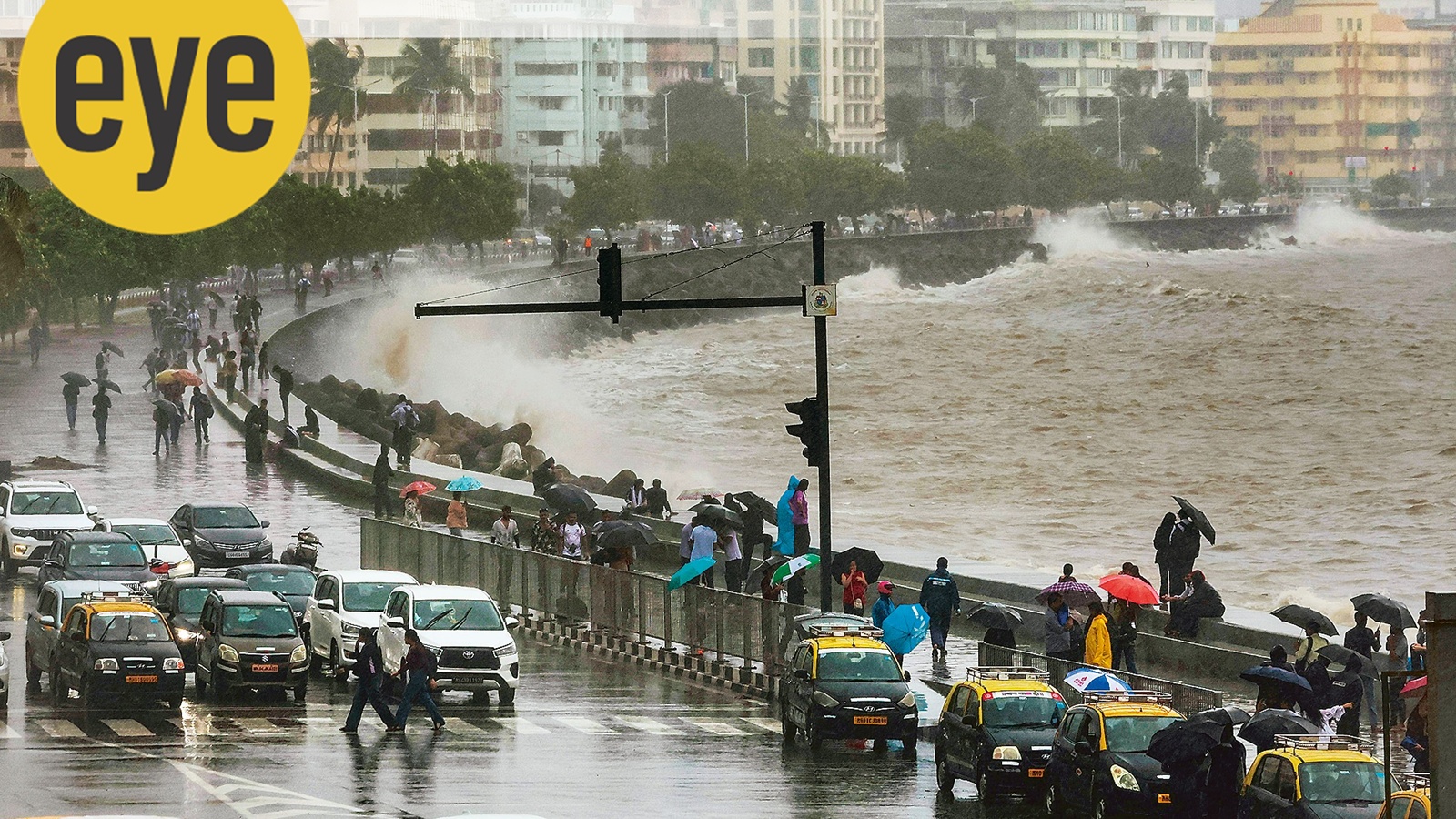
From Duckback raincoats to the 2005 deluge: Author Jerry Pinto’s love letter to Mumbai’s monsoon
It was 1980; my friend Mehlli Gobhai, the painter, was to have his first group show at the Bronx Museum of the Arts in New York, curated by Madeleine Burnside and Jeanette Ingberman. He wanted to be there, of course, but he also was reluctant to miss what he called the melodrama of the monsoon, the grey clouds piling up over the horizon and then sweeping imperiously into the city, changing everything from gold and grit to grey and moss.
“I kept changing my ticket,” he told me. “And my mother kept warning me. I replied: ‘Well, if billionaires can beat jet lag and time zones and sign multimillion-dollar deals, I can turn up on the day of the opening’.”
The monsoon is the city’s wild card. Through the heat of the summer, we long for it. When it arrives, everything must change. Clothes must be decided according to it. Umbrellas must be fished out and dusted off. Rainwear must be purchased. My father said June was the month that stretched his budgetary capacities the most: both his children had to be kitted out for school: new books, new uniforms, ‘rainy shoes’ as we called them, and Duckback raincoats which had their own peculiar smell when they lay, unused over your arm, as you plodded along to school.
But there was a wild excitement about the rain. We watched out for it, hoping for No School days. We splashed through puddles and watched mushrooms grow, white as milk, among the dark roots of the trees. Snails appeared. Trees fell. Moss crept up walls. The schoolrooms leaked and fungus drew maps along the cracks.
In adulthood, one’s attitude changes. One knows that the city is rainfed, that the lake levels are low. But it always seems to rain in the wrong places and at the wrong times. Through the longueurs of mid-June to mid-September, we resent its commanding presence. It must be accounted for. Appointments must be made with the caveat: ‘…rain willing’.
And each year, we know we will be failed by the municipal authorities. I suspect sometimes that the flooding of the city is nature’s revenge on us. The sea spits up thousands of kilos of plastic waste on the beaches of Mahim and the seafront at Marine Drive. The water accumulates and we watch as television cameras wade through the leptospirosis-rich waters to get footage of a family whose old people are stranded on the top of beds, their homes reduced to stagnant pools.
The floods have their benchmark: 26 July 2005. Everyone in the city knows what they were doing and how they got home. I was working in Mahalaxmi and at around 3 pm, I decided that I would walk home. My boss then, Radhakrishnan Nair, thought this was stupid. We should simply sit it out in the office, sleep there, get home the next day. But there is something about the notion of home that calls when pralaya seems imminent.
The late Pria Agni, artist extraordinaire whom we lost too young, also lived in Mahim so we decided we would walk together. Without even discussing it, we chose to use Tulsi Pipe Road. There was a moment of fear when we walked through Parel. I was at five ten waist-deep, Pria shoulder-deep. We met a young woman who looked close to panic and held her between us until we got to knee-deep water. She decided to try her luck with the trains at Dadar though we didn’t think this a great idea.
Mahim was fine. There were no floods. It was business as usual and the elderly folk who had not stirred out were surprised at our stories. Our great big sponge, Shivaji Park, was doing its work. My sister, who worked then at Kalina in the University Library, walked home too and at one point, made her way through the flood water with another woman, holding hands, clinging to the wall by the bridge on the side of the Mithi River. All the seven goddesses of Mumbai —Mumbadevi, Kalbadevi, Prabhadevi, Sheetaladevi, Mahalaxmi, Gaondevi, Mother Mary — were working overtime that day.
We have obviously learned nothing. We are cutting down our mangroves. More and more of Shivaji Park is being covered by concrete. We are still throwing away as much plastic as suits us.
Original Source
This content was distilled for a focused reading experience. All rights belong to The Indian Express.
Read original publication