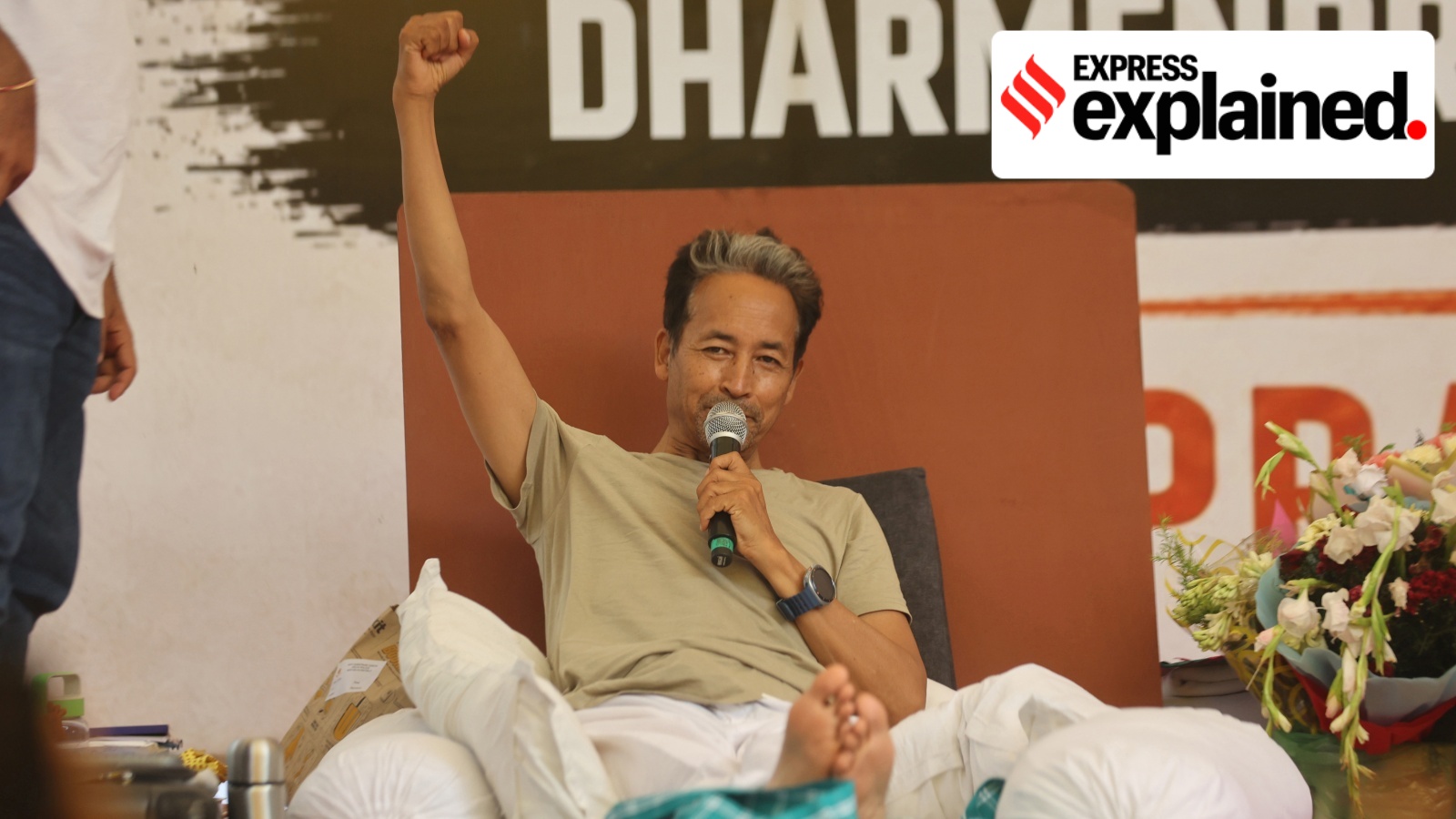
The journey of Sonam Wangchuk, the activist: Education to ecology to politics
Wangchuk has been part of the protest organised by the Cockroach Janta Party, demanding broader reforms to the examination system and the resignation of Union Education Minister Dharmendra Pradhan over multiple examination paper leaks.
Here’s a look at how activism played a key role in Wangchuk’s life — right from a young age when his father went on hunger strike — and how the educator and innovator came to be involved with politics.
Wangchuk was born in Uleytokpo, a riverside village in Leh, in 1966. His father, Sonam Wangyal, was a prominent Ladakhi politician who also served as a minister in Jammu & Kashmir when Ladakh was part of the erstwhile state.
Wangyal led a hunger strike in 1984 to push for the region’s demand for Scheduled Tribe status for Ladakh. He died in 1998.
Wangchuk was initially homeschooled by his mother because his village did not have a school. He completed his school education after nine years of age in Srinagar and New Delhi. He has a mechanical engineering degree from NIT Srinagar which was then, Regional Engineering College (Srinagar).
After finishing his degree, Wangchuk set up an alternative learning school in Leh — Students Educational and Cultural Movement of Ladakh (SECMOL) — in 1988. SECMOL had the stated objective of improving the education system in Ladakh. At the time, school books used Urdu as the medium of instruction until class 8 and English in classes 9 and 10.
SECMOL launched Operation New Hope as a way to address these issues. The movement turned into a campus where over 700 teachers and education officials and administrators were trained. In 1998, the Dalai Lama made a special contribution of Rs 1,50,000 to SECMOL for its educational work.
New textbooks were specifically designed for Ladakh introducing English in primary schools paving the way for eventually taking the class 10 pass percentage in Ladakh schools from 5% in the late 1980s to 75% in the 2000s.
In 2005, Wangchuk was appointed a member of the National Governing Council for elementary education in the Ministry of Human Resource Development.
In his years as a researcher and innovator, Wangchuk remained focused on addressing issues closest to home owing to its fragile ecology.
Ladakh was faced with water scarcity for large parts of the year owing to its harsh climate and topography. Wangchuk created artificial structures called “ice stupas” so as to augment the water supply in the summer, to store and gradually release water.
Wangchuk’s research into the problems being faced by the people of Ladakh led him to raise concerns about the environment both locally and internationally. Wangchuk studied the problems of the region and provided solutions that include the solar tent prototype, Agri Voltaic roadmap for Ladakh among others. In 2018, Wangchuk and his wife set up the Himalayan Institute of Alternate Learning (HIAL) to bring experiential learning to the students of Ladakh. This is also the year he won the Ramon Magsaysay award for his work in community-led educational reforms.
The harshest punishment at the school, he says in a video, is to be sent home for two weeks.
After the constitutional changes of August 2019, splitting the state of Jammu & Kashmir into two Union Territories — J&K and Ladakh — Wangchuk was one of the first people to welcome the move. While areas under the Kargil district took to the streets in protest against the Centre’s decision almost immediately, Leh joined the dissent almost a year later, but with a view to gain larger democratic representation for the region.
After Ladakh began to take shape as a Union Territory, Wangchuk, who had continued to stay away from active politics, in 2023 announced a climate fast at Khardung La — one of the highest passes in the world — to highlight the effects of climate change on the fragile ecosystem of Ladakh and to demand protections for the people of Ladakh under the Sixth Schedule. The Sixth Schedule under Article 244 provides for the formation of autonomous administrative divisions that have some legislative, judicial, and administrative autonomy within a state.
The government didn’t allow the fast and put him under house detention.
Wangchuk also made a political statement saying Ladakh was better off with Jammu & Kashmir than a Union Territory. A year later, he announced a fast until death for his demand of constitutional safeguards for Ladakh. In September 2025, during his 21 day fast, protests turned violent and four locals from Leh were killed in police firing.
After this episode, Wangchuk was jailed under the National Security Act and incarcerated at the Jodhpur jail for six months. The Centre accused Wangchuk of instigating the youths with his “provocative statement” and revoked the FCRA licence of his institute. The charges were revoked in March 2026 and Wangchuk returned to Leh.
In March 2024, he announced a “Pashmina March” for the restoration of pasture land for the shepherd raising pashmina goats in Ladakh. He modelled this march on Mahatma Gandhi’s dandi march against the British in 1930.
In the years since his involvement with the agitation for Ladakh’s inclusion under Sixth Schedule, he has stated that his 21 day fasts are based on the fact that Gandhi ji’s longest fast was 21 days.
Original Source
This content was distilled for a focused reading experience. All rights belong to The Indian Express.
Read original publication