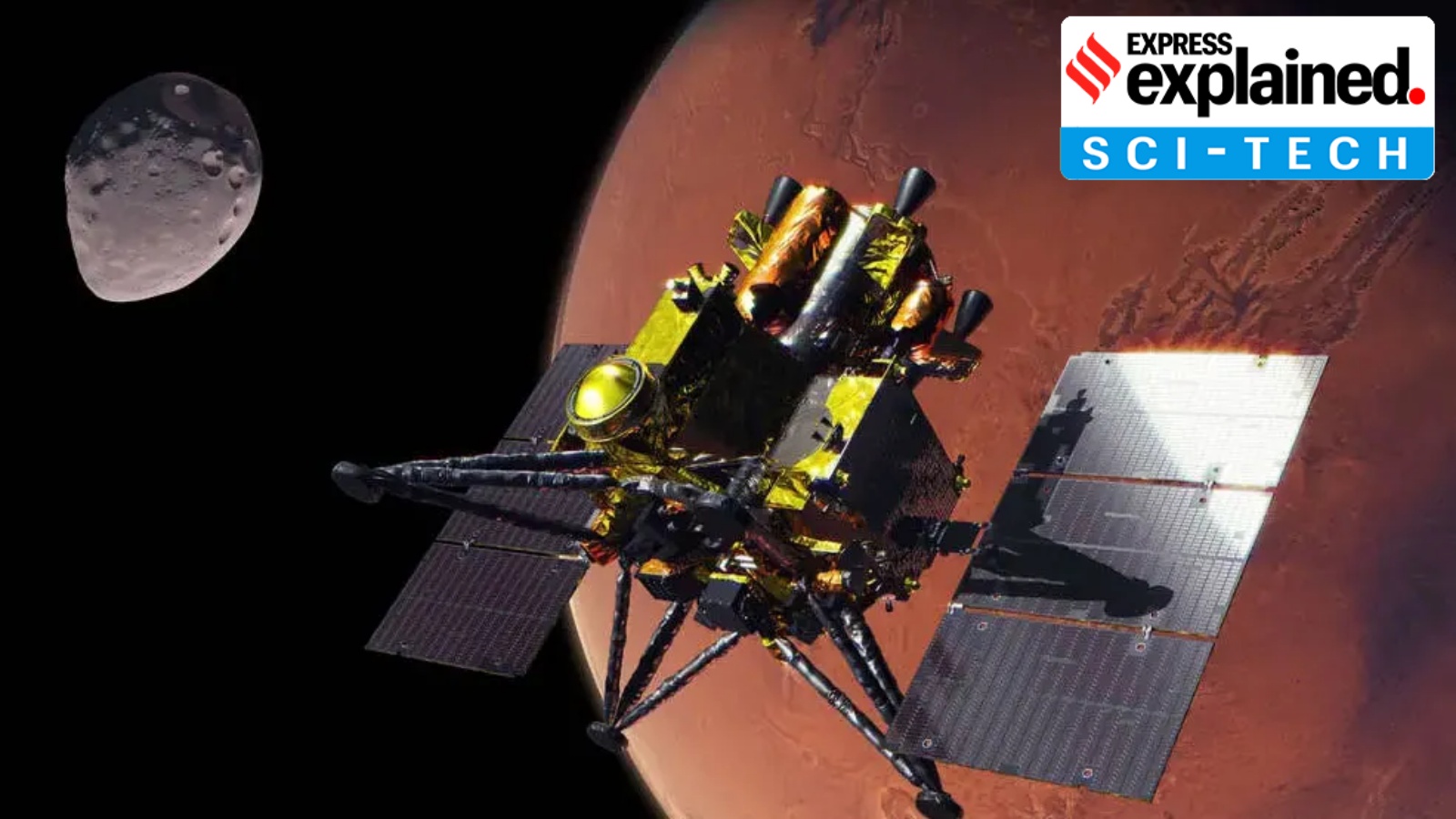
Japan heads to Mars for a piece of its moon: What launch hopes to achieve
Listen 00:00 0.5x 0.75x 1x 1.25x 1.5x 2x AI Narration This audio is AI generated.
Earlier today, the Japan Aerospace Exploration Agency (JAXA) launched an H3 rocket from the Tanegashima Space Center at approximately 4:40 am Japanese Standard Time (JST) — or 1:11 am IST — towards Mars.
The mission, termed Martian Moons Exploration (MMx), aims to study the origin of the Martian moons Phobos and Deimos — named after the sons of the Greek god of war, Ares, who is better recognised as his Roman counterpart, Mars.
The mission endeavours to retrieve physical samples from Phobos and return them to Earth. The samples are expected to return to Earth in 2031 and the agenda states that it shall collect at least 10 grams of material from Phobos.
Should the mission be successful, this shall be the inaugural country to return samples from a moon of Mars. However, why is the mission interested in exploring the moons instead of the Red planet itself? And what sort of insights are scientists hoping to glean from these samples? We explain.
Phobos and Deimos were first discovered by the American astronomer Asaph Hall in 1877 at the US Naval Observatory in Washington D.C.
Majorly, these two moons have held the interest of the scientific community because theirs origins are not yet discovered. There are, however, two theories, according to NASA.
The first explanation proposes that both moons are relics of asteroids which were captured by the gravitational pull of the planet. The irregular shapes of the two, combined with certain surface characteristics, make this theory a real possibility.
The unanswered question, however, stems from the fact that capturing asteroids into stable orbit around a planet is no simple task. Scientists are also yet to establish whether it explains the movement of both moons and their other characteristics.
The other working theory states that both moons were formed due to a collision of a large celestial body or asteroid into Mars. As debris was ejected into the planet’s orbit, it came together over time to form both moons.
Should this explanation turn out to be correct, the composition of the moons may reveal clues about Mars itself. Mars’ gravity makes landing on the planet returning samples a challenge. Phobos, specifically, has much weaker gravity than Mars and the spacecraft shall have to manoeuvre carefully to avoid mishaps.
JAXA’s MMX mission hopes to assist scientists take a step closer to the answer. Earlier in 2010, Japan’s Hayabusa spacecraft returned samples from the asteroid Itokawa, which made Japan the first country to successfully execute a sample-return mission from an asteroid.
MMx is designed to be a five-year round trip to the Martian system and the craft is expected to return to Earth in 2031.
The spacecraft is scheduled to take approximately a year to reach Mars and shall arrive around August 2027.
Following its arrival, it shall enter quasi-satellite orbit around Phobos. This shall allow it to remain close to the moon while conducting observations of its topography and chemical composition. These details shall also help scientists determine a suitable landing spot.
The spacecraft is made up of three main modules — propulsion, exploration and sample return — which will support the journey to Mars, surface ops and eventual return to Earth.
It carries 13 scientific instruments, including cameras, spectrometers and devices to measure the moon’s surface and composition. One of its key components is the IDEFIX rover, developed jointly by CNES (France) and the DLR (Germany). The rover will be deployed on Phobos before the main aircraft.
The mission also plans to observe Deimos during a flyby. MMX will also test technologies needed for future round-trip missions to the Martian system, including autonomous navigation and landing in extremely weak gravity.
The MMX mission comes at a time when major space powers are actively seeking to develop their capabilities for planetary exploration.
Importantly, the mission shall help assess whether Phobos may be able to serve as a staging point for crewed missions to Mars. Its weak gravity means that landing and taking off from the moon requires a fraction of the fuel needed for a descent onto the surface of Mars.
Although largely headed by JAXA, the mission also includes the European Space Agency (ESA), NASA, CNES (France), DLR (Germany), and the Australian Space Agency.
The allows nations to share the cost of innovation while advancing shared goals. In fact, NASA’s Mars sample-return mission — aimed at bringing back surface soil deposits from the planet — was scrapped earlier this year by US Congressional budget action which dictates federal spending.
Japan is, “climbing a ladder that helps position the nation as one of the leaders in planetary exploration,” Rao said. “It (Japan) is already known for expertise in sample-return missions. It is now signalling that it is one of the scientific great powers which belongs at the proverbial table”.
Original Source
This content was distilled for a focused reading experience. All rights belong to The Indian Express.
Read original publication