China’s new curbs on tunnel boring machines: What they mean for India
Listen 00:00 0.5x 0.75x 1x 1.25x 1.5x 2x AI Narration This audio is AI generated.
After imposing restrictions on rare earth magnets that continue to affect Indian automobile manufacturers, China has introduced fresh global restrictions on tunnel boring machines (TBMs), a key piece of equipment for metro rail and highway construction.
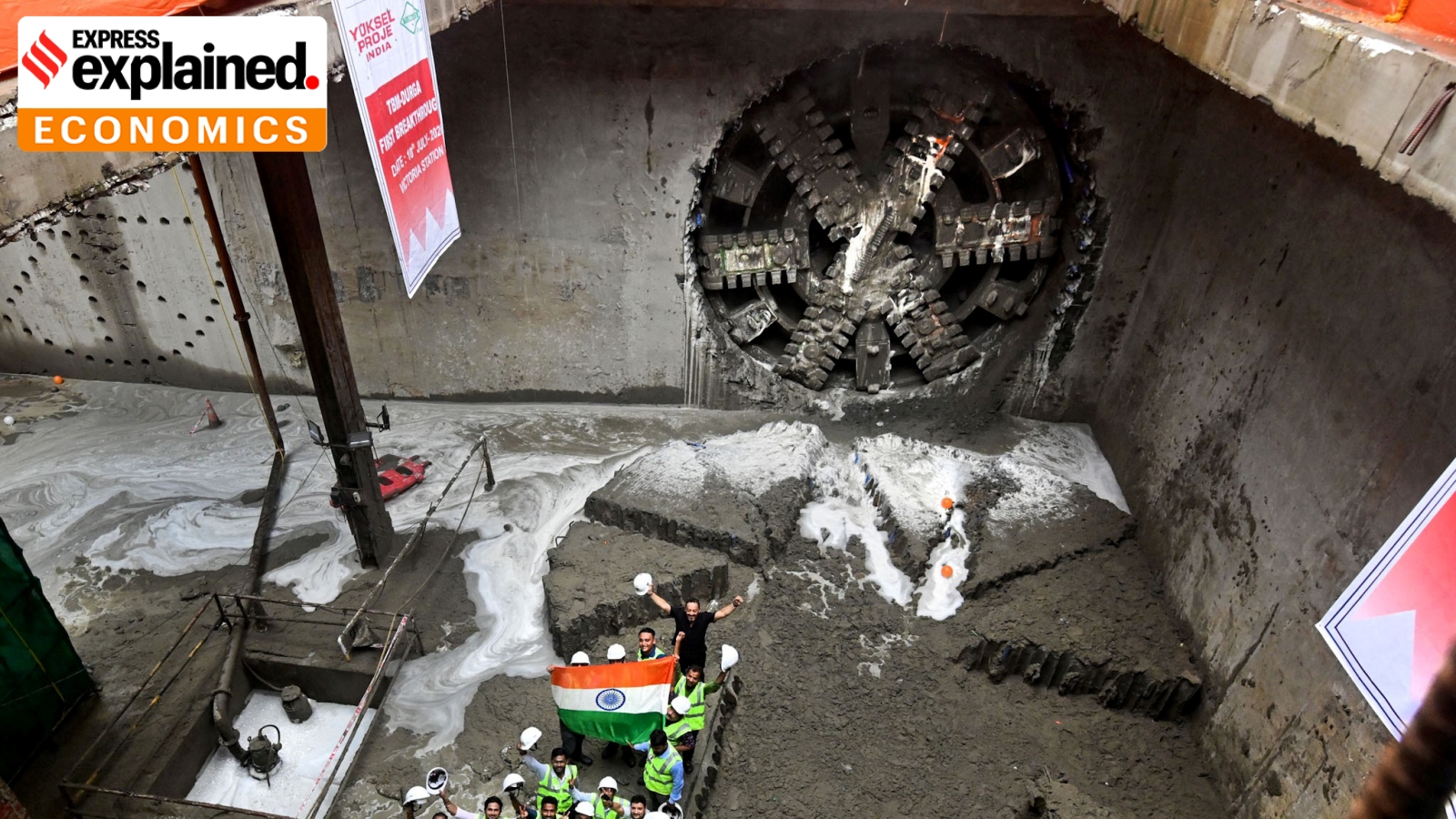
These 3,000-tonne machines are playing a crucial role in several construction projects in India, particularly the country’s first 508-km bullet train project — the Mumbai-Ahmedabad High-Speed Rail Corridor. The project also includes a 7-km undersea rail tunnel.
TBMs, currently used in several countries across Europe, Canada, the US and Australia, ensure a much safer excavation process than conventional blasting methods. This would be especially important for the Indian high-speed rail project, where the tunnel passes through a densely populated area.
But China’s Commerce and Industry Ministry Monday said that export operators would need to apply for a license in accordance with provisions of export control law and regulations on the export control of dual-use items and that the restrictions will go into effect on November 18.
While China has announced a fresh licensing mechanism on TBMs, India has already been facing delays in imports of the machine since 2024. However, it received the TBMs earlier this year in March after tensions began easing somewhat between the two countries.
In a video of an interaction between Commerce Minister Piyush Goyal and Germany’s then Vice Chancellor Robert Habeck during a metro train ride in Delhi in 2024, the Commerce Minister had flagged issues with delayed shipments and told Habeck that India was to get some TBMs from Germany company Herrenknecht, a leader in TBMs, that the company was making in China the sale of those machines to India was being blocked.
While a fresh licensing mechanism gives more leverage to the Chinese government in trade talks, the impact on India would depend on how China uses such restrictions. Commerce Minister Piyush Goyal last week said India is “working to develop the relationship with China once again, but the last word has not yet been scripted on this journey”.
However, External Affairs Minister S Jaishankar and Finance Minister Nirmala Sitharaman have flagged concerns over economic issues with China, underlining the “one-sided” and “tilted” trade balance. India’s trade deficit with China in the first six months of 2026-27 was $69 billion, 27% higher than in the corresponding period of 2025-26.
India has been opening its door to Chinese investment in certain strategic areas, including the power sector. But India has been ramping up anti-dumping measures on China too. According to Swiss think-tank Global Trade Alert, India opened 18 anti-dumping and anti-subsidy investigations in the July-September quarter, more than any other country. The single largest target was China.
A series of Chinese restrictions also comes amid Beijing’s involvement in high-level negotiations with the US and the EU. While the US and China have entered a two-month trade truce, China and the EU are also involved in trade talks after the EU moved to limit imports of Chinese-made electric vehicles and EV batteries and imposed measures to protect the European steel industry.
Amid backlash from several trading partners, China’s global trade surplus hit $1.2 trillion in 2025 and is expected to surpass $1 trillion this year too. According to a report by Rhodium Group last month, an increase in China’s global export share implies a decline in the rest of the world’s share.
“We find that the countries that bear the greatest costs are those that are large trading economies in general, and have export profiles most similar to China’s. By 2030, we estimate that the US will lose 1.2 percentage points (pp) of its share of global trade, Indonesia 0.8pp, Canada 0.5pp, Germany 0.4pp, and the Netherlands 0.4pp. The rest of the world combined is projected to lose 4.6pp. Combined, these figures account for China’s estimated ~8pp gain,” the report said.
Original Source
This content was distilled for a focused reading experience. All rights belong to The Indian Express.
Read original publication