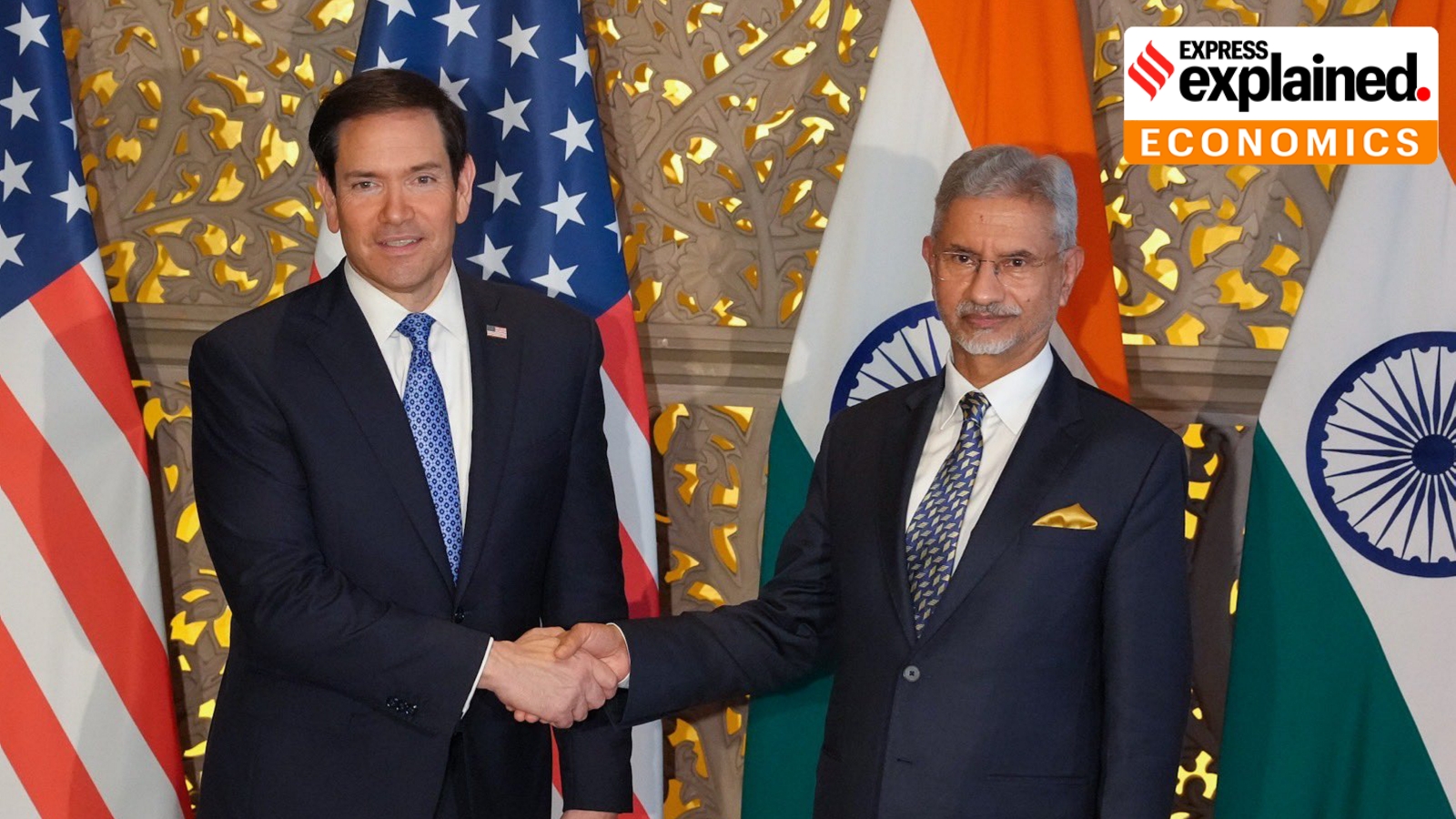
Why Marco Rubio is heading to Reliance’s Jamnagar refinery, and what’s on the table
Listen 00:00 0.5x 0.75x 1x 1.25x 1.5x 2x AI Narration This audio is AI generated.
US Secretary of State Marco Rubio will visit the world’s largest single-location refinery complex — Reliance Industry Ltd’s (RIL) twin refineries in Gujarat’s Jamnagar — on Wednesday (October 21) as part of his India trip.
While Rubio met External Affairs Minister S Jaishankar and some Indian business leaders in Mumbai on Tuesday, his Jamnagar visit and likely meeting with RIL Chairman Mukesh Ambani are being watched closely over a range of energy-related issues, given the Indian conglomerate’s growing importance for the US in the current global environment.
On the table at Jamnagar could be RIL’s planned investment in a new refinery project in Texas, the Trump administration’s efforts to secure fuel supplies amid global energy market turmoil ahead of the midterm polls in the US next month, the broader issue of oil imports from Russia, Venezuelan oil imports by RIL, and potential for increasing American energy sales, according to experts.
Rubio’s India visit — his second in six months — is significant as it comes at a sensitive time in the bilateral ties as Washington and New Delhi are working to conclude a trade deal, even as disagreements over tariffs and India’s hefty Russian oil imports continue to be points of friction. Last week, US Ambassador to India Sergio Gor described Rubio’s India trip in October as “a little more business-focused” than his May visit.
Apart from RIL’s involvement in the Texas refinery project, Gor also underscored the company’s importance in the global oil refining industry, as it is India’s largest exporter of refined petroleum products and one of its two refineries at Jamnagar is an export-oriented unit. Rubio’s visit to Jamnagar appears to signal that Washington views India’s refining industry and its top private-sector player as important players in the global energy market. The US hasn’t disclosed any detailed agenda for Rubio’s Jamnagar trip. RIL also didn’t comment on the planned visit.
Notably, Rubio’s visit to RIL’s Jamnagar facility comes days after Elon Musk alleged “certain oligarchs” were intentionally blocking Starlink’s license approval to maintain a “monopolistic chokehold” on India.
Musk, who is seen as a close ally of the Trump administration, had targeted Ambani on the issue. “Is Ambani the real boss of India,” Musk had said in a post on X. Later, however, he posted “Much appreciated” on X after RIL responded by saying that it welcomed competition in satellite communications, including Starlink, while noting that Reliance Jio’s own satellite services awaited government clearances.
One of the most significant potential talking points could be RIL’s involvement in a proposed refinery project in Brownsville, Texas. For Rubio, a visit to Jamnagar would provide an opportunity to discuss the project’s progress, the broader investment relationship, and the scope for further cooperation between American energy companies and RIL.
In March, US President Donald Trump announced plans for the refinery, to be built by America First Refining, and thanked RIL for its “tremendous investment” for the project. According to Trump, the Brownsville refinery — the first new refinery in the US in five decades — entails a $300-billon deal.
The $300 billion appears to be the value of crude oil that the refinery will process and the fuels it will produce over five years. According to America First Refining, 1.2 billion barrels of US light shale oil with an estimated value of $125 billion will be purchased and processed by the 60-million-barrels-per-year refinery, and 50 billion gallons of refined products — worth $175 billion — will be produced. The project offers Washington an opportunity to showcase foreign investment in American energy infrastructure, while Reliance could gain a strategic foothold in the world’s largest oil-consuming economy.
From a fuel supply perspective, the Jamnagar complex is an important production centre with refining capacity of 68.2 million tonnes per annum (mtpa), of which 35.2 mtpa is dedicated for exports. RIL is India’s largest exporter of petroleum fuels like diesel and jet fuel and is seen as a major swing supplier in the global fuels market, particularly when disruptions affect supplies from other regions, as is the case presently with West Asia and Russia.
Experts said that Rubio could use the visit to explore the broader role RIL and even other Indian refiners can play in strengthening energy trade between the two countries, although there is no confirmed indication that the Jamnagar visit is partly aimed at securing diesel shipments for the US. Beyond diplomatic and geopolitical considerations, decisions on fuel exports depend on various commercial factors like refining margins, shipping costs, product specifications, market prices, and the relative attractiveness of competing export markets.
Rubio’s visit also comes against the backdrop of a shift in US approach to Russian energy sanctions. After signing into law last month a legislation that grants him powers to impose up to 100% tariffs on top buyers of Russian energy, including India, Trump last week waived the application of the law’s provisions just days before they were to take effect. RIL has been a major Indian buyer of Russian oil.
The Russian oil issue has become especially sensitive as Washington and New Delhi attempt to advance their broader economic relationship. In fact, speaking in Uzbekistan on Monday, Rubio said that the decision to waive the implementation of the new Russia sanctions law also took into account the India-US trade deal, which is close to conclusion. Rubio’s Jamnagar visit could provide a further opportunity for a discussion on the commercial realities facing Indian refiners, particularly with regard to Russian oil imports.
India’s oil imports from Russia really took off after the Ukraine war broke out. With much of the West shunning Russian crude following Russia’s February 2022 invasion of Ukraine, Moscow started offering discounts on its oil to willing buyers. Indian refiners were quick to avail the opportunity, leading to Russia — earlier a peripheral supplier of oil to India — emerging as India’s biggest source of crude, displacing the traditional West Asian suppliers.
For Washington, Moscow’s revenue from energy exports has been a problem. For over a year now, the Trump administration has tried to strong-arm New Delhi into pivoting away from Russian crude, including by imposing additional penal tariffs last year. Its argument has been that by buying Russian oil, India has been funding Russia’s war in Ukraine.
For India, crude procurement is essentially linked to energy security, affordability and the refining sector’s requirements. The country depends on imports to meet over 88% of its crude oil requirement, with energy imports accounting for the lion’s share of its merchandise imports and having significant implications for the economy.
Discussions are likely to also touch upon the possibility of further increasing American energy purchases by India, and RIL in particular, as per industry analysts. The US is already a major supplier of crude oil, liquefied natural gas (LNG), and liquefied petroleum gas (LPG) to India, and increasing energy exports to this market would serve Washington’s commercial interests.
The Trump administration has publicly stated on various occasions that it wants India to buy more American energy, particularly as an instrument to rebalance bilateral trade and deepen economic cooperation.
RIL’s massive refining complex is well positioned to evaluate a broad range of crude grades, including those from the US. As India’s largest private sector refiner, if it steps up oil imports from the US, American energy exports could potentially capture a greater share of India’s oil import slate. The US is currently India’s fifth-largest supplier of crude oil, behind Russia, Iraq, Saudi Arabia, and the UAE. While energy cooperation is bound to come up in Rubio’s discussions with Jaishankar, his Jamnagar engagement could complement those discussions with a focus on RIL.
In this context, Venezuelan crude could also be a key point of interest. The US wants higher Venezuelan oil flows as that benefits Washington, which now effectively controls the motorisation of Venezuelan oil. RIL is already a major buyer of Venezuelan crude outside of the US and is expected to remain important for further expanding Venezuelan oil flows to India. RIL’s refineries have very high complexity levels, making them apt to process heavy crudes like those from Venezuela.
Original Source
This content was distilled for a focused reading experience. All rights belong to The Indian Express.
Read original publication