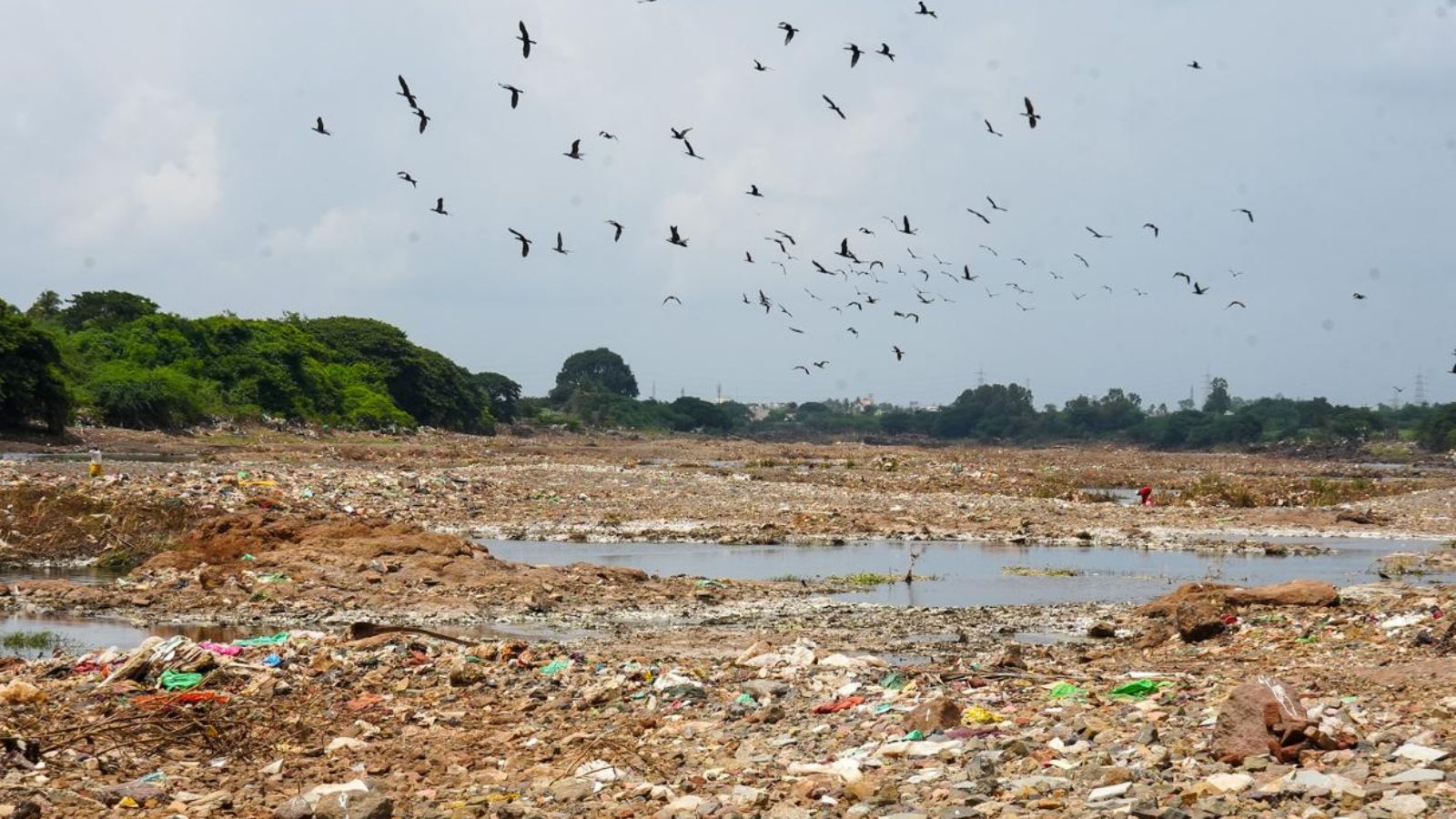
Smoke, stench and a protest: How Pune students fought riverside garbage dumping
In March this year, school and college students staged a series of protests and blocked trucks carrying garbage through the university campus to the dumping site. The agitation eventually forced the gram panchayats of Loni Kalbhor and Kadamwak Wasti to stop dumping waste there. The two panchayats were later allotted alternate government land as a temporary dumping site until permanent waste management facilities are developed, said Trupti Kolte Patil, Tehsildar of Loni Kalbhor.
The protests came after years of dumping on the riverbank. Trucks carrying garbage from the two gram panchayats routinely unloaded waste on government land along the Mula-Mutha. Satellite images show that more than 50 per cent of the river near Loni Kalbhor was covered with tonnes of garbage. Waste had also accumulated along a 250-metre stretch of the nullah flowing from the village into the river.
The dumping site was located immediately next to the MIT-ADT University campus in Loni Kalbhor. According to university authorities, more than 18,000 students study on the campus, apart from those enrolled in the MIT group schools located there. Students had to endure a foul stench for years, while frequent fires at the dumping site posed a recurring hazard.
The issue reached a tipping point in late February 2026 when a massive fire broke out at the dump. Smoke engulfed the campus, filling the rooms of boarding students at MIT Vishwashanti Gurukul World School and forcing them to be shifted out. University authorities said several students had to be hospitalized due to smoke inhalation, while firefighters and university staff took four days to extinguish the blaze.
Awanti Narwade and Chiransh Thakur, students at the school, said they initially gave the gram panchayats 10 days to stop the dumping after their first protest.
“But even after 10 days, the garbage trucks didn’t stop. They kept coming. So then we just shut all the gates so that no vehicle could enter,” Narwade said.
Kolte Patil said the dumping had initially been permitted on government land, but subsequent inspections revealed that a large portion of that land had been washed away due to flooding.
“The dumping was happening on government land. However, we found that much of the government land had been swept away during floods. Half of it was washed away, so the garbage dumping was happening in the river,” she said.
The university also approached the National Green Tribunal (NGT). In its submission to the tribunal, the Maharashtra Pollution Control Board said a huge quantity of municipal solid waste was being dumped into the river in an unscientific manner. On June 12, the NGT restrained the two gram panchayats from dumping any more waste at the site.
Mahesh Chopade, Registrar of MIT-ADT University, said the institute had spent Rs 25-30 lakh to clear the accumulated waste and transport it to Hadapsar after the dumping stopped.
“Right now, PMRDA has said it will not allow any dumping on the riverbank. However, governments change every five years and new officials may not be aware of the history of the issue. The government should find a permanent solution,” Chopade said.
“There was so much garbage. Before the dumping, there used to be trees on the riverbank. Breathing became difficult because of the smell and the smoke. Our children would also fall ill. The fish also suffered because the river was polluted,” said Rohit Kanche, a lifelong fisherman.
Original Source
This content was distilled for a focused reading experience. All rights belong to The Indian Express.
Read original publication