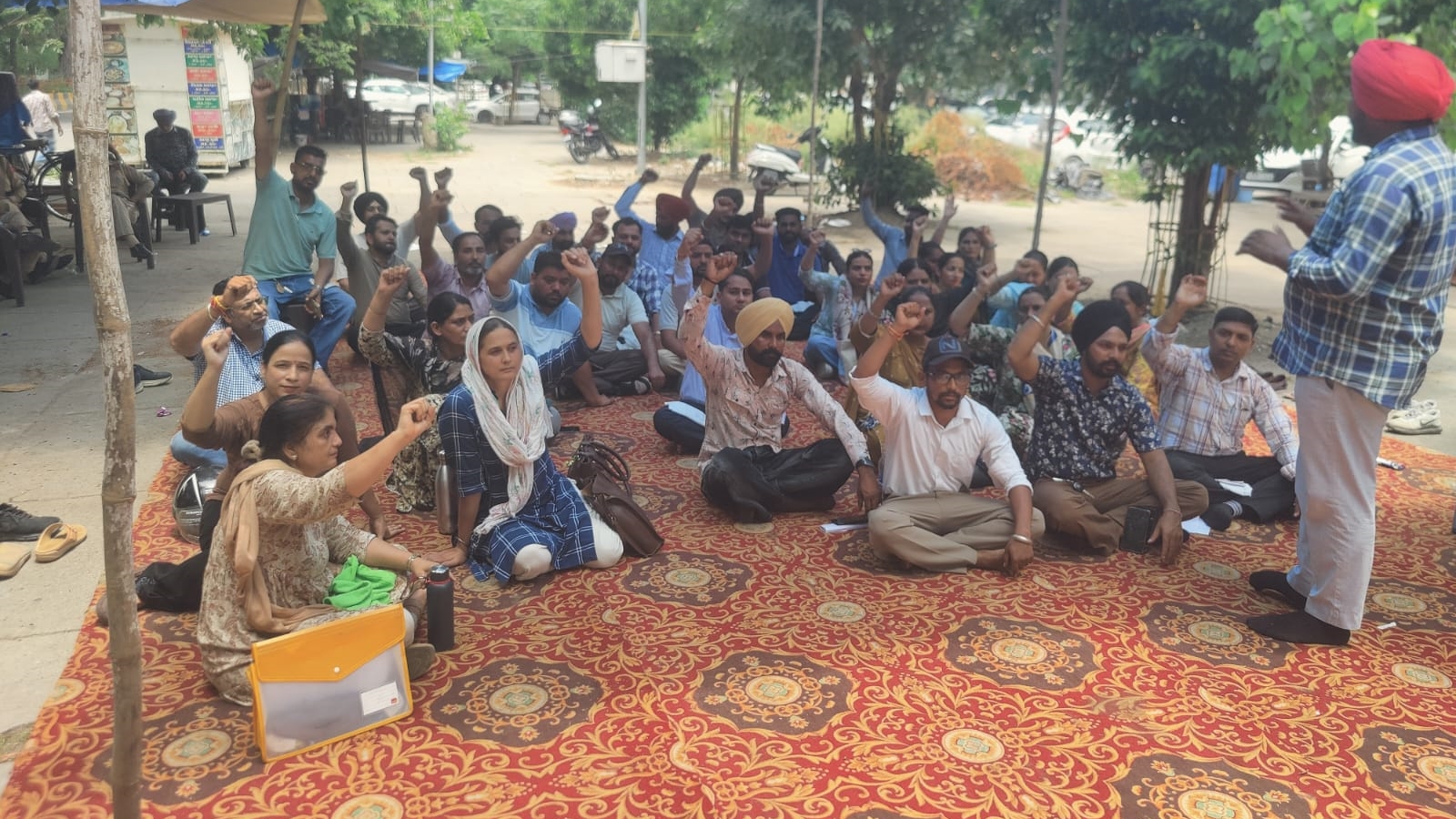
How employee protests have fared under AAP govt: Concessions, but no complete victory
The first major employee agitation after the AAP came to power was launched in October 2022 by the Contributory Pension Employees Federation Union (CPFEU) and the Purani Pension Bahali Sangharsh Committee for restoration of the OPS. The unions announced “pol khol” rallies in poll-bound Himachal Pradesh, where the AAP was contesting the Assembly elections, and threatened to extend the campaign to Gujarat, another poll-bound state, if the Punjab government failed to act.
On November 18, 2022, the government issued a notification for implementation of the OPS. Nearly four years later, however, the implementation remains pending.
The Punjab State Ministerial Services Union (PSMSU), representing ministerial employees across 52 government departments, launched an indefinite strike on November 8, 2023. The main demands included release of pending DA arrears and implementation of the OPS. Employees of the Punjab Civil Secretariat and around 40 directorates extended support. The strike was called off 40 days later on December 18 following a meeting of the union representatives with Chief Minister Bhagwant Mann.
The immediate outcome was the release of one instalment of 4 per cent DA pertaining to July 2022. As per PSMSU president Gurnam Singh Virk, that was the only DA instalment released during the AAP government’s tenure, with subsequent instalments from January 2023 onwards still pending.
The Revenue Patwar Union and Revenue Kanungo Association announced an indefinite pen-down strike from September 1, 2023, after the arrest of a patwari and a kanungo in corruption cases. The agitation also brought to fore a problem in the Revenue Department where patwaris were being given additional charge of vacant circles. The unions agreed to perform duties in their own circles but refused additional charge.
The government invoked the Essential Services Maintenance Act (ESMA) and moved to make alternative arrangements, including deployment of trainees and newly recruited patwaris. Appointment letters were issued to 710 patwaris.
The standoff had largely eased by September 8, with several union members transferred. Unlike the OPS and sanitation workers’ agitations, the protest did not result in a major concession to the unions’ core demands.
The power sector saw a prolonged agitation in late 2024 after the suspension of Harish Kumar Sharma, Chief Engineer of the Ropar Thermal Power Plant, and termination of Harjeet Singh, Director Commercial of Punjab State Power Corporation Limited (PSPCL). The Punjab State Electricity Board Engineers Association (PSEBEA) adopted a work-to-rule approach, with engineers continuing their regular duties but refusing official calls after their stipulated eight-hour working day.
In December 2024, engineers, employees and pensioners formed a joint forum and organised statewide protests. The agitation gained momentum after PSPCL transferred 17 engineers who were active PSEBEA members. Most of these transfers were revoked after about two months.
In March 2025, Sharma’s suspension was revoked, following which the agitation was called off.
Unrest, however, continues among outsourced power-sector workers, including those protesting outside the PSPCL headquarters in Patiala and workers at the Lehra Mohabbat and Ropar thermal plants seeking regularisation.
The government raised the monthly wages of workers engaged in hazardous work and sewer maintenance to Rs 20,520. It also notified regularisation for contractual employees in these categories who had completed five years of service. Outsourced workers with three years of service were to be shifted to contractual status. The wage increase was significant when compared with the basic salary of a constable, clerk or primary teacher during the three-year probation period, which is around Rs 19,900 a month. The sanitation workers, however, had demanded a monthly wage of Rs 40,000.
Around 2,100 MGNREGA employees went on strike in June 2026 over unpaid wages and the demand for regularisation under the Rural Development Department. The strike was called off in the last week of July, but the workers did not secure their principal demand. Instead of regularisation, they signed contracts under the VB-G-RAM-G arrangement on July 30.
They received wages for July despite being on strike and were assured that June wages would be released. However, wages from February to June 2026 remained pending, even though funds had reportedly been released by the Centre, according to the Rural Development Department.
Original Source
This content was distilled for a focused reading experience. All rights belong to The Indian Express.
Read original publication