Solving Crime
The dead taxi driver’s wife, Kalpana, was a member of the housekeeping staff at a private hospital. The couple had two children, the elder a girl and the younger a boy, and the family lived in Bengaluru’s Yeswanthpur.
It was 3 am on May 22, 2017, Kalpana, 32, ran out of her house seeking help from neighbours, claiming that her husband had collapsed after attempting suicide.
As her husband, Satish, had fallen unconscious, Kalpana and her neighbours, Maya and Sukkur, shifted him to MS Ramaiah Hospital, where doctors declared him dead.
Inspector Y Mudduraj, then posted at Yeswanthpur police station, recalled, “Kalpana was there at the hospital, and she was grieving. We just took basic information and a statement from her. We did not trouble her in the name of investigation or anything. After the post-mortem, they took the body and performed the final rites.”
The police initially suspected that Satish was an alcohol addict and might have died by suicide after suffering from some health issues. But the doctor who conducted the post-mortem noted that although there were traces of a sedative in his viscera, there were also some marks on the neck of the body.
On the evening of May 23, 2017, when Mudduraj was at the Yeswanthpur police station, a person named Krupa Shankar, a relative of Satish, walked in and shared his suspicion that Satish may have been killed. He also backed his argument with an anecdote that made the murder angle the most plausible.
Krupa Shankar informed that Kalpana had gone missing with her children on April 18, 2017. Then, Satish had filed a missing persons complaint at the Yeswanthpur police station. The police traced Kalpana and her children to Tekkalakote, Ballari district. She was found staying with her friend and ex-colleague Javed Basha, an aspirant in the Kannada cine industry. The two were having an affair, which Satish and others in the family were aware of, but the woman and the children were reunited with Satish on that occasion.
The police then started checking the Call Detail Records (CDR) of Kalpana and Javed.
“The police found an interesting detail. Multiple phone calls were exchanged between Javed and Kalpana between 2.40 pm and 11.35 pm on May 22, 2017. The phone calls were also exchanged between 12.23 am and 12.29 am in the early hours of the next day, but there were no calls exchanged between 12.29 am and 2.36 am. On the other hand, the doctors suspected that Satish could have died around 1 am. When the police checked further, they found that Kalpana and Javed’s phones were active at the same location during the time Satish died. It became crucial evidence to show that Javed was at Kalpana’s residence when the murder took place,” said Mudduraj.
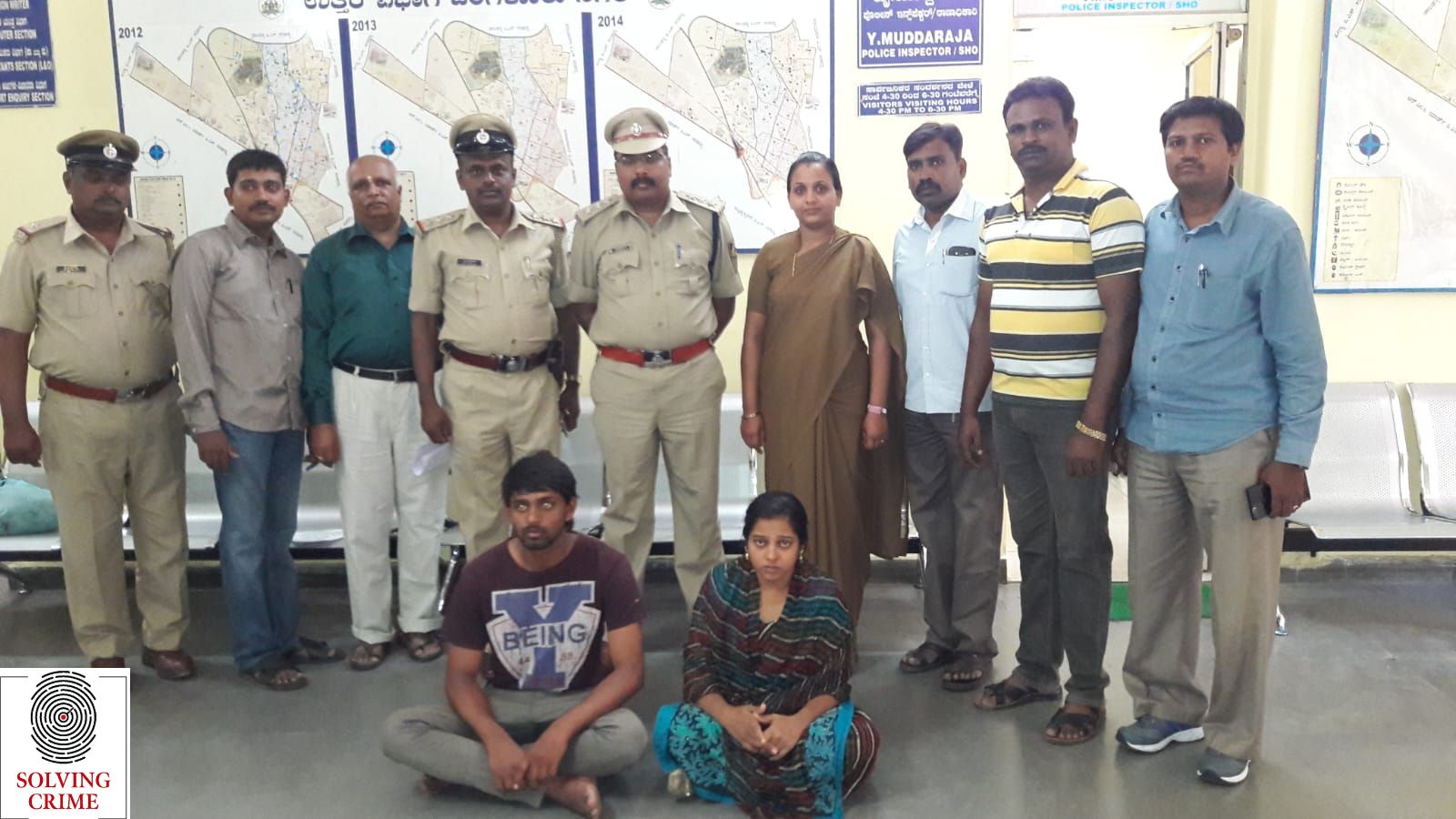
The police took Kalpana into custody, and she confessed to the crime during interrogation. Javed, who had returned to Ballari, was also arrested.
Recounting the interrogation, Mudduraj said Kalpana told them that it was a pre-planned murder.
“Javed bought Alprazolam tablets from a medical shop in Ballari and handed them over to Kalpana. On May 22, 2017, when Satish arrived home, Kalpana served him pumpkin curry mixed with Alprazolam tablet powder for dinner.
“Satish then went to sleep, while Kalpana put the children to sleep in another room. Around 12.30 am, Javed entered the house. The duo stuffed cloth into the mouth of Satish and then strangled him. During this, Satish showed some resistance, and Javed hit him with a stone,” the inspector added.
The police filed the chargesheet before the court in 2017 itself. Mudduraj said his only fear was that the witnesses would turn hostile, and he decided to counter such a situation by depending mainly on scientific and medical evidence.
“In murder cases, especially within the family, there are high chances that witnesses will turn hostile for several factors. One of the major factors is the future of the children. But as a police officer, I cannot ignore it. I was prepared for it,” he added.
“In fact, in this case, it started the moment Kalpana was taken into custody. She started begging the police, stating that there were small kids whom she had to take care of, and complained that her husband was an alcoholic. But our job is to go by the law,” Mudduraj further said.
In the chargesheet, the police had cited 40 witnesses, but dropped four witnesses, and the complainant, Krupa Shankar, died before the trial had even started. Ten material objects were also produced before the court.
“The couple’s daughter, who was sleeping in the next room, Kalpana’s sister, neighbours, and relatives turned hostile,” said Mudduraj.
However, on July 4 this year, the 66th additional city civil and sessions court convicted Kalpana and Javed and gave them a sentence of life imprisonment under Section 302 (murder) of the Indian Penal Code.
Citing Supreme Court judgments, Judge Jayaprakash A said in the order, “It is settled law that evidence of hostile witnesses can be relied upon by the prosecution to the extent to which it supports the prosecution’s version of the incident. The evidence of such witnesses cannot be treated as washed off the records; it remains admissible in trial, and there is no legal bar to base the conviction of the accused upon such testimony, if corroborated by other reliable evidence.”
The judge then added, “The conviction is based on a complete chain of circumstantial evidence rather than direct eye witness testimony. While this does not diminish the legal validity of the conviction.”
The court, however, acquitted Kalpana and Javed under sections 201 (destruction of evidence) and 204 (intentional destruction, hiding, or alteration of documents or electronic records) of the Indian Penal Code.
Kalpana’s elder daughter, who was 12 at the time Satish was murdered, turned hostile during the trial.
Talking about her, the judge noted, “It is natural that she, being a daughter, would not depose against her own mother. Under these peculiar circumstances, though she has turned hostile, considering the facts that there is no one else to look after them, and she has to look after her younger brother, and they have no source of income, this court is of the considered opinion that though she has turned hostile, she, along with her brother, has to be suitably compensated for the death of their father. Therefore, it is just and proper to recommend to the District Legal Services Authority, Bangalore Urban, to award compensation to both the children of the deceased, considering it as a special case.”
Kalpana’s daughter, who is now 22 years old, is pursuing an MBA, and her brother is a school student.
Original Source
This content was distilled for a focused reading experience. All rights belong to The Indian Express.
Read original publication