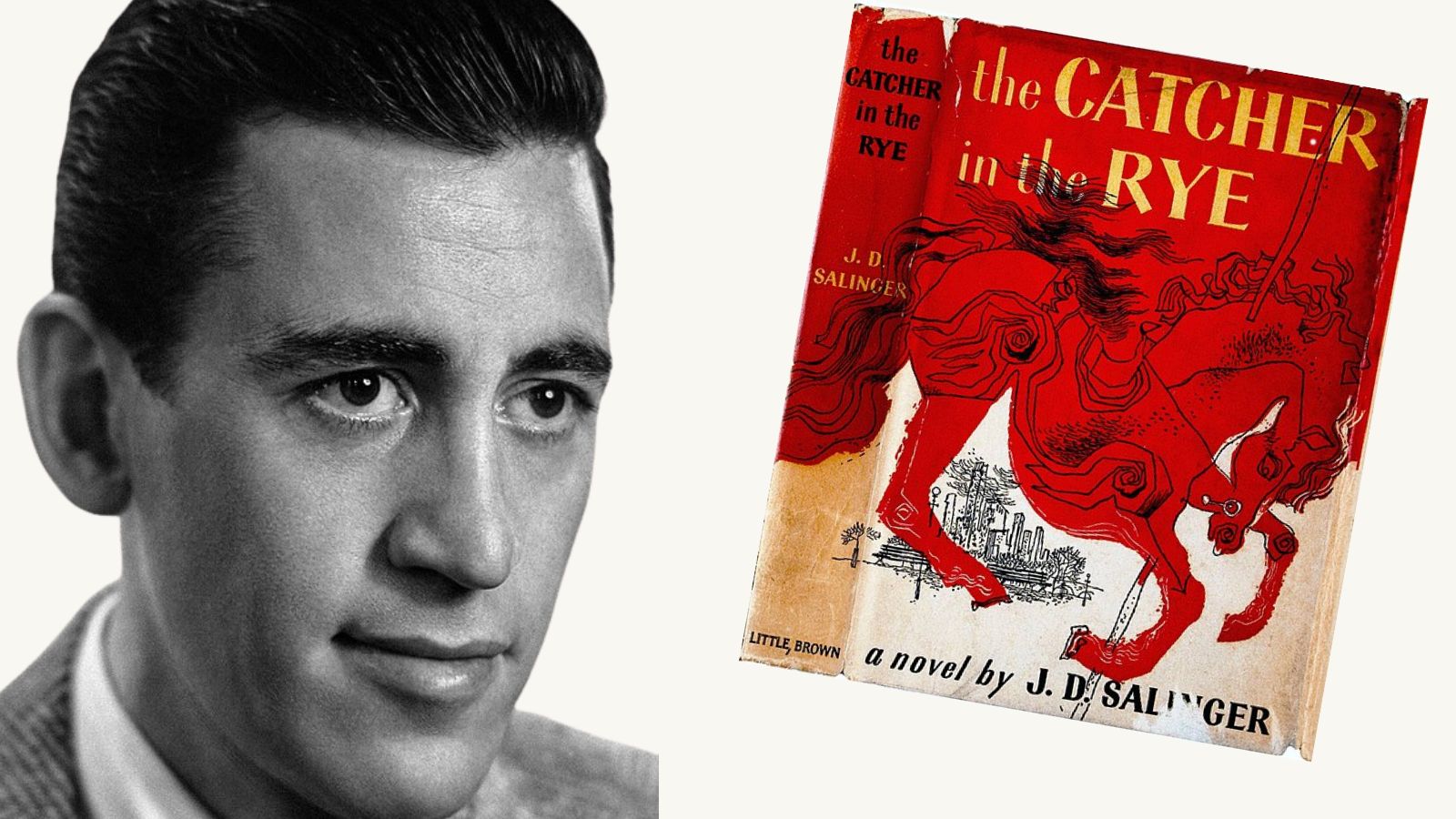
75 Years of Catcher in the Rye: Salinger, the Gita and Buddha
When the novel begins, 16-year-old Caulfield has just been expelled from his fourth prep school. Instead of going home to face the music, he boards a train to New York, spending three days, including two nights, all alone, unsupervised, drifting between hotel bars, cabs and Central Park.
Along the way, he cannot stop noticing how fake everyone around him seems, from his teachers and classmates to nightclub performers. He comes to see adulthood as synonymous with hypocrisy, and fears that growing up means inevitably means embracing the rot. Beneath his fury is an undertow of grief over the death of his younger brother, Allie, from leukemia at the tender age of 11, and the loss of his own childhood along with it.
It is well-known that Salinger, who as a staff sergeant participated in major battles during World War II and suffered battle fatigue (now called post-traumatic stress disorder), attended the Ramakrishna-Vivekananda Center on East 94th Street in Manhattan after his return.
He also corresponded with the center’s founder Swami Nikhilananda. The letters recording their exchange on matters of spirituality were donated to New York’s Morgan Library. One of the letters also describes his practice of reading a passage from the Bhagavad Gita every morning before his feet touched the floor.
“From 1952 until the end of Salinger’s publishing career, Vedantic thought became entrenched in his work,” writes his biographer Kenneth Slawenski in J D Salinger: A Life. “The challenge that lay before him in 1952 was how best to introduce such an Eastern philosophy to American sensibilities without preaching and without appearing so odd as to turn readers away.”
Apart from The Catcher in the Rye, the notoriously reclusive author only ever published three other books, including Nine Stories (1953), Franny and Zooey (1961), and Raise High the Roof Beam, Carpenters and Seymour: An Introduction (1963), which offer an insight into his spiritual leanings.
In Franny and Zooey, the former becomes absorbed in repeating the Jesus Prayer, a practice comparable in some respects to japa, the repetition of a sacred name or mantra in Hindu traditions, while the latter , invokes the Bhagavad Gita’s teaching of doing one’s duty without care for the reward. In Nine Stories (1953), the precocious 10-year-old Teddy McArdle espouses his belief in reincarnation.
Salinger was already interested in Eastern spirituality when he was writing his debut novel as he describes Caulfield’s 10-year-old sister Phoebe sitting cross-legged “outside the covers, with her legs folded like one of those Yogi guys.”
In Salinger’s world of slang-speaking prep school students and cocktail lounges, it is easy to miss the subtle strands of Eastern philosophy, which overtly manifests in his later works. In his 1976 dissertation on ‘The influence of Hindu-Buddhist psychology and philosophy on J D Salinger’s fiction’ Humayun Ali Mirza of Binghamton University, writes, “Although there are virtually no overt Eastern ‘borrowings in the gather, certain nuances of Zen and Vedanta are obvious to the discerning reader: Caulfield’s dichotomy of the real and the phony is an echo of the ‘Vedantic Brahman and Maya, the real and the unreal, concepts which pervade Salinger’s Glass saga.”
Much like the sheltered prince Siddhartha Gautama, sickness and death jolt Caulfield from a comfortable privileged life, and lead him to his wanderings in a quest to understand the world. In ‘A Retrospective Look at the Catcher in the Rye’ (American Quarterly, 1977), the American scholar Gerald Rosen draws an intriguing parallel. “In Buddhism one is asked to give up one’s illusions. Catcher was given final shape in the post-war period, and it is basically a novel of disillusionment,” he writes.
Caulfield clings to reminders of the past, be it Allie’s baseball glove or the broken record he carries around long after it has stopped playing. He also loves the Museum of Natural History because, as he says, “The best thing, though, in that museum was that everything always stayed right where it was.” It is a boy’s plea to freeze time itself so that nothing else he loves has to change or die, but change is inevitable.
The same philosophies are reflected in Caulfield’s habit of dividing the world into the “real” and the “phony.” In Vedanta, Brahman represents the unchanging reality, while Maya is the veil of appearances that obscures it. Caulfield’s restless quest for something genuine amid a world he thinks is false and corrupt offers some resemblance.
The title of the novel comes from Caulfield imagining himself standing at the edge of a cliff in a field of rye, catching children before they fall. “Holden dreams of an Edenic world, outside of time, beyond aggression: a world prior to the anxiety caused by the Fall,” writes Rosen. Others compare the image to the bodhisattva who postpones personal liberation in order to help others escape suffering.
These readings notwithstanding, The Catcher in the Rye, first and foremost, remains an American classic about adolescence and alienation. Knowing where Salinger’s own spiritual journey eventually took him allows those familiar with Hindu and Buddhist teachings to re-interpret his iconic novel with fresh eyes.
Original Source
This content was distilled for a focused reading experience. All rights belong to The Indian Express.
Read original publication