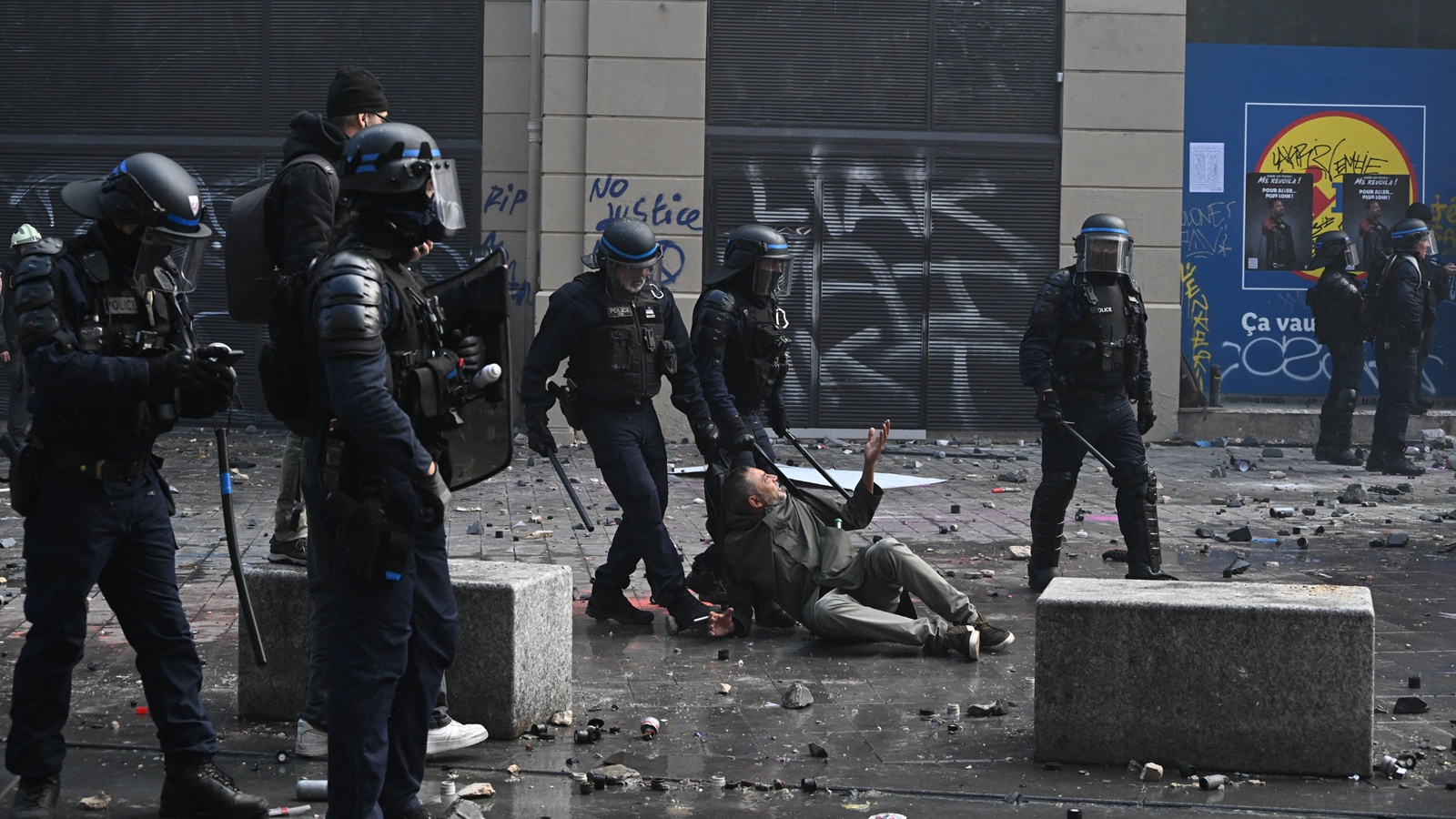
France, Italy, Spain: Protests across Europe have a shared crisis, different contexts
Listen 00:00 0.5x 0.75x 1x 1.25x 1.5x 2x AI Narration This audio is AI generated.
Although dramatic images of violent protests in France have dominated the headlines, protests are also sweeping across major European cities in Spain, Italy, Portugal, Belgium and even Albania. Most of these protests began with specific demands from younger generations, such as dissatisfaction with school conditions in France. They soon drew in other sections of society, particularly trade unions and those affected by related issues, including the cost-of-living crisis. Protests in one country are also inspiring similar movements elsewhere.
With major elections approaching in France, Italy and Spain, domestic political dynamics have further complicated the situation, as political parties seek to capitalise on public discontent to advance their electoral agendas.
Broadly, protests are attributed to sluggish economic growth, declining competitiveness and the perceived failure of multiculturalism across Europe. As members of the eurozone, these countries must also operate within the EU’s fiscal framework, which sets limits on budget deficits and public debt. This constrains their fiscal space, limiting the scope for increased public spending on essential services, including education. Younger generations feel less secure about their future than earlier generations who benefited from more generous welfare systems.
For years, right-wing parties have channelled public anger towards outsiders and gained electorally, while the radical left is also gaining ground in some countries as centrist parties are seen as failing to deliver. The problem, therefore, cannot be attributed simply to misguided policies of either the left or the right.
These countries are governed by coalitions spanning very different ideological positions: from France’s liberal-centrist government and Italy’s right-wing parties to Spain’s left-wing coalition, a mixed coalition in Portugal and Belgium’s centre-right government.
In countries such as Italy, Spain and Portugal, the housing crisis, particularly for younger generations, has been a major concern for years. The influx of millions of tourists has fuelled anti-tourism protests in several cities in the past, as short-term rentals through platforms such as Airbnb have reduced the availability of affordable housing in city centres. The surge in energy prices following the war in Ukraine has further intensified the cost-of-living crisis. Together, rising living costs and the housing emergency have become serious concerns for young people and low-paid workers across southern Europe.
Spain’s left-wing government sought to cap rents, restrict evictions of vulnerable groups and curb investment by corporate funds through new legislation. However, right-wing and regional opposition parties blocked the minority government’s emergency housing decrees in Congress. Amid the political impasse, Prime Minister Pedro Sánchez called a snap national election, placing housing affordability and the right to housing, particularly for younger generations, at the centre of the country’s political battle.
Protests in Albania, one of Europe’s lower-income countries, reflect a different set of grievances. For months, demonstrators have taken to the streets as part of the so-called “Flamingo Revolution”, driven by anger over alleged government corruption, economic hardship and a controversial luxury tourism project on the southern coast linked to Jared Kushner, Donald Trump’s son-in-law.
Overall, Europe’s protests reflect a shared crisis, but not a single cause. Understanding them requires looking beyond continent-wide structural weaknesses to the distinct political and economic realities shaping discontent in each country.
The writer is professor and Jean Monnet Chair at the Centre for European Studies, Jawaharlal Nehru University
Original Source
This content was distilled for a focused reading experience. All rights belong to The Indian Express.
Read original publication