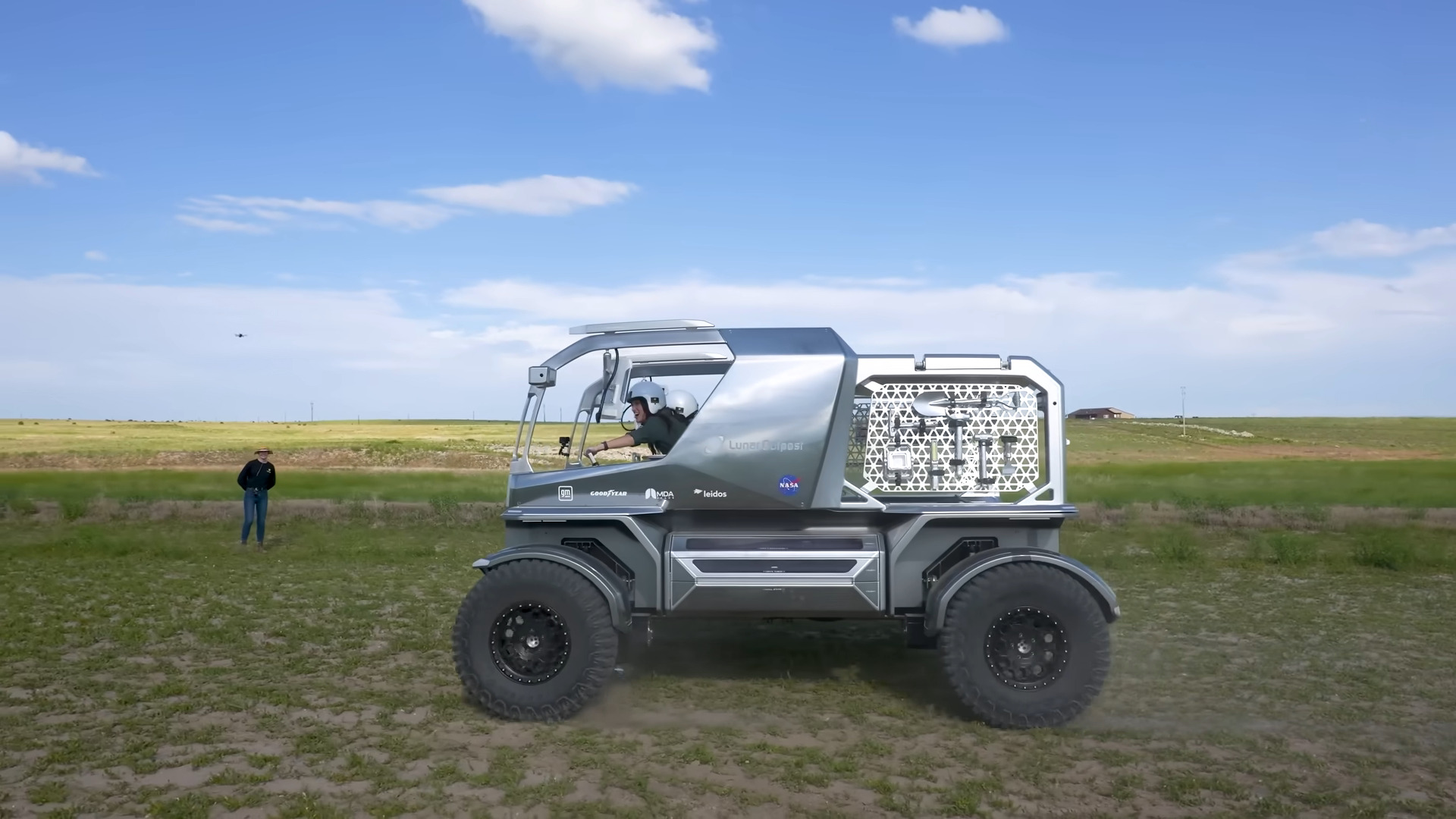
Driving On The Moon At A Blistering 11.6 MPH
As NASA continues humanity’s slow march back to the Moon, different pieces of the puzzle of establishing a more permanent base there are falling into place. One of these pieces is the the Lunar Terrain Vehicle (LTR), and [Cleo Abram] and [Michelle Khare] got a look at the LTR candidate from Lunar Outpost.
Designed to help astronauts traverse the lunar surface as well as function as a semi-autonomous rover when uncrewed, the LTR will be an integral part to any future Moon base. NASA announced earlier this year that it would be moving forward with the LTR featured in this video and another from competitor Astrolab. Regardless of manufacturer, the LTR will have to deal with some wild conditions in the lunar environment.
Lunar dust is abrasive, so the LTR generates an electric current to pull the dust under the truck to prevent it from entering the cab of the vehicle as it moves along. Given the extreme temperature swings on the moon (-200˚C to 200˚C), the space truck will also be fitted with wire mesh tires as nobody wants to be changing a flat in space. The two seats in the cab are oversized and can help lift the astronauts up as space suits hamper their agility to a significant degree. There are compartments for storing samples, and the truck has a robot arm that can grab samples to bring back if no one is along for the ride.
We’ve still got a few years before crews arrive on the moon, but when they do, there’s a good chance they’ll be using the LTR to explore the lunar south pole in hopes of water.
“Lunar dust is abrasive” is a bit of an understatement. From what I’ve gathered, the dust particles are electrostatically charged in a vacuum, and they float around because the static charge is big enough to repel them from the surface in the low moon gravity. And on top of that, there is no erosion which rounds off dust particles. There are no river bed pebbles. It’s all pointy sharp stuff.
A long time ago I was wondering about a “background” / horizon haze on photographs from the ancient lunar missions. How can there be such a haze when there is no atmosphere? So I read a bit around and found info on that floating dust. There are some studies of attempts to repel that dust by also electrostatically charging objects sent to the moon.
This makes me think about a van de graaf generator sitting there running and producing regolith blocks like an ice cube maker with the addition of a bit of adhesive. Brick making machines sitting there running off solar and dust and when you need a building you go grab the right number of bricks, and meanwhile the local environment has somewhat reduced floating dust concentrations.
There have been studies on melting it using a microwave emitter to form a sort of lunar concrete. It means you don’t need to bring any expensive adhesive to the moon, because there’s nothing to make it from there. Just a power source, like a plutonium-fueled RTG.
Or solar, or you can even make aluminum/iron/magnesium and oxygen fuel from the regolith itself. Although that’s more an energy transport medium, it doesn’t generate any energy since you have to break the oxides off before re-combining them via combustion. Good for cheap solid rocket boosters, though.
“As NASA continues humanity’s slow march back to the Moon”: reconsideration? It is not slow, it is futuristically superb.
My apologies; as I am not a native english speaker, I did not grasp the meaning of the phrase (the return). The rest is ironic
It’s slow compared to the first push back in the sixties. It’s okay, I’m just glad NASA is trying bigger things again. I’m not complaining, although I do have my doubts about the mission strategy.
11.6 MPH is 18.67 km/h, our technical audience prefers normal units
No, no… let’s keep the MPH, it easy to remember as the average height of a group of a 1000 Muppets is 1.61 meter, so 11.6 Muppets Per Hour comes down to 18,67km/h. Now I might be slightly wrong about the true average height of the modern Muppet but who cares, I always found working with Muppets way more fun than kilometers.
Correct. NASA should be taking the hint from pretty much every space movie ever made. Imperial (or US customary) units are a recipe for disaster, especially if they ever expect to work with the rest of planet Earth.
Internally NASA supposedly does work in metric, even the original Apollo Guidance Computer did, it just converted things to feet/second etc on the DSKY.
Puting km/h and altitude on the video stream is hardly “works with”. And it is a PITA to us old folks who used poundals and slugs in college when “metric” was CGS – centimeter gram seconds. Though lately it looks like Europe is heading towards the 7th century cubit – mustard seed – day system.
“Driving On The Moon At A Blistering 115023 Sb/h” “Driving On The Moon At A Blistering 99686 Mb/h” “Driving On The Moon At A Blistering 87958 Lb/h”
info: 11.8 miles is equal to approximately 99,686 standard medium bananas laid end-to-end. This calculation is based on a standard medium banana length of 7.5 inches. Depending on the exact size of the banana, the total changes slightly: – Small bananas (165 mm or 6.5 inches) – Medium bananas (200 mm or 7.5 inches) – Large bananas (230 mm or 8.5 inches)
Once you get to the moon you can use your own speedometer in Arshins or whatever you prefer. Or maybe they could go with yards/second since that’s pretty much identical to meters/second… Close enough.
The new Tesla Roadster top speed will be MACH 0.5. So much for MPH and km/h.
Mach is a dimensionless number, it is a formula you need to do based on a variety of factors like the air density. Although that last one should be easy to solve for the moon :)
I give it 4 feet before it brakes. NASA cant build anything that works. Yet our tax dollars keep getting poured into this insane company that give no return for the tax payers.
Before it brakes? I mean it should be up to the operator to apply the brakes whenever he chooses
It’s not built by NASA. It’s SpaceX’s candidate to be used on the NASA mission. Sure, same difference.
Seems to me that having the wire-mesh tires is not aiding in avoiding the dust. But what can you do eh. Also it struck me that the tire she showed was a bit bouncy even on Earth, and that does not bode well for low gravity, looks like the thing will be jumping like Tom’s x-roadster.
I only scrolled quickly through the video to see the tire though, without sound, so perhaps it’s all explained.
I actually made a 3d model of this particular rover a while back for a project. Pretty nice looking for a moon go-cart.
Please be kind and respectful to help make the comments section excellent. (Comment Policy)
This site uses Akismet to reduce spam. Learn how your comment data is processed.
Original Source
This content was distilled for a focused reading experience. All rights belong to Hackaday.
Read original publication