Even Chemical Bonds Obey Einstein’s Relativity
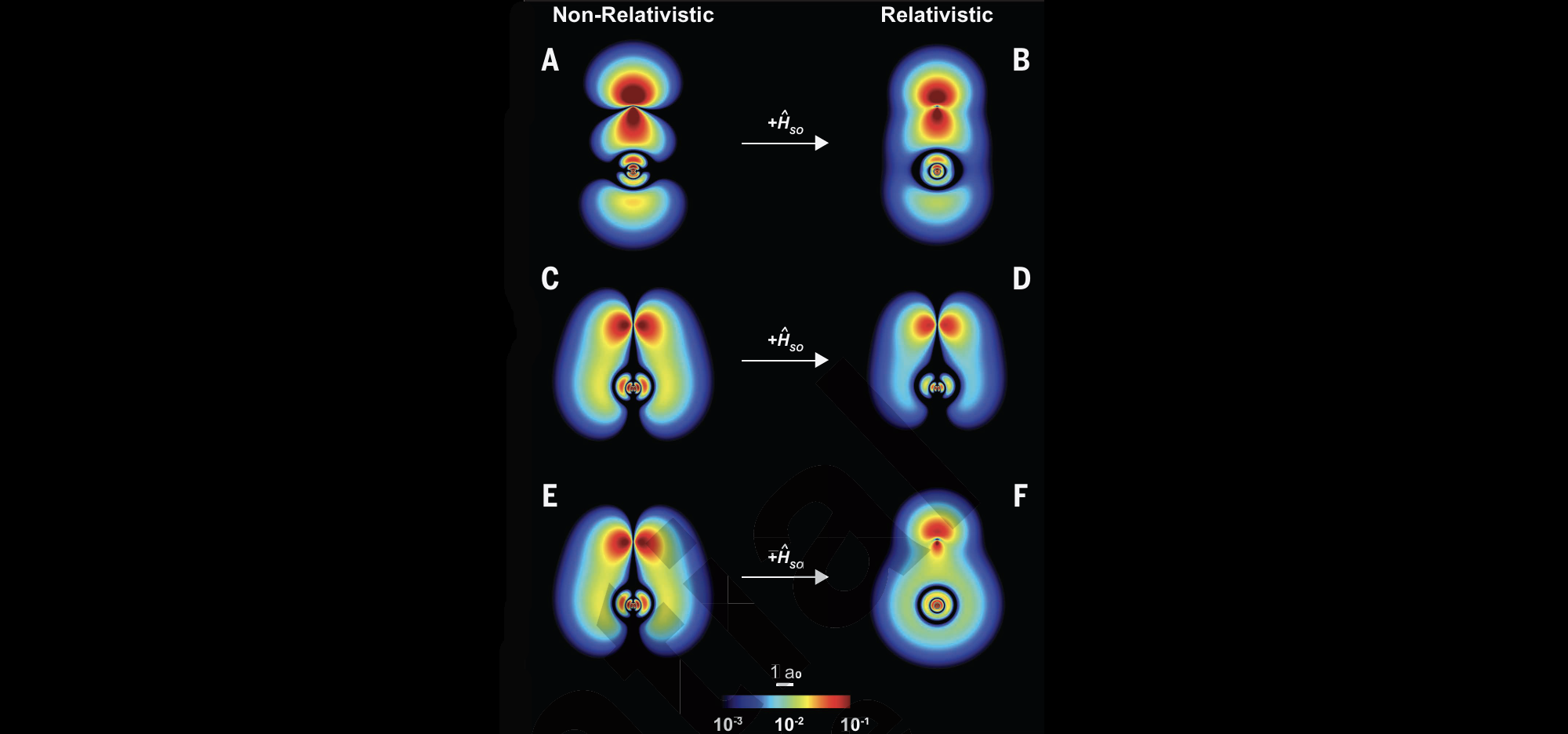
Although Einstein’s Theory of Relativity is typically associated with really large and really heavy things like planets in solar systems and big things in universes in general, it turns out that even at an atomic scale its effects can be measured. These are the findings of Brown University scientists, whose measurements on very heavy elements indicate the presence of relativistic bonds.
The essential summary is that our concept of how triple bonds work may be flawed, with the assumption that there are distinct sigma and pi bonds, the latter being the awkward, weaker ‘side bonds’ where the overlapping atomic orbitals do not directly line up as with a sigma bond. As it turns out, if there’s enough mass involved, relativistic effects smudge both types of bonds together into a hybrid type of bond.
Although the sigma-pi triple bond theory still seems to hold up for lighter atomic nuclei, in the case of the examined bismuth-carbon triple bond, the typical, slightly radioactive bismuth-209 nucleus with atomic number 83 is heavy enough to affect the orbital mechanics and with it the chemical bonds that these produce.
This is an important finding, as it affects our basic understanding of how strong the bonds between certain elements are. Pi bonds are after all significantly weaker than sigma bonds, so a hybrid form would effectively make triple bonds involving a heavier element stronger than one between lighter elements.
Stars, Planets, Plants, and atomic bonds. All of them….. This is not, by any stretch, news. It was not news four/five decades ago when I was in uni.
This is the first good direct OBSERVATION of the effect, as it is dashedly difficult to observe, as the observation has an effect upon the observed.
I’d be more worried about the plants in the interstellar medium than the ones found in solar systems.
there’s some refinement but fwiw everyone who sits through a college-level Electricity & Magnetism for Phyics majors course knows you have to take relativity into account to properly compute the electron orbitals
Huh, I’m a little confused by this and would like to hunt down the original. A lot of organic chemistry theory relies on carbon’s sigma and pi bonds hybridizing into four identical electron distributions, resulting in the tetrahedral nature of carbon in molecules. Also, am I wrong in remembering that the gold-tinted reflective color of gold and copper is because of relativistic effects in the highest occupied electron orbitals and their interactions with incident photons?
This is just for the heavier elements: for lighter stuff you’ll still have the classical view.
I wonder about the effects on chemical reactions compared with observers at relativistic speeds. Perhaps different compounds are observed in different directions. It would be interesting to see how this effects stimulations of the early universe.
i imagine it’s like modelling airplane crashes. if the relative velocities are large enough then an airplane acts more like sand than like a rigid structure. you switch to modeling indiivdual particles (in this case, subatomic particles) and the bonds between them become meaningless compared to the impact velocity.
One will have to read the paper to see what is new or what got more evidence. I remember at the time as I did some calculations with the likes of gaussian and orca, that for some theory levels and heavier elements there were sets with relativistic effect on them. That was like 15 years ago.
Is this the same reason the heavier noble elements are a little more slutty than the other ones?
I like the baboons in the diagram to the left more even though the right side is more soft. They have a more real appearance, but maybe I’m just a dumb primate.
No, a mandrill is a metal rod used to hold another metal piece for machining. ;-)
But Dirac’s work dealt with electrons moving at relativistic speeds. Shouldn’t that cover this?
Please be kind and respectful to help make the comments section excellent. (Comment Policy)
This site uses Akismet to reduce spam. Learn how your comment data is processed.
Original Source
This content was distilled for a focused reading experience. All rights belong to Hackaday.
Read original publication