Attack Of The Atomic Oxygen
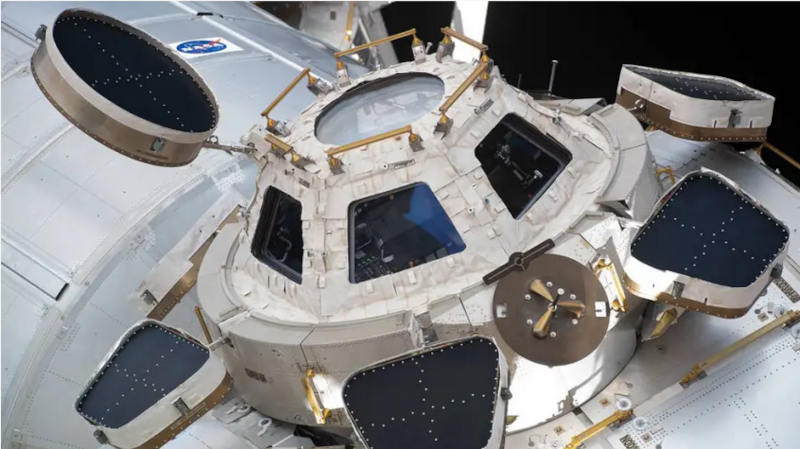
While designing anything for operation in space has its challenges, there is at least one thing that is more of a problem for objects in Earth orbit than for deep-space probes: atomic oxygen. We like oxygen because we need it to live, but it is also highly reactive as a single atom. Luckily, on Earth, most of what we breathe is O2. [Space Daily] talks about the challenges of the International Space Station dealing with the “space weather” of atomic oxygen in low Earth orbit.
Part of the problem is that even when we know better, we tend to think of the atmosphere coming to an abrupt end and space being a hard vacuum. But in reality, the atmosphere gradually dissipates, and at “only” 400 km above the Earth, the Space Station is really flying through a very thin atmosphere.
To compound the problem, this is above the ozone layer, so the Sun’s UV light rips O2 into single oxygen atoms. Over time, these free oxygen atoms can affect many parts of a spacecraft exposed to them. Engineers first noticed that materials recovered from spacecraft had more damage and changes to material properties on the pieces facing the direction of travel. NASA has spent years testing different materials by mounting trays of different material samples outside the ISS.
Carbon-based polymers take a big hit from atomic oxygen exposure. Polymide film is frequently used, but it erodes with exposure. Carbon composites also lose mass. Other materials change in other ways. For example, an optical surface may roughen with exposure.
The usual answer is to over-design for mission objectives or to cover certain polymers with coatings like silicon dioxide or aluminum oxide, which are not as reactive to free oxygen. For a long-duration mission like the ISS, you may have to pay special attention to the materials in use. Very low satellites also need special care, as there is more oxygen in lower orbits.
There are other effects, too, such as extreme thermal cycles, debris strikes, and other indignities that space-traveling materials must withstand. But in deep space, atomic oxygen is a rare issue. Until, at least, we go somewhere else that has a lot of oxygen.
Atomic oxygen is charged, so an opposed electrostatic charge on a spacecraft will reduce interactions. Not completely, but significantly.
Electrostatic charge management on spacecraft has been a thing since Gemini.
I’m not really sure what you’re talking about – atomic oxygen in a LEO environment is almost entirely unionized (so neutral) and in its ground (triplet, two unpaired electrons) state.
When they generate oxygen beams for testing material corrosion in space they specifically have to neutralize the oxygen beam, usually by scattering a beam off a low work-function material or by just deflecting away the charged components.
If the oxygen was predominantly ionized and the surface was insulating, you’d quickly build up an equal charge and just naturally repel the ions. In earlier beam tests they used to just flood the environment with free electrons to neutralize the surface rather than specifically trying to de-ionize it.
Parts of mammalian immune systems generate and deploy weird reactive oxygen allotropes like atomic and singlet (spin paired O2) for absolutely demolishing pathogens, but these also leak and are probably responsible for a significant part of aging. Singlet oxygen is also a concern in near earth environments as it also damages organic and carbon-inorganic structures and is readily produced by UV.
Which is kind of what makes it so reactive. It really wants to fill that 2p shell.
First Manley says ‘most of the atmosphere is O2’ and now Williams says “most of what we breathe is O2”. So what gives? Are people following some kind of mandatory ‘de-learning’ course at the moment or what?
According to Wikipedia: * sea level: mostly O^2^ * Ozone layer: O^3^ * Orbit: O^(1)^
edit: well ok, this markdown processor here doesn’t understand superscript syntax. * sea level: mostly O2 * Ozone layer: O3 * Orbit: O(1)
And of course, the amount of atmosphere at the ozone layer and above is vanishingly small compared with the amount below it, so a lot of general treatments of “the atmosphere” will generalize oxygen as in its overwhelmingly 02 form.
I am not saying the atmosphere, I mean the oxygen you breathe. The atmosphere is of course mostly nitrogen. Good thing too.
I guess we have a difference of opinion on what breathe means. But I acknowledge it’s a bit of an confusing term in a way because you can mean ‘breathe and use’.
The dictionary defines it such: 1 take air into the lungs and then expel it as a regular physiological process. >(of a plant or invertebrate animal) respire or exchange gases.
(Where I add that respire means ‘breathe out’ so that would even have less oxygen in it! )
Anyway, I’m sure most HaD readers know that air is not mainly oxygen that we breathe.
No, it’s grammar. The phrase you’re having issues with is “most of what we breathe,” and you think ‘what’ is referring to ‘the air.’ In the context of the sentence, it’s clearly referring to ‘the oxygen’. It’s a very common grammar issue (vague pronoun reference, although in my opinion the context is very clear here): you’re misidentifying what noun the pronoun ‘what’ is referring to.
It’s the same thing as saying “I took that class. Most of what I learned was crap.” That doesn’t imply that most of what you learned your entire life was crap, it’s just referring to that class.
In the context it’s pretty clear that this should be understood as “most of the oxygen that we breathe is O2”, not literally “most of the air that we inhale is O2”.
Yeah technically should be “most of the oxygen we breathe is O2” but I think the context makes it obvious.
Please be kind and respectful to help make the comments section excellent. (Comment Policy)
This site uses Akismet to reduce spam. Learn how your comment data is processed.
Original Source
This content was distilled for a focused reading experience. All rights belong to Hackaday.
Read original publication