Bad cholesterol slashed 62% by single dose of gene-editing drug in small trial
Researchers running a Phase I safety trial for the drug, dubbed VERVE-102, published interim results from just 35 patients this week in the New England Journal of Medicine. Though the numbers are small and the analysis is preliminary, VERVE-102 appeared safe, with no serious adverse events reported from the treatment, even at the largest doses. The most significant finding was a temporary, mild increase in a liver enzyme that suggested minor injury in the liver, where the drug works.
The small amount of data also hints that the drug is effective. The subgroup of participants who received the largest dose have seen their bad cholesterol—that is, their low-density lipoprotein or LDL—drop 62 percent, to a mean of 78 mg per deciliter. For people with high cholesterol—like the participants in the trial—a reduction of this magnitude could cut the risk of cardiovascular disease from plaque buildup in arteries by an estimated 50 percent if it’s sustained for over 20 years. The trial only has up to 18 months of follow-up data so far, but from that, the positive effects of VERVE-102 seem to be holding up. The LDL reductions have been sustained in all the subgroups.
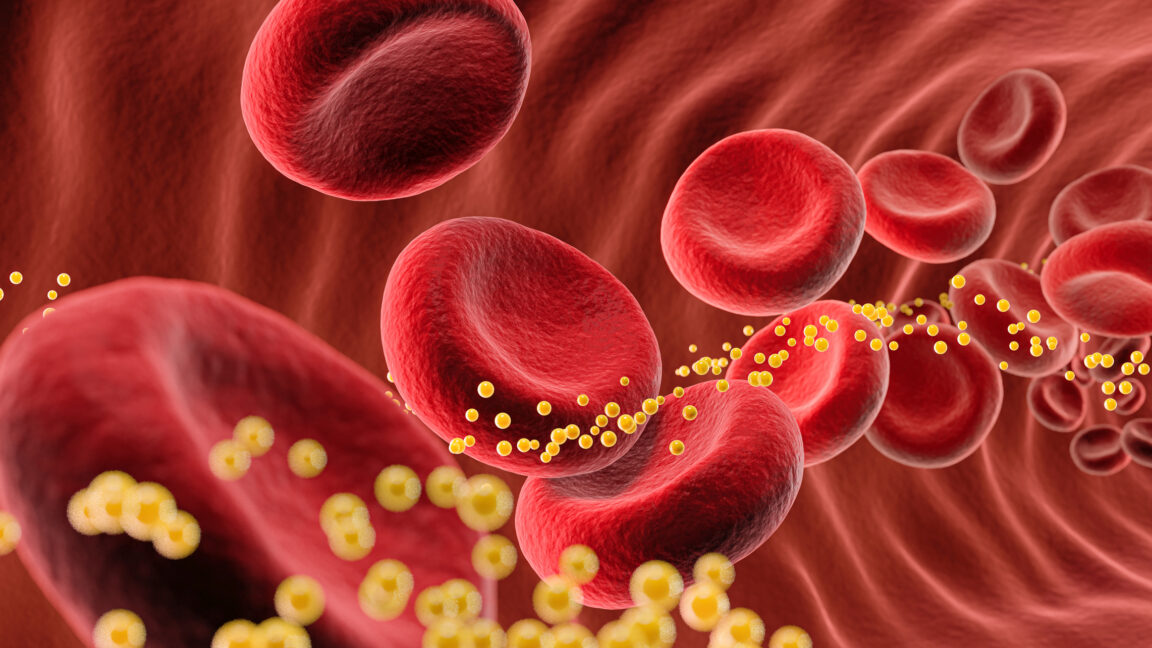
VERVE-102 works by using an mRNA-based gene-editing design. The mRNA is packaged into nanoparticles that carry tags that allow them to be easily taken in by liver cells, which play a central role in cholesterol metabolism. The mRNA provides the cell with instructions to make molecular machinery that can change a single base in DNA, called an adenine base-editor protein. It carries a modified portion of the gene-editing machinery CRISPR-Cas9 that nicks a single strand of DNA. The nanoparticle package also provides a guide RNA that directs the base-editing protein to make a specific base change and nick in a specific gene.
That target gene is one that codes for proprotein convertase subtilisin/kexin type 9 (PCSK9). This enzyme plays a role in regulating LDL levels in the blood. Specifically, it promotes the destruction of LDL receptors on liver cells that would otherwise help clear LDL from circulation. Thus, people who have overactive versions of PCSK9 have fewer LDL receptors and higher LDL levels in their blood. Those who have defective versions of PCSK9 have lower LDL levels. This has been known for years, making PCSK9 a well-established target. Multiple drugs already in use for treating high cholesterol work by hobbling PCSK9.
With VERVE-102, though, the goal is to permanently break the gene that encodes PCSK9. Specifically, the guide RNA directs the adenine base-editing protein to change a single base in the PCSK9 gene such that it causes cellular machinery to prematurely read a stop signal, and the enzyme is not produced.
In the trial, the first 35 patients were given different doses so researchers could gradually test safety. The first four participants started with the lowest dose of 0.3 mg per kilogram of body weight. When that went well, a second subgroup of six got 0.45 mg/kg. Then others got 0.6 mg/kg, 0.7 mg/kg, 0.8 mg/kg, and the final high dose of 1 mg/kg, which was given to seven participants. The first subgroup that got the lowest dose was followed for 18 months, while the subgroup that got the highest dose was followed for just three months so far.
The researchers noted a dose response in both the amount of PCSK9 the treatment knocked out and the size of the LDL reduction; the larger the dose, the less PCSK9, and the lower the LDL. For the lowest dose, mean PCSK9 levels dropped 51 percent, while mean LDL dropped 9 percent. For the highest dose, mean PCSK9 levels dropped 88 percent with mean LDL dropping 62 percent.
The participants were all people who had either developed cardiovascular disease early in life (at or below age 55 for men or 65 for women) or were people who had an inherited condition that caused high cholesterol.
The drug was developed by Verve Therapeutics, which was bought by Eli Lilly last year for $1.3 billion. While Verve has been testing the drug on people at some of the highest risks from high cholesterol, its co-founder and now Lilly Senior Vice President Sekar Kathiresan hopes to see its use expand, providing an option for patients with high cholesterol that doesn’t require lifetime management with medications, like statins.
Riyaz Patel, the co-author on the trial and a cardiologist at Barts Health NHS Trust and professor of cardiology at University College London, agreed. In a statement released by Lilly, Patel said the early data was “encouraging,” indicating that VERVE-102 could “offer a novel approach to achieving substantial and durable LDL-C reduction with a one-time treatment.”
“Many patients with elevated LDL-C struggle to achieve sustained control despite ongoing efforts with the medicines available today, putting them at significant risk for cardiovascular events. With coronary artery disease still one of the leading causes of death worldwide, the need for new approaches is real,” Patel said.
While the researchers and Lilly are optimistic, this is, again, a very small, very preliminary look at the drug in clinical action. It will require further trials, with more people and longer follow-ups, to convincingly demonstrate safety and efficacy. But, if all goes well, Lilly notes that the Food and Drug Administration has already granted VERVE-102 a Fast Track designation for review.
95 Comments Comments Forum view Loading comments... Prev story Next story Most Read 1. The most spectacular rocket explosion since N1 just happened in Florida 2. Fed up with vibe coders, dev sneaks data-nuking prompt injection into their code 3. Here's why the failure of Blue Origin's New Glenn rocket is so catastrophic 4. Rocket Report: A dark day for Blue Origin; Pentagon eyes new launch site 5. Websites have a new way to spy on visitors: Analyzing their SSD activity Customize Ars Technica has been separating the signal from the noise for over 25 years. With our unique combination of technical savvy and wide-ranging interest in the technological arts and sciences, Ars is the trusted source in a sea of information. After all, you don’t need to know everything, only what’s important.
Original Source
This content was distilled for a focused reading experience. All rights belong to Ars Technica.
Read original publication