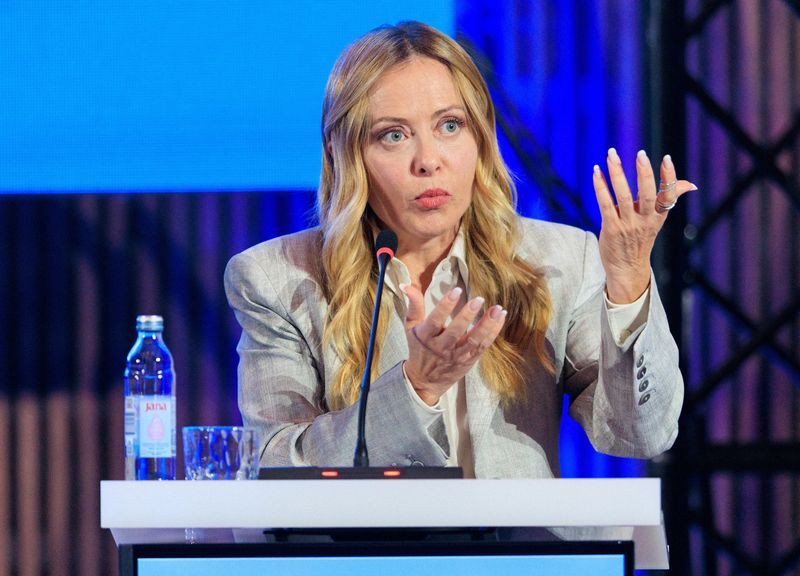
U.S.-Russia deal on diesel is 'very risky choice,' Italy PM Meloni says
Stay signed in to save the points you've earned. Click on the points to redeem your rewards at Nexus before they expire.
ROME, Oct 14 (Reuters) - The deal between the United States and Russia over diesel supply is a "very risky choice" that runs counter to efforts to force Vladimir Putin to sit at a negotiating table with Ukraine, Italian Prime Minister Giorgia Meloni said on Wednesday.
The United States and Russia agreed last week that Moscow would initially supply more than 300,000 metric tons of diesel to U.S. and global markets.
"The outcome of this decision is uncertain, while the risks are clear," Meloni told the Italian parliament ahead of an EU summit this week.
"It provides Moscow with legitimacy as its bombs continue to fall on Ukrainian cities, generates new revenue to finance the war, and implicitly weakens the effectiveness of sanctions," she added.
Ukrainian President Volodymyr Zelenskiy criticised the accord, calling it "an investment in a war that must be ended."
U.S. President Donald Trump said it would lower energy prices in the United States, a major political headache for his Republican Party ahead of pivotal midterm elections that determine control of Congress.
Meloni told parliament the 27 EU countries should appoint "an authoritative figure" to negotiate for Europe over the Russia-Ukraine war, without ruling out a formal mandate for the E3 Group comprising Germany, France and Great Britain.
In other remarks, she said the EU summit would discuss what she said had been an escalation in Russian hybrid attacks, referring to drone incursions, cyber attacks, sabotage and other covert operations aimed at weakening backing for Kyiv.
"We need to protect our critical infrastructure: energy grids, undersea cables, ports, airports, and the underwater domain, where Italy possesses outstanding expertise," she said.
We would love to keep you posted on the latest promotion. Kindly fill the form below
Original Source
This content was distilled for a focused reading experience. All rights belong to The Star.
Read original publication