On this day in space! Aug. 30, 1992: Astronomers discover 1st Kuiper Belt object out beyond Pluto
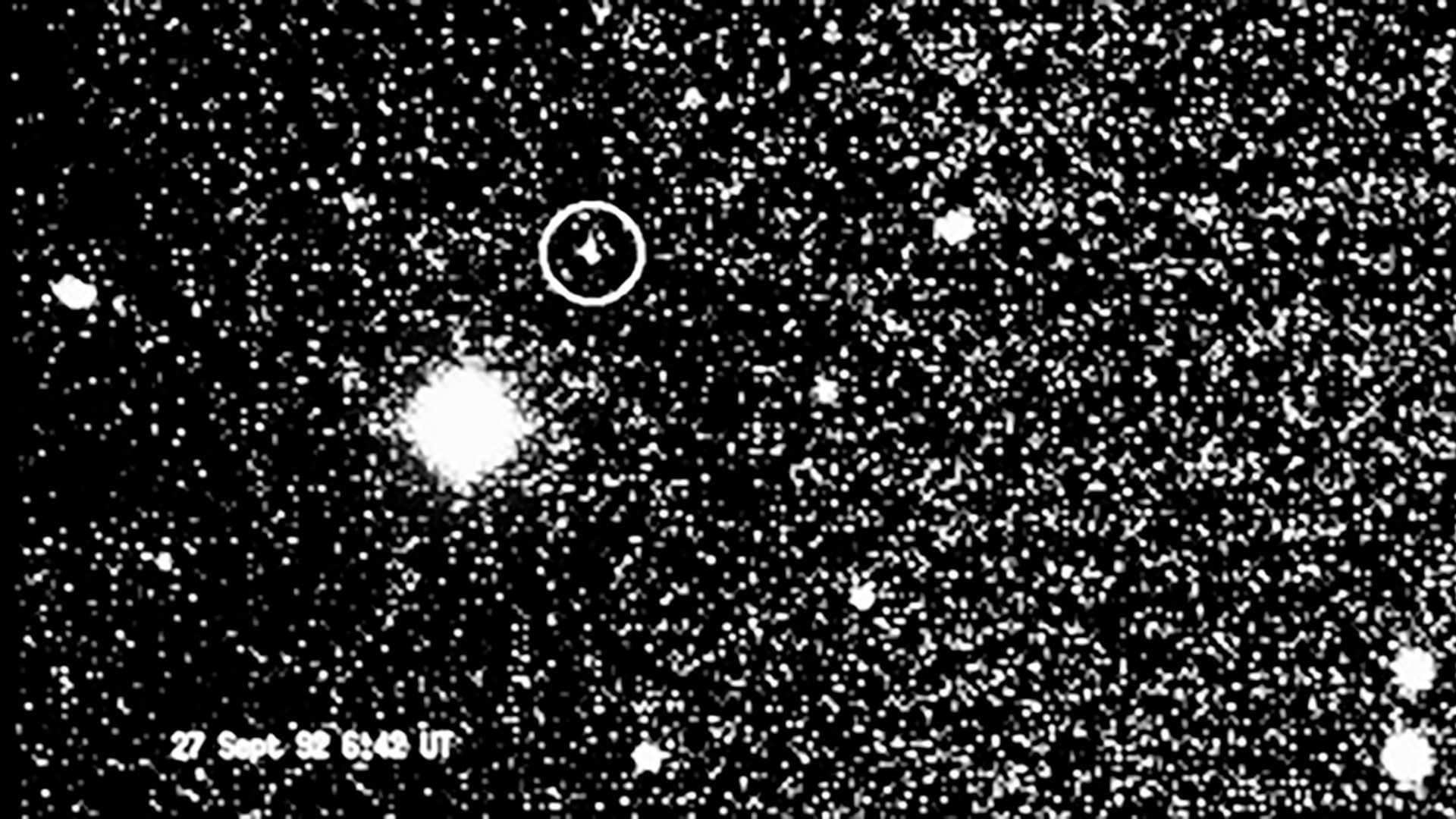
This image shows a European Southern Observatory view of 1992 QB1, the first Kuiper Belt Object, discovered on Aug. 30, 1992.
This graphic shows the scale of the Kuiper Belt and its place in our solar system, which itself is surrounded by a vast Oort cloud of icy comets and other objects.
Welcome to Space+ ! Hi , Your membership journey starts here.
Stargazing tips, cosmic events and expert insights on the universe
Your membership perks Start exploring exclusive deals, expert advice and more
Space news, cosmic updates and expert insights straight to your inbox.
Breaking space news, the latest updates on rocket launches, skywatching events and more!
Space.com's Sci-Fi Reader's Club. Read a sci-fi short story every month and join a virtual community of fellow science fiction fans!
Get full access to premium articles, exclusive features and a growing list of member rewards.
The edge of the solar system got a lot more interesting with the discovery of Kuiper Belt object 1992 QB-1.
When you purchase through links on our site, we may earn an affiliate commission. Here's how it works.
Before then, Pluto was believed to be the most distant planetary body of our solar system. No one had seen anything orbiting farther out because these so-called Trans-Neptunian objects were far too faint to detect with the technology they had at the time.
With new digital imaging techniques, astronomers were able to spot a new and tiny world orbiting 4 billion miles beyond Neptune. Officially designated 1992 QB1, this 100-mile-wide (160 kilometers) object was thousands of times fainter than Pluto. Now astronomers have confirmed more than 2,000 objects orbiting out there in what is now known as the Kuiper Belt.
Our solar system was a much smaller place before the discovery of 1992 QB-1. We had nine planets, from Mercury to Pluto, and that was the end.
But when astronomers found 1992 QB-1, it led to a much larger solar system than anyone could have dreamed.
On this day in space! Aug. 24, 2006: Pluto loses its planet status Astronomers may have discovered the 1st moon outside of our solar system - or is it something weirder? In 1776, the solar system only had 6 planets. Now, it has 8. Does it end there? The Kuiper Belt, named after the Dutch astronomer Gerard Kuiper who first proposed its existence, is a doughnut-shaped region that begins at the orbit of Neptune, about 2.8 billion miles (4.6 billion miles) from the sun. If you use the distance between the Earth and sun, which is 93 million miles (1 astronomical unit or 1 AU), as a guide, the Kuiper Belt begins about 30 AU from the sun and extends out to 1,000 AU. It's one of the largest structures in the solar system.
While 1992 QB-1 was the first confirmed Kuiper Belt object after Kuiper theorized the region's existence, the dwarf planet Pluto - which is also beyond Neptune - was found first in 1930.
Today, Kuiper Belt objects aren't just objects in photos, they are places humanity has explored with spacecraft. In 2015, NASA's New Horizons spacecraft flew by Pluto, a first in history. That probe went on to fly by the Kuiper Belt object Arrokoth on Jan. 1, 2019.
Speaking of finding unseen objects in space, on this day in space (in 2026, it JUST happened), NASA's Roman Space Telescope launched atop a SpaceX Falcon Heavy rocket to observe more of the universe than ever before. Here's why that matters.
Want more space history? Check out our full On This Day In Space Story archive and watch our On This Day In Space videos on YouTube.
On this day in space! Aug. 29, 1965: NASA's Gemini 5 breaks spaceflight duration record On this day in space! Aug. 29, 1965: NASA's Gemini 5 breaks spaceflight duration record after 2 astronauts spent '8 days in a garbage can'
\n We\'re processing your payment. Please don\'t close or refresh this page.\n
Original Source
This content was distilled for a focused reading experience. All rights belong to Space.
Read original publication