This Week in Science: Mosquito Magnets, Bonus Benefits of GLP-1s, And More : ScienceAlert
First up: You're not imagining it – it turns out that some people really do attract more mosquitoes than others. It all has to do with the particular scents and microbes on your skin.
Read on below, and make sure you also check out our TWIS video!
In a new study reported in iScience, we just got a step closer to solving the mystery and figuring out why mosquitoes seem to be strangely more attracted to some people, while ignoring others.
In an experiment led by scientists from Florida International University (FIU), researchers recruited 119 volunteers from Miami and had each of them place their arm in a long tube called an olfactometer.
At the other end of this tube, the researchers introduced three different species of mosquitoes – Aedes aegypti, Aedes albopictus, and Culex quinquefasciatus – to see which mosquitoes were attracted to which people.
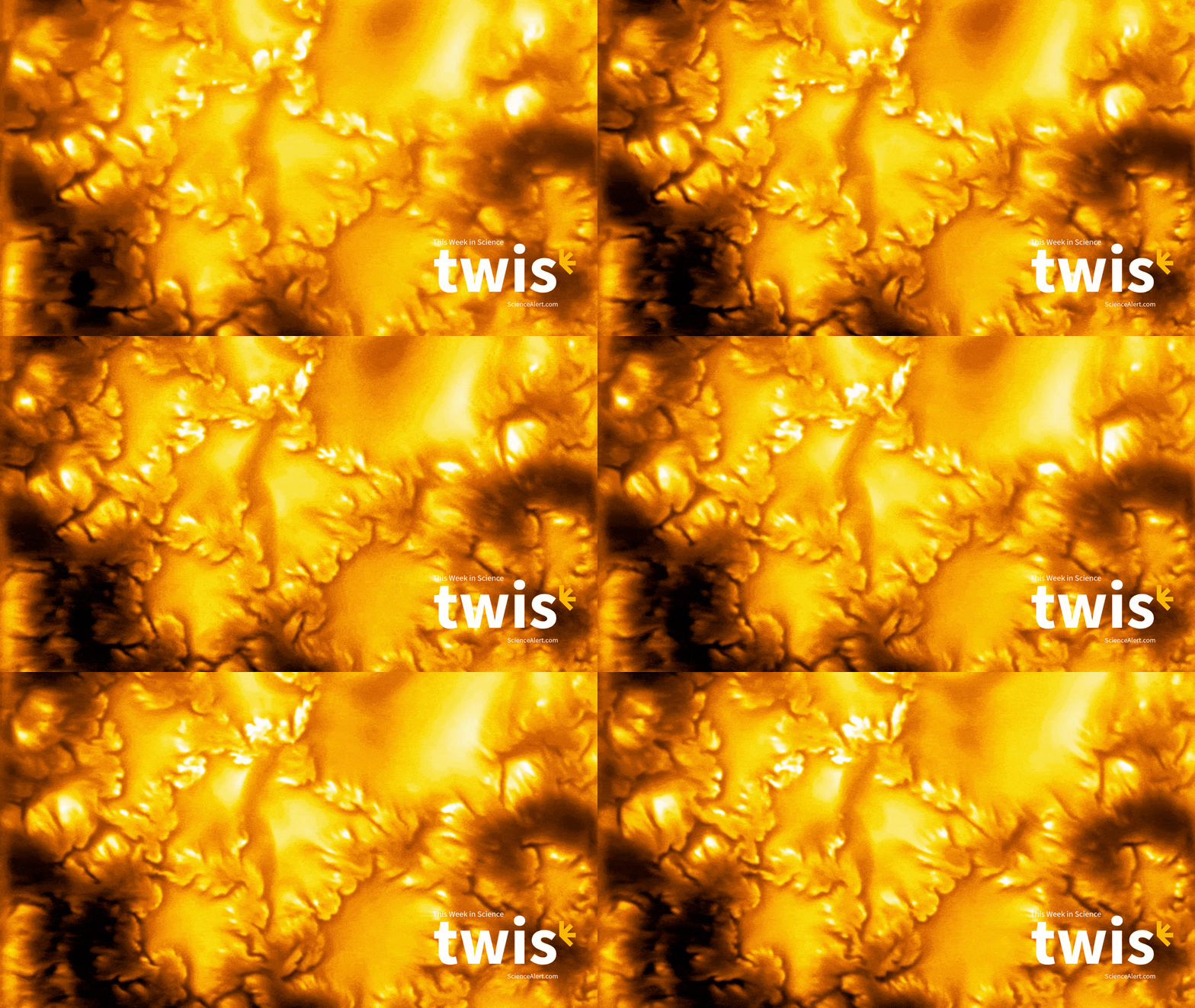
Vast towers of heat surge upwards from deep inside the Sun, spreading outwards, cooling, and falling away at the edges of convection cells about the size of Texas.
The most powerful solar telescope on Earth, the NSF's Daniel K. Inouye Solar Telescope located in Hawaii, has already dramatically changed our understanding of the Sun.
Now, it's taken a massive leap forward. In the highest-resolution images of the Sun ever captured, Inouye has exposed a hidden landscape of eddying whirlpools swirling around the Sun's magnetic boundaries.
For decades, scientists have theorized that kids actually need to get a bit dirty for their immune systems to develop fully.
It's known as the 'hygiene hypothesis'. And, as childhood rates of allergies, asthma, and hay fever rose drastically in industrialized Western nations, scientists noticed the same did not go for children raised on farms.
"Girls and boys who grow up on farms and are exposed to a wider variety of microbes have the problem far less often," says epidemiologist Markus Ege.
Now, Ege and his colleagues have found exactly which bacterial species mediate the farm effect in rural European children. This discovery goes some way towards verifying the hygiene hypothesis once and for all.
It's there that some of the most intimidating predators make their home – black and brown bears that could eviscerate a person with one swipe of a mighty paw, and mountain lions that stalk almost silently on padded feet.
Many hikers will gird themselves against the possibility of an attack from one of these feared beasts – but, as two new papers explain, there's an animal out there that even the most formidable predators will try to avoid.
In fact, attacks by these animals are so uncommon that, in North America, people are far more likely to be struck by lightning.
GLP-1 drugs such as Ozempic have transformed healthcare in recent years, dramatically altering how we treat conditions like type 2 diabetes and obesity.
But while the medications are primarily used to help lower blood sugar and reduce appetite, scientists keep finding GLP-1 effects appear to extend much further, affecting our health in ways we never expected.
Now, a new study has uncovered another unintended effect, and it shows we're still only scratching the surface of fully understanding how GLP-1 receptor agonists impact the body.
In a paper published in Diabetes, Obesity and Metabolism, researchers found that GLP-1 drugs are linked with a lower risk of age‐related macular degeneration (AMD), a common eye disease that is the leading cause of irreversible vision loss in older adults.
If the earliest animals hadn't been such prolific poopers, life might not have diversified into all the weird and wonderful forms we see today.
That's the conclusion reached by a new review study published in Trends in Ecology & Evolution.
The team of scientists in Australia and Germany found that the Cambrian explosion – a period around 540 million years ago when the ancestors of most animal groups arose – could have been partly set in motion by an explosion of feces, left by those that came before.
"Next to rising oxygen levels and other contributing factors, the importance of feces in ancient ecosystems is often overlooked," says Russell Bicknell, an evolutionary biologist at Flinders University in Australia.
Watch the video above for a recap of the top stories from this week!
Original Source
This content was distilled for a focused reading experience. All rights belong to ScienceAlert.
Read original publication