Disparity in non-communicable disease burden attributable to ambient PM2.5 exposure among adult population subgroups in India
Thank you for visiting nature.com. You are using a browser version with limited support for CSS. To obtain the best experience, we recommend you use a more up to date browser (or turn off compatibility mode in Internet Explorer). In the meantime, to ensure continued support, we are displaying the site without styles and JavaScript.
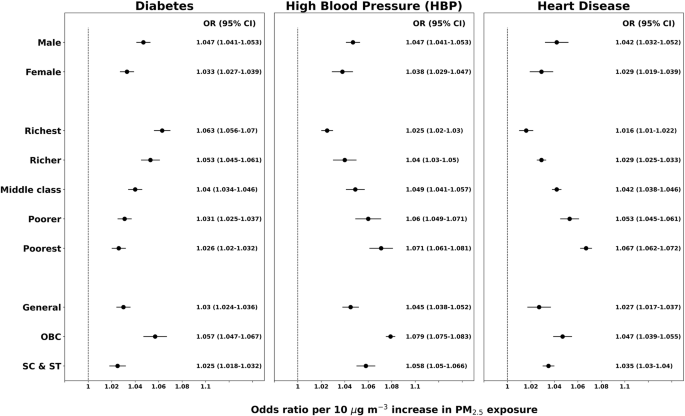
Ambient fine particulate matter (PM2.5) exposure is a leading risk factor for non-communicable diseases (NCDs) globally. Yet gaps remain in understanding the disparities in PM2.5-related NCD burdens across population subgroups, especially in low- and middle-income countries like India.
Our findings underscore the need for equity-focused policies targeting vulnerable subgroups to reduce disparities in environmental health burdens in India.
This is a preview of subscription content, access via your institution
Prices may be subject to local taxes which are calculated during checkout
Cohen AJ, Brauer M, Burnett R, Anderson HR, Frostad J, Estep K, et al. Estimates and 25-year trends of the global burden of disease attributable to ambient air pollution: an analysis of data from the Global Burden of Diseases Study 2015. lancet. 2017;389:1907–18.
Dey S, Purohit B, Balyan P, Dixit K, Bali K, Kumar A, et al. A satellite-based high-resolution (1-km) ambient PM2.5 database for India over two decades (2000–2019): applications for air quality management. Remote Sens. 2020;12:3872.
Murray CJ. Findings from the global burden of disease study 2021. Lancet. 2024;403:2259–62.
Chowdhury S, Pozzer A, Dey S, Klingmueller K, Lelieveld J. Changing risk factors that contribute to premature mortality from ambient air pollution between 2000 and 2015. Environ Res Lett. 2020;15:074010.
Balakrishnan K, Dey S, Gupta T, Dhaliwal RS, Brauer M, Cohen AJ, et al. The impact of air pollution on deaths, disease burden, and life expectancy across the states of India: the Global Burden of Disease Study 2017. Lancet Planet Health. 2019;3:e26–39.
Pandey A, Brauer M, Cropper ML, Balakrishnan K, Mathur P, Dey S, et al. Health and economic impact of air pollution in the states of India: the Global Burden of Disease Study 2019. Lancet Planet Health. 2021;5:e25–38.
Mandal S, Jaganathan S, Kondal D, Schwartz JD, Tandon N, Mohan V, et al. PM2.5 exposure, glycemic markers and incidence of type 2 diabetes in two large Indian cities. BMJ Open Diabetes Res Care. 2023;11:e003333.
Yadav R, Deora S, Yadav G. Air pollution and its impact on cardiovascular health–It’s time to act fast!. Indian Heart J. 2021;73:1–6.
Singh T, Chaudhary E, Roy A, Ghosh S, Dey S. Meeting clean air targets could reduce the burden of hypertension among women of reproductive age in India. Int J Epidemiol. 2025;54:dyaf007.
Sarkar D, Kumar A, Imam F, Ghosh S, Marshall JD, Apte J, et al. Contrasting patterns in ambient PM2.5 exposure disparity across population subgroups in urban and rural India. GeoHealth. 2026;10:e2025GH001387.
Sillmann J, Aunan K, Emberson L, Büker P, Van Oort B, O’Neill C, et al. Combined impacts of climate and air pollution on human health and agricultural productivity. Environ Res Lett. 2021;16:093004.
Wei X, Ho KF, Yu T, Lin C, Chang LY, Chen D, et al. The joint effect of long-term exposure to multiple air pollutants on non-accidental and cause-specific mortality: A longitudinal cohort study. J Hazard Mater. 2024;472:134507.
deSouza PN, Chaudhary E, Dey S, Ko S, Németh J, Guttikunda S, et al. An environmental justice analysis of air pollution in India. Sci Rep. 2023;13:16690.
Thapa R, Van Teijlingen E, Regmi PR, Heaslip V. Caste exclusion and health discrimination in South Asia: A systematic review. Asia Pac J Public Health. 2021;33:828–38.
Kawano A, Kelp M, Qiu M, Singh K, Chaturvedi E, Dahiya S, et al. Improved daily PM2.5 estimates in India reveal inequalities in recent enhancement of air quality. Sci Adv. 2025;11:eadq1071.
Joenssen DW, Bankhofer U Hot deck methods for imputing missing data: the effects of limiting donor usage. In: InInternational workshop on machine learning and data mining in pattern recognition. Berlin, Heidelberg: Springer Berlin Heidelberg; 2012. pp. 63–75.
Garg RK. The alarming rise of lifestyle diseases and their impact on public health: A comprehensive overview and strategies for overcoming the epidemic. J Res Med Sci. 2025;30:1.
Santos AC, Willumsen J, Meheus F, Ilbawi A, Bull FC. The cost of inaction on physical inactivity to public health-care systems: a population-attributable fraction analysis. Lancet Glob Health. 2023;11:e32–9.
Brauer M, Guttikunda SK, Dey S, Tripathi SN, Weagle C, Martin RV. Examination of monitoring approaches for ambient air pollution: A case study for India. Atmos Environ. 2019;216:116940.
Katoch V, Kumar A, Imam F, Sarkar D, Knibbs LD, Liu Y, et al. Addressing biases in ambient PM2.5 exposure and associated health burden estimates by filling satellite AOD retrieval gaps over India. Environ Sci Technol. 2023;57:19190–201.
Gupta P, Kothe S. Interpreting the Caste-based Earning Gaps in the Indian Labour Market: Theil and Oaxaca Decomposition Analysis. arXiv preprint arXiv:2110.06822. 2021.
Pandoh A, Singh A. Examining wage inequality among women in India: A multidimensional analysis of socio-economic disparities. PloS one. 2025;20:e0320940.
Swaminathan S, Hemalatha R, Pandey A, Kassebaum NJ, Laxmaiah A, Longvah T, et al. The burden of child and maternal malnutrition and trends in its indicators in the states of India: the Global Burden of Disease Study 1990–2017. Lancet Child Adolesc Health. 2019;3:855–70.
Wang Y, Ding D, Kang N, Xu Z, Yuan H, Ji X, et al. Effects of combined exposure to PM2.5, O3, and NO2 on health risks of different disease populations in the Beijing-Tianjin-Hebei region. Sci Total Environ. 2025;958:178103.
Cooper MJ, Martin RV, Hammer MS, Levelt PF, Veefkind P, Lamsal LN, et al. Global fine-scale changes in ambient NO2 during COVID-19 lockdowns. Nature. 2022;601:380–7.
DeLang MN, Becker JS, Chang KL, Serre ML, Cooper OR, Schultz MG, et al. Global Surface Ozone Concentration Dataset 1990-2017 Mapped at Fine Resolution through the Bayesian Maximum Entropy Data Fusion of Observations and Model Output. (No Title). 2024.
Mizen A, Thompson DA, Watkins A, Akbari A, Garrett JK, Geary R, et al. The use of Enhanced Vegetation Index for assessing access to different types of green space in epidemiological studies. J exposure Sci Environ Epidemiol. 2024;34:753–60.
Espinosa-Salas S, Gonzalez-Arias M. Behavior modification for lifestyle improvement. StatPearls. 2026.
Al-Jawaldeh A, Abbass MM. Unhealthy dietary habits and obesity: the major risk factors beyond non-communicable diseases in the eastern mediterranean region. Front Nutr. 2022;9:817808.
Fransen HP, Boer JM, Beulens JW, De Wit GA, Bueno-de-Mesquita HB, Hoekstra J, et al. Associations between lifestyle factors and an unhealthy diet. Eur J Public Health. 2017;27:274–8.
Chaudhary E, Dey S, Ghosh S, Sharma S, Singh N, Agarwal S, et al. Reducing the burden of anaemia in Indian women of reproductive age with clean-air targets. Nat Sustainability. 2022;5:939–46.
Zhang J, Kai FY. What’s the relative risk?: A method of correcting the odds ratio in cohort studies of common outcomes. Jama. 1998;280:1690–1.
Kerr GH, Van Donkelaar A, Martin RV, Brauer M, Bukart K, Wozniak S, et al. Increasing racial and ethnic disparities in ambient air pollution-attributable morbidity and mortality in the United States. Environ health Perspect. 2024;132:037002.
Qi M, Santos H, Pinheiro P, McGuinness DL, Bennett KP. Demographic and socioeconomic determinants of access to care: A subgroup disparity analysis using new equity-focused measurements. PLoS One. 2023;18:e0290692.
Corsi DJ, Subramanian SV. Association between socioeconomic status and self-reported diabetes in India: a cross-sectional multilevel analysis. BMJ open. 2012;2:e000895.
Pradeepa R, Mohan V. Epidemiology of type 2 diabetes in India. Indian J Ophthalmol. 2021;69:2932–8.
Hussain A Raising awareness and improving diabetes care to reduce the impact of complications. Diabetes Res Clin Pract. 2023;205:110968.
Hystad P, Larkin A, Rangarajan S, AlHabib KF, Avezum Á, Calik KB, et al. Associations of outdoor fine particulate air pollution and cardiovascular disease in 157 436 individuals from 21 high-income, middle-income, and low-income countries (PURE): a prospective cohort study. Lancet Planet Health. 2020;4:e235–45.
Brown PE, Izawa Y, Balakrishnan K, Fu SH, Chakma J, Menon G, et al. Mortality associated with ambient PM2.5 exposure in India: results from the million death study. Environ health Perspect. 2022;130:097004.
Anand K, Walia GK, Mandal S, Menon JS, Gupta R, Tandon N, et al. Longitudinal associations between ambient PM2.5 exposure and lipid levels in two Indian cities. Environ Epidemiol. 2024;8:e295.
Yang S, Liang X, Dou Q, La Y, Cai J, Yang J, et al. Ethnic disparities in the association between ambient air pollution and risk for cardiometabolic abnormalities in China. Sci Total Environ. 2022;838:155940.
Josey KP, Delaney SW, Wu X, Nethery RC, DeSouza P, Braun D, et al. Air pollution and mortality at the intersection of race and social class. N Engl J Med. 2023;388:1396–404.
Lelieveld J, Evans JS, Fnais M, Giannadaki D, Pozzer A. The contribution of outdoor air pollution sources to premature mortality on a global scale. Nature. 2015;525:367–71.
Chowdhury S, Dey S, Guttikunda S, Pillarisetti A, Smith KR, Di Girolamo L. Indian annual ambient air quality standard is achievable by completely mitigating emissions from household sources. Proc Natl Acad Sci. 2019;116:10711–6.
Hajat A, MacLehose RF, Rosofsky A, Walker KD, Clougherty JE. Confounding by socioeconomic status in epidemiological studies of air pollution and health: challenges and opportunities. Environ health Perspect. 2021;129:065001.
Venkataraman C, Brauer M, Tibrewal K, Sadavarte P, Ma Q, Cohen A, et al. Source influence on emission pathways and ambient PM 2.5 pollution over India (2015–2050). Atmos Chem Phys. 2018;18:8017–39.
Geldsetzer P, Fridljand D, Kiang MV, Bendavid E, Heft-Neal S, Burke M, et al. Disparities in air pollution attributable mortality in the US population by race/ethnicity and sociodemographic factors. Nat Med. 2024;30:2821–9.
Schilling J, Shokouhi S, Montgomery A, Nadkarni GN, Charney AW, Shanker A, et al. Development of a decentralized cohort for studying post-acute sequelae of COVID-19 in India in the Data4life Study. Commun Med. 2023;3:117.
Karthika M, Abraham J, Kodali PB, Mathews E Emerging trends of chronic diseases and their care among older persons globally. Handbook of aging, health and public policy: perspectives from Asia. 2025:641–64.
The authors acknowledge Demographic and Health Survey (DHS) programme for accessing the socio-demographic and health information from the National Family Health Survey (NFHS) database. The air pollution estimates of ambient PM2.5 has been used from our earlier work Katoch et al. (2023).
The work was supported by a research grant (001307) from the Clean Air Fund (CAF) and from the Indian Council of Medical Research (DDR/CAR-2024/00529) through a Centre for Advanced Research. DS acknowledged the financial support from the Council of Scientific and Industrial Research (CSIR, File number: 09/0086(12746)/2021-EMR-I), Government of India. SD acknowledged the Fellowship for the Vipula and Mahesh Chaturvedi Chair in Policy Studies.
Centre for Atmospheric Sciences, Indian Institute of Technology Delhi, New Delhi, India
Adjunct Faculty, Department of Health, Policy and Management, Korea University, Seoul, South Korea
SD and DS conceived the work, and DS performed the core analysis with the help of AK, FI, and SG. DS wrote the initial manuscript with key inputs from SD. SG provided additional comments and contributed to the final version of the manuscript.
Ethical approval was not required because this research did not involve human subjects. All methods were performed in accordance with the relevant guidelines and regulations.
Publisher’s note Springer Nature remains neutral with regard to jurisdictional claims in published maps and institutional affiliations.
Springer Nature or its licensor (e.g. a society or other partner) holds exclusive rights to this article under a publishing agreement with the author(s) or other rightsholder(s); author self-archiving of the accepted manuscript version of this article is solely governed by the terms of such publishing agreement and applicable law.
Sarkar, D., Kumar, A., Imam, F. et al. Disparity in non-communicable disease burden attributable to ambient PM2.5 exposure among adult population subgroups in India. J Expo Sci Environ Epidemiol (2026). https://doi.org/10.1038/s41370-026-00927-x
Anyone you share the following link with will be able to read this content:
Sorry, a shareable link is not currently available for this article.
Provided by the Springer Nature SharedIt content-sharing initiative
Original Source
This content was distilled for a focused reading experience. All rights belong to Nature.
Read original publication