Tulane researchers hope AI will speed up the search for one of science's 'holy grails'
Jackson Smith, a Tulane chemistry PhD student working on the Genesis Mission project, uses a torch to melt quartz tubing to make a container for high-temperature chemical reactions on Monday, August 24, 2026.
Jackson Smith, a Tulane chemistry PhD student, aligns a crystal for an X-ray diffraction measurement, a technique used to determine the structure of materials synthesized in the Genesis Mission project on Monday, August 24, 2026.
Members of Tulane's Genesis Mission research team examine a 3D model of a known superconductor, looking for structural and magnetic features that may help identify new materials capable of superconductivity. Seated, from left, are Akilan Ramasamy, a PhD student in physics and engineering physics; Jianwei Sun, professor of physics and engineering physics; Daniel Straus, assistant professor of chemistry; and Aron Culotta, professor of computer science. Standing, from left, are Joneya Williams, a masterÕs student in physics and engineering physics, and Jorge Vega, a PhD student in physics and engineering physics. The group gathered at Tulane University on Monday, August 24, 2026.
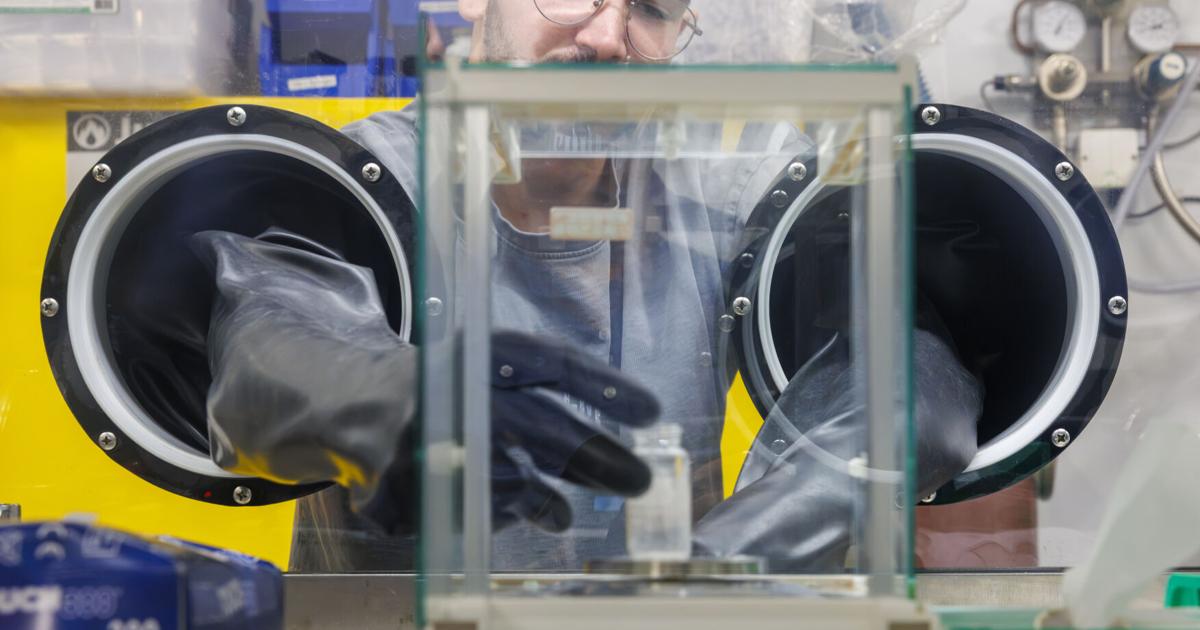
Jackson Smith, a Tulane chemistry PhD student working on the Genesis Mission project, handles materials inside an oxygen- and moisture-free glove box filled with argon gas. The controlled environment allows researchers to safely work with chemicals that react with normal air on Monday, August 24, 2026.
More than a century ago, a Dutch scientist named Heike Kamerlingh Onnes earned a Nobel Prize in physics by discovering the world's first “superconductor,” a material that can transfer electricity without heating up and losing energy.
Since that breakthrough, researchers around the world have identified thousands of similar materials that have been instrumental in creating some of science's modern marvels, including MRI machines that use superconductor-powered magnets to create detailed images of the inside of the human body.
The only problem with all of those materials? They have to be very, very cold to become superconductors, which is why finding one that works at higher temperatures has been one of science's most elusive goals for years.
Now, a team of Tulane University scientists is trying to prove that artificial intelligence can speed up that search and give the U.S. a boost in the global competition for AI-fueled scientific breakthroughs in the process.
In July, Tulane physics professor Jianwei Sun and his team were among 278 awardees to beat out roughly 5,000 other applicants for a grant from Genesis Mission, a $5 billion multiagency federal initiative to use AI for scientific discovery. Two teams at LSU are also participating in the sprawling program created last November by the Trump administration, which earlier had cut funding for some university research.
The Tulane team, which is partnering on the project with the Oak Ridge National Laboratory in Tennessee, has nine months to spend $750,000 in a race to prove AI's value to their work. At stake is a second phase of funding that could unlock as much as $15 million for Tulane in what's become an increasingly competitive university research environment.
Sun said a bigger incentive is the chance his team could help researchers get one small step closer to a groundbreaking discovery.
“Finding a high-temperature superconductor would change the world just like the Copper Age or Iron Age did thousands of years ago,” he said during an interview with his team earlier this month. “I'm very excited about demonstrating that AI can accelerate this type of discovery.”
In addition to their vital contribution to MRI machines, superconductors are used to improve the performance of particle accelerators used to study the building blocks of matter, and they can be found in some quantum computers and special power systems.
“It would be like finding the holy grail of science,” said Daniel Straus, a Tulane assistant professor of chemistry and a member of Sun's team.
The thirst for a breakthrough was evident three years ago, when researchers in South Korea set off a frenzy among their fellow scientists — and Silicon Valley investors — by announcing they'd found a superconductor that was stable at room temperature. Ultimately, when attempts to reproduce the results failed, the discovery was declared a bust, and that team went back to square one.
Scientists have, over time, found superconductors that work at higher temperatures than their predecessors from a century ago — but still nowhere near conditions found naturally anywhere on Earth.
That breakthrough remains a dream that experts say could pave the way for superefficient power grids; tiny, hyperefficient electronics and motors; and even trains that run via “magnetic levitation.” It could also unlock advances in insanely complicated and powerful quantum computers that could, among things, make data centers obsolete.
Straus said superconducting power lines could also make it possible to transmit electricity over long distances with minimal energy loss, which means utilities could build nuclear power plants “in the middle of nowhere” so there's less danger to people if there's an accident.
On a recent weekday afternoon, as thousands of undergrads strolled across Tulane's campus in the sweltering heat, Sun's team of chemists, physicists and computer scientists were gathered around a conference table on the second floor of the Stanley Thomas Building, one of several that houses the university's roughly 3,000-student School of Science and Engineering.
Partners from the Oak Ridge National Laboratory, a high-tech research facility with its origins in the World War II-era Manhattan Project, joined the conversation via video conference.
It was the Genesis Mission group's first “all hands” meeting, and by the end of the conversation, team members had signed off on a plan of attack for the coming months that capitalizes on their different areas of expertise as they compete to unlock a second tranche of funding.
The first step will be for the team's physicists and computer scientists to write algorithms that will sift through massive databases of existing materials to identify the ones that have the potential to be superconductors.
“Instead of starting from scratch and saying, 'How many oxygens am I going to put in this?' we find something that someone has made but didn't report if it was a superconductor,” said Jackson Smith, a Ph.D. student of chemistry.
“Based off of what AI says, we can narrow down the search faster with AI than with human eyes,” he said.
But using computers to aid the search isn't as simple as typing a question into a ChatGPT search box. Instead, the computer scientists and AI specialists have to create elaborate “quantum-mechanical simulations” that help predict how atomic and subatomic matter might behave. Logging into a state-owned “supercomputer” dubbed LONI (the Louisiana Optical Network Initiative) will cut the time it takes to run these complicated algorithms from months to days, Straus said.
Aron Culotta, a Tulane professor of computer science, believes the tools will make a “huge impact” as his team combs through curated repositories like the Inorganic Crystal Structure Database and the Cambridge Structural Database, which both compile details about the atomic structure of materials from more than a century of scientific research.
“AI is good at sifting through lots of information and finding patterns,” he said. “There's a lot of room to make the process faster and more effective while humans stay in control.”
After identifying promising materials, the researchers will recreate them in Tulane's labs by combining different chemical compounds and heating them in special furnaces. Then the most promising materials studied in Tulane's labs will go for further study at Oak Ridge, which has highly specialized equipment for that purpose.
“It is impossible to just use theory alone, like computations, to predict a new superconductor,” Straus said. “We have to make them and test them.”
By next March, at the six-month mark of Sun's project, the team hopes to show that AI was able to identify at least a handful of existing materials that have superconductive properties.
If second-phase funding is unlocked, Culotta said the team could scale up by looking for new materials that haven't ever been studied and automating more of the process.
“We've already got plenty of superconductors that require impractically low temperatures to operate,” he said. “Finding ones that function at higher temperatures is the ultimate goal.”
Your browser is out of date and potentially vulnerable to security risks.We recommend switching to one of the following browsers:
Original Source
This content was distilled for a focused reading experience. All rights belong to NOLA.com.
Read original publication