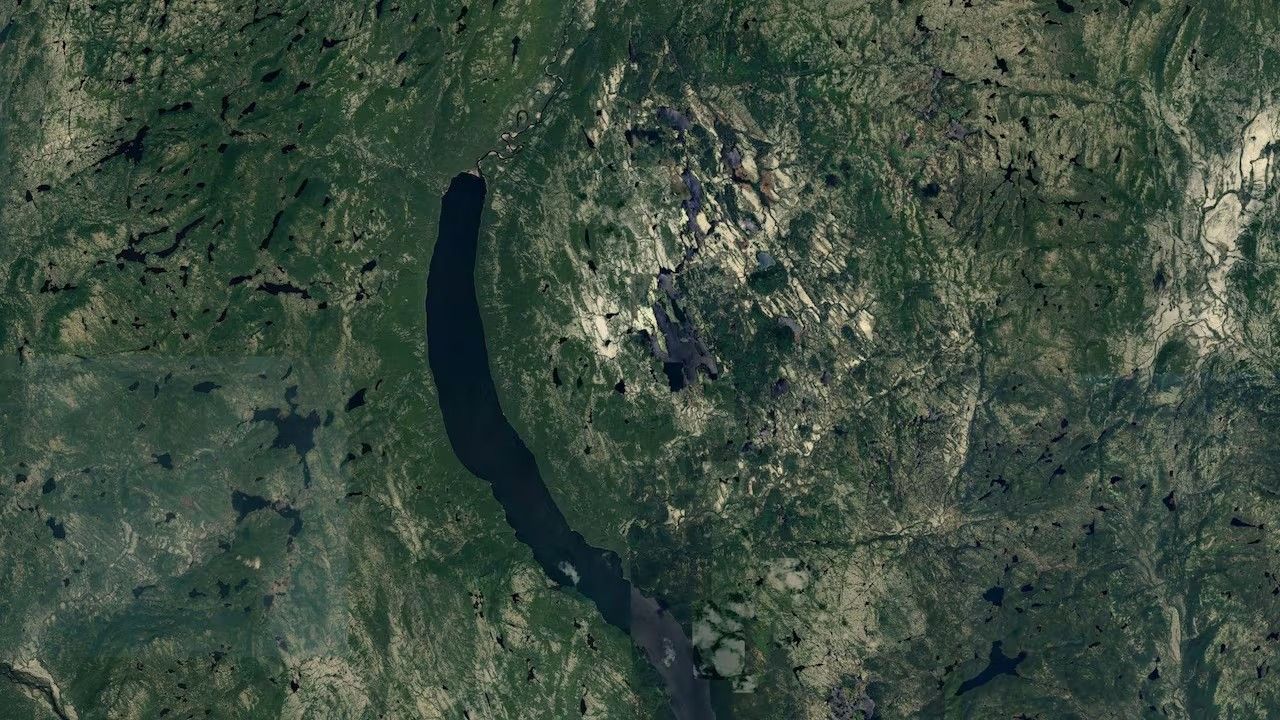
'This was one of the most arduous expeditions I've ever done': Scientists confirm that 15-mile-wide pit found on Google Maps is ancient meteor crater
A) Shatter cone at the center of the structure. B) melt rock 4 km (2.5 miles) west of the structure center
Unlimited access to our exclusive features, expert analysis and in-depth interviews, all ad-free
Rigorously fact-checked science, expert commentary and an ad-free experience built for those who want to go beyond the headlines
Unlimited, ad-free reading No ads on any Live Science articles. No pop-ups. Full access to everything.
Trusted, in-depth, pro-science features that are available only to Pro members.
The latest science direct from the most respected people in their fields.
Welcome to Live Science club! Hi , Your membership journey starts here.
Feed your curiosity with an exclusive mystery every week, solved with science and delivered direct to your inbox before it's seen anywhere else.
Breaking space news, the latest updates on rocket launches, skywatching events and more!
Get full access to premium articles, exclusive features and a growing list of member rewards.
Joël Lapointe was using Google Maps to plan a camping trail through Quebec's Côte-Nord region when he stumbled across a large indentation. Now, scientists have confirmed that the pit was indeed a meteor impact crater that dates back roughly 390 million years.
By Pandora Dewan Published 16 July 2026 In News When you purchase through links on our site, we may earn an affiliate commission. Here's how it works.
Joël Lapointe was planning a camping trail through Quebec's Côte-Nord region when he stumbled upon a large indentation in the terrain, CBC reported at the time. The pit, centered around Lake Marsal, was about 25 kilometers (15.5 miles) in diameter and a near-perfect ring - it didn't seem like a normal ditch. Lapointe eventually got in touch with French geophysicist Pierre Rochette, who said that the surrounding topography was "very suggestive" of an impact crater.
Initial testing of samples retrieved from the site contained a mineral called zircon often formed during meteor impacts. However, zircon's presence alone was not enough to prove the crater's extraterrestrial origin story. So a team of scientists had visited the pit in person.
But there is one feature Osinski said can be seen with the naked eye: grooves or lines in the rock's surface called shatter cones, which are caused by shockwaves passing through the ground.
'Unequivocal evidence' of Earth's oldest impact crater turns out to be off by half a billion years An ancient piece of the moon found in Africa hints at a violent, long-ago collision Gold glitters around Ghana's 'lake of souls' thanks to catastrophic meteor strike In October 2025, Osinski and a team of geologists visited the site to investigate whether any of these features were present. "This was one of the most arduous expeditions I've ever done - and I've done 25 expeditions to the Arctic and 6 continents," he said. "The terrain was incredibly rough and rugged, plus [there were] lots of bugs."
Get the world's most fascinating discoveries delivered straight to your inbox.
Taking samples from the rocks, the team dated the crater at 390 million years old.
Osinski, who runs a website called Impact Earth dedicated to verifying meteor impact sites, is used to getting emails about strange looking satellite images. "I get lots of messages from the public thinking they have found a crater and 99/100 turn out not to be the case," he told Live Science. "This is one of those rare examples that shows this is possible."
So far, we know of roughly 200 impact craters on Earth, 31 of which have been found in Canada. "Typically about 1 or 2 craters are discovered per year, but these are typically less than 5-10 km [3 to 6 miles] in size," Osinski said. "[A crater of this size] is pretty rare."
Ultra-rare meteorite could be evidence of a lost planet that once orbited near Earth - Space photo of the week A giant 'shadow' has been creeping across Mars for 50 years - and scientists aren't sure why NASA confirms meteor exploded over northeastern US with force of 230 tons of TNT The last meteor crater confirmed in Canada was in 2010.
After the new investigation confirmed the pit was punched out by a meteor impact, Osinski, Rochette and their team named it Uhaachatik Crater following discussions with the Ekuanitshit Innu council, a council representing the indigenous people in the area. The researchers will present their work at the Annual Meeting of the Meteorological Society in Germany next month.
Speaking to Radio-Canada, Lapointe said that he was very happy to hear his discovery had been confirmed as a genuine meteor crater. "It's not every day that an ordinary citizen finds a 390-million-year-old crater," he said. "I encourage everyone to not ignore intuition or an observation, even if it isn't part of your field of expertise."
Osinski and the team will continue their work on the collected samples to learn more about the impact site. "Any crater discovered offers us insight into how craters form and the effects that they can have on Earth's geology, biology, and climate," he told Live Science.
\n We\'re processing your payment. Please don\'t close or refresh this page.\n
Original Source
This content was distilled for a focused reading experience. All rights belong to Live Science.
Read original publication