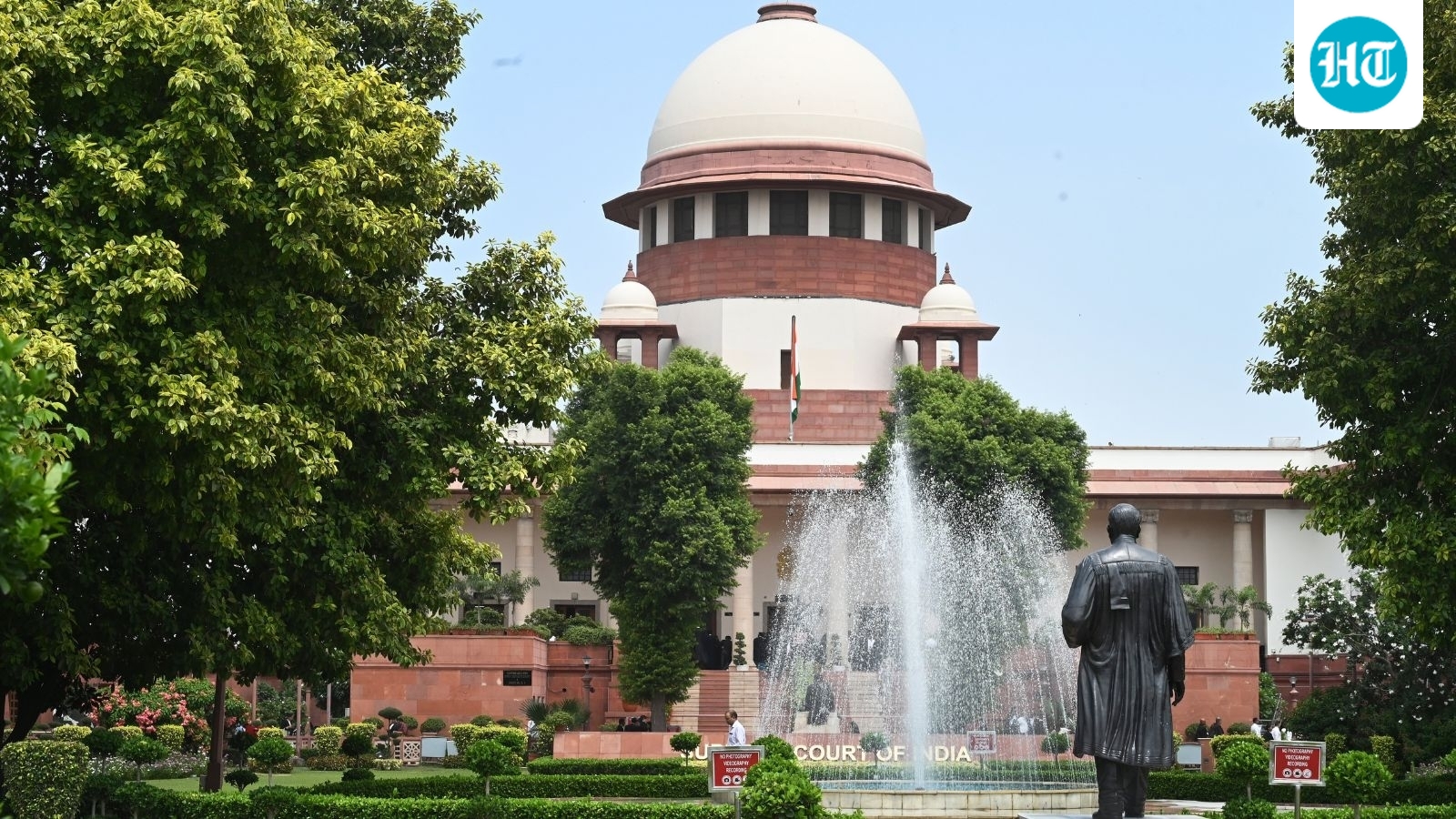
Supreme Court says temple property cannot be taken over by government, even for public purposes
The Supreme Court has ruled that temple property is held for the deity and cannot be usurped by the government, “whatever its label or ostensible public purpose”, underscoring that every decision concerning the properties of a religious
The judgment concerns 1 acre and 10 cents of land belonging to Nagapalayam Mariamman-Ponnachiamman Temple in Erode district, Tamil Nadu. (Arvind Yadav/HT Photo)or charitable institution must be guided solely by the trust’s best interests and never by the government’s administrative convenience.
“The State, as custodian, cannot unilaterally usurp, nor permit any of its officers to usurp, the property of the religious/charitable institutions it is charged to protect,” a bench of justices PS Narasimha and Alok Aradhe said in a judgment delivered on October 16.
The court made it clear that the State’s power to regulate temple administration does not make it the owner of temple assets, and that the duty to protect such properties cannot be used to justify their transfer to the government, even for a public purpose. “The administration of property belonging to a religious/charitable institution carries with it a duty of preservation, not a power of unfettered disposition,” it said.
“An acceptance of a gift of temple land by a Revenue functionary, however laudable the public purpose it is intended to serve, offends the object of the Act,” said the bench, adding that temple property is held for the deity and not for “gratuitous disposal by whoever happens to hold the office of trustee, however well-intentioned”.
The ruling in a dispute over temple land in Tamil Nadu comes amid a broader legal debate over state control of Hindu religious institutions. The Supreme Court is also seized of a batch of petitions challenging the constitutional validity of laws governing temple administration and religious endowments in Tamil Nadu, Andhra Pradesh, Telangana and Puducherry.
The petitions, the first of which was filed by the late Swami Dayanand Saraswati in 2012, were revived for hearing by a bench led by justice BV Nagarathna in May this year. Similar statutory frameworks regulate the administration of Hindu temples and religious endowments in several states, including Karnataka and Kerala. The pending challenge raises broader questions about the extent of government supervision over religious institutions and the balance between statutory regulation and their rights over their affairs and assets. The batch of cases are expected to come up next week.
Also read: Ram temple complex work nears finish, 148 of 150 projects completed
The present judgment arose from a dispute over 1 acre and 10 cents of land belonging to Nagapalayam Mariamman-Ponnachiamman Temple in Kodumudi village in Tamil Nadu’s Erode district. In August 2017, a temporary trustee executed a gift deed transferring the land to the state government, represented by the district collector and tehsildar, for the construction of a taluk office. The government accepted the gift, mutated the land in its name, and reclassified it as “Sarkar Poramboke” before proceeding with construction.
Setting aside the high court ruling, the Supreme Court held that the land was an inam property granted for the support and maintenance of the deity and was governed by Section 41 of the 1959 Act.
Also read: Temples in 1000-1700 CE served as economic institutions, provided legitimacy to political authority: NCERT
“The Legislature has thus consciously withheld from a gift of an inam property, the very possibility of subsequent validation, by the Commissioner or the Government alike,” noted the bench, adding that such a gift was “void ab initio and no sanction, however solemnly accorded, could have breathed life into it”.
The court rejected the argument that the transfer could be justified because the land was intended for a public office. It said the State, acting through the commissioner and other officials under the law, was “a custodian and regulator of temple properties, not their owner”.
Explaining the legal character of religious endowments, the bench underscored that temples were repositories of land, buildings, jewellery and other wealth accumulated over centuries through offerings by devotees and endowments by rulers and commoners, given in the faith that what had been dedicated to the deity would remain so in perpetuity.
“That wealth, once given, ceases to belong to the donor, to the priest, to the trustee, or to the State; it vests in the deity, and every hand through which it subsequently passes holds it only in trust for the deity and, through the deity, for the community of worshippers it was meant to serve,” the judgment said.
Also read: Surrounded by 4 cops, cuffed on the ground: Video shows arrest of US teen accused of plotting Hindu temple shooting
However, taking into account that a taluk office had already been constructed on the land using public funds and was serving the administrative needs of the area, the Supreme Court did not annul the lease arrangement under which the government continued to occupy the property. Instead, it enhanced the monthly rent from ₹13,235 to ₹31,000, with effect from March 8, 2019, when the land was handed over for construction.
Directing the state to pay arrears of rent, after adjusting any amount already paid, within three months, the bench also ordered it to pay ₹1 lakh in costs to the temple. The lease’s duration, renewal and other terms will be determined by the trust in accordance with the law, with the temple’s benefit as the paramount consideration.
The court directed state authorities and the Hindu Religious and Charitable Endowments Department to strictly follow the statutory procedures governing transactions involving religious institutions’ properties. It emphasised that the continuation of the lease did not confer unilateral control over its terms on the government, and that any renewal would require a fresh determination of fair rent.
“Every decision touching the properties of a religious/charitable institution must be guided solely by the best interest and benefit of the trust, and never by the administrative convenience of the government,” said the bench.
Original Source
This content was distilled for a focused reading experience. All rights belong to Hindustan Times.
Read original publication