'Sheer recklessness': Ex-Japan minister slams India for delays in bullet train project, MEA hits back
As a former Japanese minister stirred up a controversy through a social media post that blamed the Indian side for delays in the Mumbai-Ahmedabad high-speed railway project, India said on Friday that cooperation between New Delhi and Tokyo is “progressing well” and both sides have agreed to launch the first section in 2027.
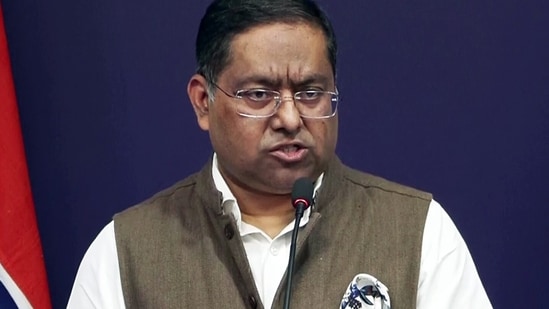
MEA spokesperson Randhir Jaiswal speaks during a media briefing in New Delhi. (ANI Video Grab )Hideki Makihara, who was involved in the railway project while serving as Japan’s vice minister of economy, trade and industry, alleged in a social media post on July 15 that the Indian side’s “sheer recklessness” stood out during meetings and negotiations on the project and that New Delhi did not “keep promises”.
When external affairs ministry spokesperson Randhir Jaiswal was asked at a regular media briefing about Makihara’s accusations, he replied that this was “an individual opinion and at considerable variance with facts”.
Jaiswal contended that India-Japan discussions on the Mumbai-Ahmedabad high-speed train are “progressing well”, and construction work on the project has “rapidly progressed”, with plans for the first section to be opened in 2027.
As Japan will be in a position to provide the E20 train series for the project “only in the early 2030s”, since the train is still under development, “both sides agreed to start the operations with [an] Indian high-speed train”, Jaiswal said.
“The signalling equipment has been ordered accordingly and is in line with international specifications. No Japanese offer was received in this context,” Jaiswal said. “The project execution is in line with the common goal of starting the high-speed train project at the earliest.”
The social media post by Makihara, who briefly served as justice minister, was linked to an online article written by Isao Tsujimura, a Japanese engineer based in India, that contended that India was opting for European-origin signalling equipment and a new Indian high-speed train to launch the first section, even though a majority of the funding for the project is being provided by Japan.
Tsujimura further contended that the European-origin signalling system will be incompatible with Japan’s Shinkansen bullet trains and that “India's Shinkansen project will almost certainly end up being a pipe dream”.
Makihara said in his social media post in Japanese that he was personally involved with the Shinkansen project in India, “but what stood out in international meetings and negotiations was the sheer recklessness of the Indian side, repeated over and over”.
He added, “They just don't keep promises, no matter what. Even if they make a promise, they flip it right away. They keep pushing their own self-interest right up to the very end. The minister in charge was especially awful – if the top guy’s like that, there's no way to have any decent dealings.”
Makihara further alleged that he felt “100% that the reason [the project] hasn't moved forward is entirely on the Indian side.”
According to the National High Speed Rail Corporation’s website, India's first bullet train project envisages a high-speed rail corridor spanning 508 km to offer fast connectivity between Maharashtra and Gujarat states. The high-speed train is expected to run at a speed of 320 kmph, have 10 stops, and integrate the economies of Mumbai, Vapi, Surat, Anand, Vadodara and Ahmedabad.
The first section of the high-speed rail corridor between Surat and Bilimoria is now expected to be opened on August 15, 2027, though the project has been dogged by delays and cost overruns since it was launched in 2017, and missed its original completion date of 2023.
Rezaul H Laskar is the Foreign Affairs Editor at Hindustan Times. His interests include movies and music.
Original Source
This content was distilled for a focused reading experience. All rights belong to Hindustan Times.
Read original publication