Andrew Crommelin and Charles Davidson took the photograph that proved Einstein right about the universe in 1919. So why does history only remember Arthur Eddington's name?
Photograph of the 1919 solar eclipse taken from the report of Sir Arthur Eddington on the expedition to verify Einstein's prediction of the bending of light around the sun
The photographer who gets the credit isn't always the one who took the decisive shot
When you purchase through links on our site, we may earn an affiliate commission. Here's how it works.
Usually it's a minor issue: a mistyped byline, a client who thanks the wrong assistant. But in May 1919, it happened on a scale that reshaped our understanding of the entire universe - and the person who ended up with the glory wasn't the one holding the camera that mattered.
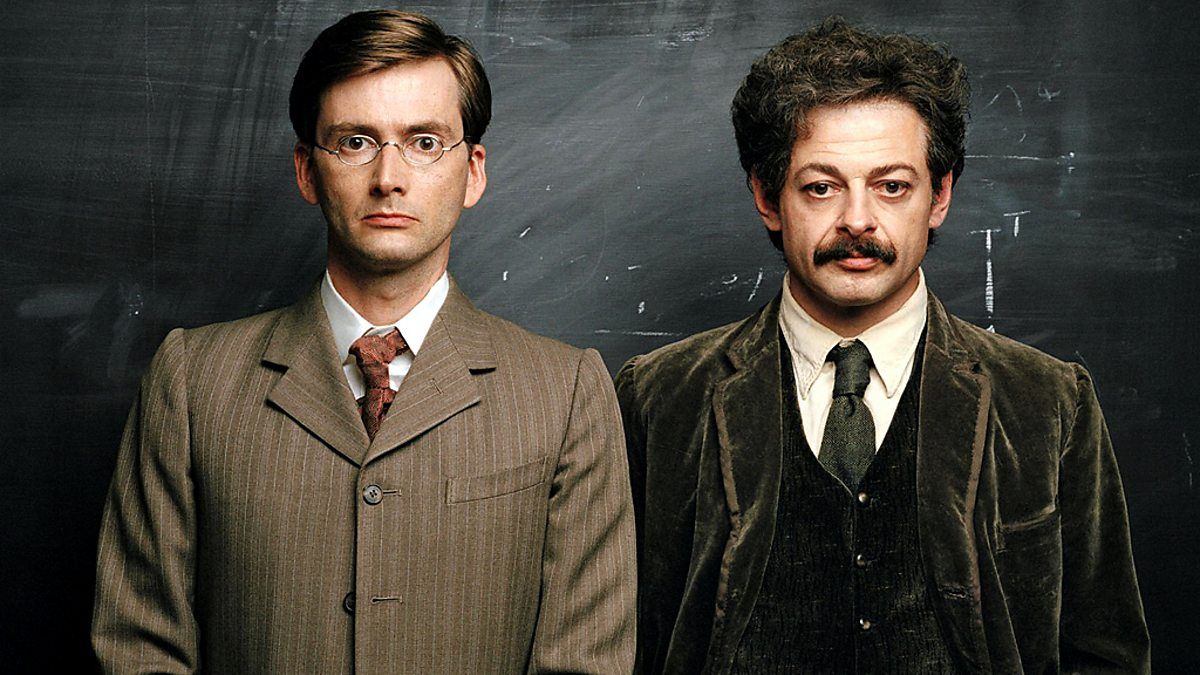
Above you can see a publicity still from the 2008 BBC film, Einstein and Eddington, with David Tennant (Dr Who, God Omens) playing English astrophysicist and mathematician Sir Arthur Eddington and Andy Serkis (The Lord of the Rings, Star Wars) playing Albert Einstein.
It's a fair summary of how the story has been told over the last hundred years: two great men, staring down the camera in front of a blackboard, working the problem out together.
And yet the photograph that settled the argument wasn't actually taken by either of them.
Earthrise: How the Apollo 8 astronauts inadvertently gave every photographer on the planet the most important lesson in preparation ever The 1965 Selma photograph with no faces in it: why James Karales' camera turned away from the hero shot and focused on the sky His neighbors "thought him mad to spend so many hours staring into a coffin." James Clerk Maxwell wasn't a photographer, but he created the world's oldest color photo with an idea still used today A tale of two expeditionsEddington travelled to the island of Príncipe, off the west coast of Africa, to photograph the total solar eclipse of May 29 1919 and measure whether starlight bent as it passed the Sun, as Einstein's general theory of relativity predicted.
He sat out a tropical storm that didn't clear until an hour before totality, then changed 16 photographic plates blind through drifting cloud, unable to see whether he was capturing anything usable at all.
The best camera deals, reviews, product advice, and unmissable photography news, direct to your inbox!
Only a pair of his plates turned out good enough to measure, and even those gave a fairly loose result: a deflection of about 1.61 arcseconds, with an error margin wide enough that on its own, it wouldn't have persuaded sceptics.
Thankfully for science, a decisive image came from the other side of the Atlantic. Andrew Crommelin and Charles Davidson of the Royal Greenwich Observatory had travelled to Sobral in Brazil to photograph the same eclipse, as insurance against exactly the kind of weather Eddington ran into.
Their trip didn't go particularly well, either. Their main telescope was ruined by heat that warped its mirror mid-shoot and blurred every star image into a smear.
Meet William Constable: The unsung pioneer of photography who helped pave the way for portraiture Alice Seeley Harris took her camera to the Congo on her honeymoon in 1898. Her gruesome photograph of severed hands helped to end one of history's greatest wrongs "It's more important to click with people than to click the shutter." The photographer behind one of history's most iconic photographs understood something that too many modern photographers do not It was their spare, a smaller 4-inch instrument brought along purely as a backup, that produced the sharpest plates of the entire project: a deflection of 1.98 arcseconds, with an error margin roughly a quarter the size of Eddington's.
That was the shot that actually proved Einstein's theory right. The whole project, though, came to be known as 'The Eddington experiment'.
Eddington and the astronomer Frank Dyson - the primary architect of the venture - designed the test and organized both expeditions. Eddington was the one who stood up at the Royal Society in November 1919, told the room that the numbers backed Einstein, and then wrote the popular accounts.
He had the better personal story, too: a Quaker who'd risked prosecution as a conscientious objector during the First World War, and spent those years teaching himself a German physicist's theory that almost nobody in Britain would read.
Crommelin and Davidson, by comparison, were Greenwich Observatory staff doing a job - and they don't appear as characters in the BBC drama at all.
Admittedly that made the script easier for viewers to follow, but it does seem a little unfair all the same. And it especially stings for any working photographer who's seen the same pattern on collaborative shoots.
Eddington obviously deserves credit for designing this groundbreaking experiment and for having the nerve to run it at all.
But the photograph that proved Einstein right came out of a spare telescope in Brazil, operated by two men whose names many people reading this article will never have heard of. Andrew Crommelin and Charles Davidson: let's remember them now.
Einstein and Eddington is streaming now on Max (formely HBO Max) and Amazon Prime in the US, and has been released worldwide by BBC DVD.
Original Source
This content was distilled for a focused reading experience. All rights belong to Digital Camera World.
Read original publication