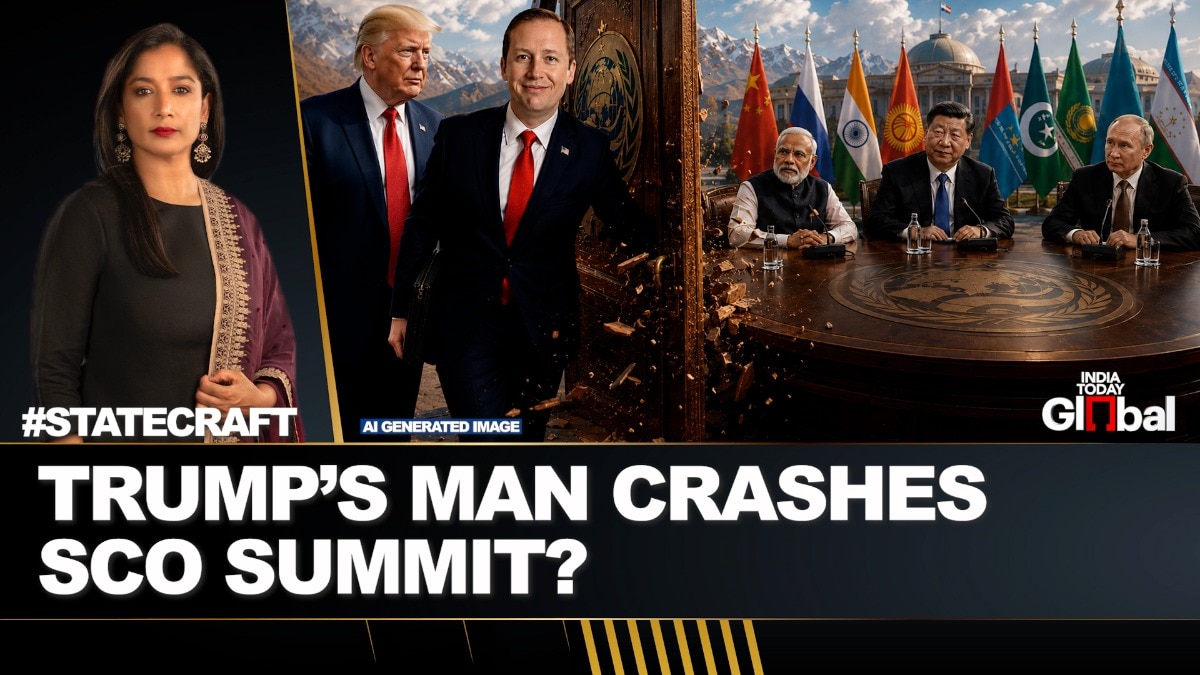
Donald Trump's Backdoor To The SCO Summit? Sergio Gor’s Bishkek Move Explained
As SCO leaders Narendra Modi, Vladimir Putin and Xi Jinping gathered in the Kyrgyz capital, US Special Envoy for South and Central Asia and Ambassador to India Sergio Gor arrived for the World Nomad Games. Officially, he was there to support American athletes. Diplomatically, however, his visit offered Washington something more valuable: access to Central Asian leaders at the same time and in the same city as a major SCO gathering.
Gor did not enter an SCO meeting or attempt to claim a seat at the table. Instead, he met Kyrgyz President Sadyr Zhaparov, Tajik President Emomali Rahmon and Uzbek President Shavkat Mirziyoyev, promoting Washington's C5+1 agenda.
The timing was hard to ignore. The SCO Council of Heads of State and SCO Plus meetings were held in Bishkek on 31 August and 1 September, while the Nomad Games opened on 31 August. That created a parallel diplomatic stage for Washington.
The United States is neither an SCO member nor a formal observer. But Gor's meetings demonstrated that Washington does not necessarily need a seat inside the organisation to engage with countries sitting around its table.
The Nomad Games provided a politically neutral setting for high-level meetings that could otherwise have appeared more confrontational. Horses, wrestling and traditional sporting competitions provided the backdrop, while trade, investment, security and technology formed part of the diplomatic conversation.
With Kyrgyzstan, Gor discussed stronger political ties, expanded trade and greater economic and investment cooperation. The two sides also discussed prospects for a second C5+1 leaders' summit in 2027.
With Uzbekistan's President Shavkat Mirziyoyev, the agenda stretched across energy, transport, critical minerals, digital technologies, artificial intelligence and agriculture.
Washington is not necessarily trying to replace either Moscow or Beijing in Central Asia. Instead, it appears to be offering the region another economic and diplomatic option. Trade, investment, technology, energy, transport and critical minerals are the hooks.
Kyrgyzstan, Tajikistan and Uzbekistan can maintain their relationships with Russia and China while simultaneously deepening engagement with Washington. This multi-vector approach allows them to collect more options and potentially strengthen their bargaining position.
Kyrgyzstan's role was particularly significant. By hosting both the SCO events and the Nomad Games, Bishkek became a diplomatic crossroads. The American delegation could participate in a major international event while conducting meetings with regional leaders without directly challenging the SCO.
Gor's second role also adds another layer. As US Ambassador to India, he was operating in a city where India was engaging with Russia and China through the SCO. That creates an unusual overlap between Washington's Central Asian outreach and New Delhi's participation in the SCO framework.
This does not establish a coordinated US-India strategy aimed at countering China or Russia. But it does highlight the increasingly interconnected diplomatic tracks surrounding Central Asia.
The bigger question is whether Washington's outreach can translate into lasting economic and strategic influence.
For now, Gor's Bishkek visit looks less like an attempt to enter the SCO and more like an attempt to operate alongside it.
Instead, it secured a parallel microphone — and made sure Central Asia could hear the American offer.- EndsPublished By: indiatodayglobal Published On: Sep 1, 2026 22:06 IST
Original Source
This content was distilled for a focused reading experience. All rights belong to India Today.
Read original publication