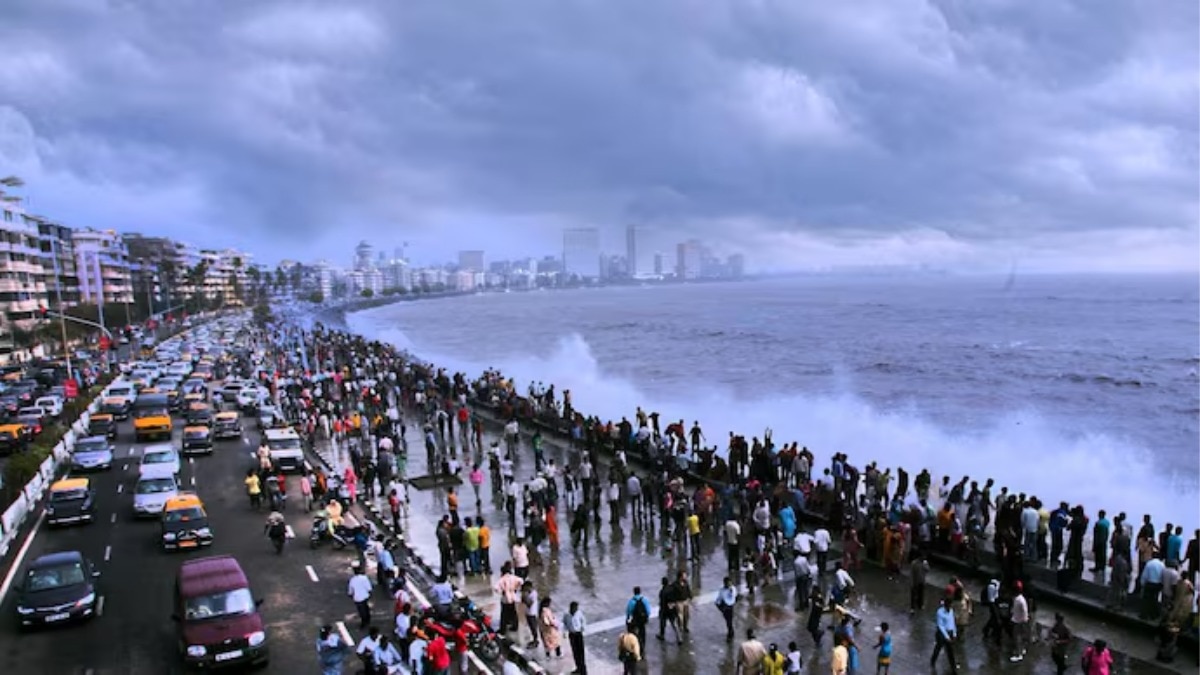
Millions in Kolkata, Mumbai at immediate risk of losing homes to rising seas: UN
The report of the UN Secretary-General, titled Challenges related to sea level rise and ways and approaches to address it, said more than 14 million people in the low-lying deltas of South Asia, including Kolkata and Mumbai in India and Dhaka in Bangladesh, are at immediate risk of displacement because of permanent inundation.
"Rising seas are no longer a distant threat: they are happening now, faster than at any point in recorded history, and the pace is accelerating, making sea level rise one of the most profound threats to populations around the world in developed and developing States alike," the report said.
The report, released Monday, said rising seas are already damaging urban infrastructure, water and sanitation systems, transport networks, energy grids, buildings and groundwater resources. The consequences, it said, extend beyond physical damage, threatening human rights, long-term development and financial stability.
The nature of the threat varies across regions. In wealthier coastal cities such as Miami, New York and Guangzhou, the biggest concern is the enormous financial value of infrastructure and assets exposed to rising seas, estimated at between USD 2 trillion and USD 3.5 trillion.
In South Asia’s low-lying deltas, however, the greater concern is human displacement. The report said more than 14 million people face an immediate risk of losing their homes to permanent inundation.
"In the low-lying deltas of South Asia, in cities such as Kolkata and Mumbai in India, and Dhaka, the defining impact is human displacement, with more than 14 million people at immediate risk of losing their homes to permanent inundation," the report said.
The UN said this difference highlights the need for coastal vulnerability assessments to look beyond financial losses and give equal weight to the number of people at risk of displacement and loss of homes.
Sea level rise is also creating growing risks to public health, the report said. Damage to coastal health and sanitation infrastructure, greater exposure to water-borne diseases, disrupted sanitation and higher risks of injury and death are among the concerns. The resulting disruption can also increase mental health stress.
The combination of rising seas and land subsidence is making flooding worse in many coastal areas, while degrading ecosystems and threatening lives, livelihoods and critical aquatic habitats.
As salt water moves further inland, freshwater wells and coastal aquifers are increasingly vulnerable to salinisation. Storm surges can also contaminate surface and groundwater for long periods, affecting drinking water supplies, farming, irrigation and ecosystems that depend on groundwater.
The report said policies linking river basins, freshwater systems, coastlines and oceans remain inadequate in many regulatory and land-use planning frameworks. This can disproportionately affect vulnerable communities, including small-scale fishers, tourism workers and economies dependent on ports.
The UN attributed the acceleration in sea level rise primarily to melting glaciers and the thermal expansion of warming oceans, driven by human-induced global warming.
Between 2014 and 2023, global sea levels rose at an average rate of 4.7 mm per year. In 2024, the rate reached 5.9 mm, a record increase driven mainly by exceptional ocean warming.
The report said sea level rise is expected to continue accelerating through 2050 because of warming already locked into the climate system.
The annual rate of sea level rise was 4.75 mm between 2012 and 2025, while the global mean sea level in 2025 remained close to the record level recorded in 2024.
The UN said nearly 770 million people, or about 10% of the global population, live in coastal areas less than five metres above the high-tide line, placing them at acute risk.
Across regions, rising seas are worsening existing climate threats such as coastal flooding, freshwater salinisation, erosion and ecosystem degradation. Critical infrastructure, agriculture, trade, tourism and cultural heritage are increasingly vulnerable.
The report described sea level rise as a “threat multiplier”, capable of damaging vital infrastructure, forcing communities to relocate and, in extreme cases, permanently eliminating land or even parts of a state's territory.
"Accelerating at an unprecedented level, sea level rise driven by melting glaciers and ocean warming is redefining coastlines and posing major threats to low-lying islands, coastal cities and communities, tropical deltas and Arctic regions," it said.
With sea level rise largely irreversible and unfolding over decades, the UN stressed the need for early and long-term adaptation planning. It called for predictable funding, better data and scientific capacity, and stronger technical, institutional and legal systems to help vulnerable countries and communities prepare for worsening impacts.- EndsPublished By: Shipra ParasharPublished On: Sep 1, 2026 23:07 IST
Original Source
This content was distilled for a focused reading experience. All rights belong to India Today.
Read original publication