He 3D prints instruments in plastic, and they sing: The IIT Madras professor making music for all
They are not carved from wood or strung by any craftsperson's hand. A machine in the corner had built them, layer by patient layer, in plain plastic.
They look like models of instruments, like something you might admire but never sound. And then someone lifts one, and draws a thumb across the strings, and it sings.
It is the beginning of an answer to a quiet, unfair question that has shadowed Indian music for generations: who is allowed to make it, and who is priced out before they have begun.
Professor Ramanathan is not quite what one expects of a senior scientist. He speaks softly, credits his students before himself, and settled in to talk as though there were nowhere else in the world he needed to be, until a conversation meant to last minutes had wandered, happily, into hours.
He is a musician who earns his living from mathematics. He plays the mridangam, the two-headed drum at the very heart of Carnatic music, and he plays it with devotion.
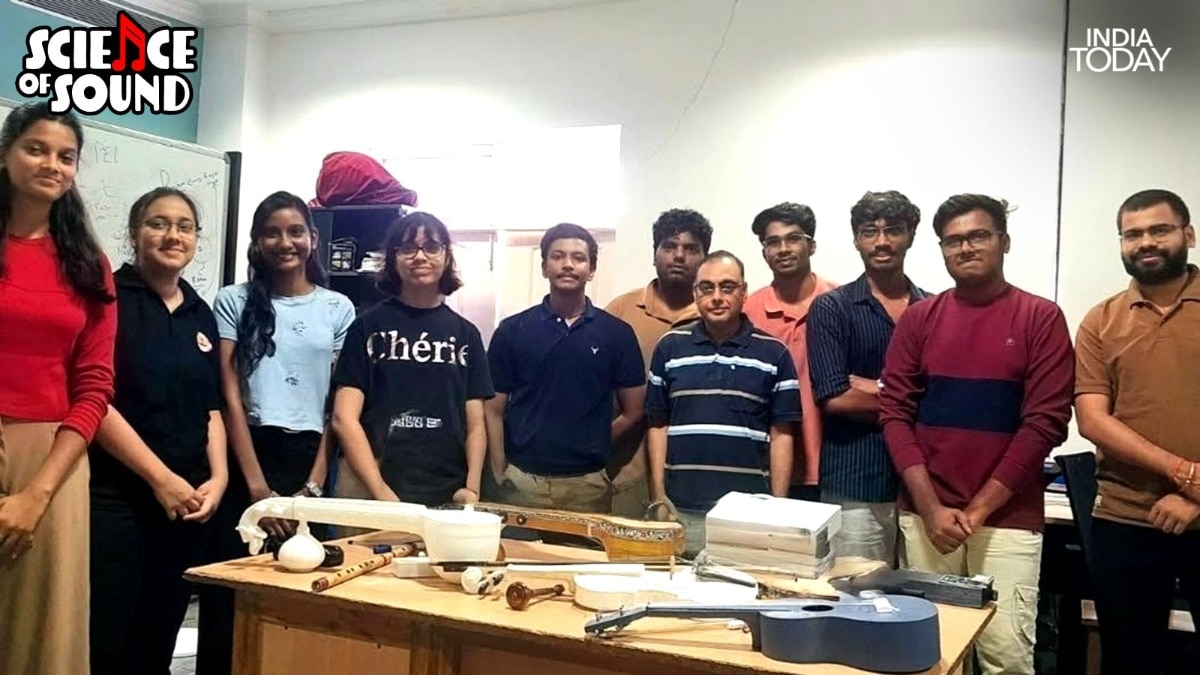
His days belong to the cold logic of shapes and equations, his evenings to the warm pulse of that drum, and the tension between those two lives runs through everything his lab does, a place where algorithms are taught to listen, where a printer builds the body of an instrument, and where, if you stand still enough, you can watch science fall quietly in love with music. Three instruments, one table: a violin and a veena in plain white plastic, and a ukulele in blue, each printed layer by patient layer before anyone drew a sound from them. (Photo: India Today)
He had, by his own admission, expected less. A journalist was coming to the lab, and he assumed it would be a brisk, surface-level affair, a few general questions and a quick exit.
Instead, the conversation settled in and kept going, because it turned to the things he cares about most, the physics of how an instrument is made, the mathematics hidden in a plucked string, the science India Today has been exploring through a series called Science of Sound.
Somewhere in that long talk, warming to it, he offered something a busy professor rarely does. He said he would drive into town himself, to a modest workshop where a craftsman has spent a lifetime making the very drum he plays. That afternoon comes later, because it belongs at the very heart of the next instalment of this series.
Professor Ramanathan spoke of the craft with the ease of someone who has spent his life inside it, and it was clear this was a man for whom the science and the soul of music were never separate things.
It had begun as a story about instruments. It became a story about who gets to make music at all.THE MATHEMATICIAN WHO NEVER STOPPED BEING A MUSICIAN
By training and by day, Professor Ramanathan belongs to the Department of Engineering Design, and his true subject is geometric modelling, the mathematics of shape.
It is the science of curves and surfaces, of how the form of an object can be captured in numbers precise enough for a computer to hold, the same family of ideas that lets engineers design a car door or an aircraft wing on a screen before a single sheet of metal is cut. It is exacting, abstract work, a long way from any concert hall. In a Mylapore workshop, a mridangam maker talks about his craft, the drum resting on his lap, while Professor Ramanathan, a mridangam player himself, looks on. (Photo: Radifah Kabir/India Today)
And yet the concert hall was always there, humming quietly underneath. As a musician, he could never look at an instrument the way the rest of us do, as a finished and slightly magical object. Where others saw a veena, he saw a shape that made a sound, geometry that happened to sing.
Somewhere along the way, he began to wonder what might happen if he turned the whole apparatus of his science, the printers, the algorithms, the modelling, onto the thing he loved most.
His students wondered alongside him. Together they have spent years chasing questions that sound simple and prove to be anything but. Can you print an instrument? Can you teach a machine to recognise a raga? Can music heal, and if it does, why?THE PLASTIC INSTRUMENTS THAT SANG
Begin with the printer, because that is where visitors always gather.
Using ordinary plastic and a 3D printer, a machine that builds an object layer upon patient layer from a digital design, his team has already produced instruments such as the violin and the ukulele.
The wider promise of additive manufacturing for musical instruments has been explored by researchers around the world, but here it is being bent towards a distinctly Indian purpose. Each was designed from the shape up, every curve and hollow modelled in the language Professor Ramanathan has spent his career fluent in. And then, one day, they played them. A fully strung 3D-printed violin from Professor Ramanathan's lab at IIT Madras, its body printed in plastic, then fitted with strings, bridge and pegs to play. (Photo: Radifah Kabir/India Today)
This is the part he still tells with a smile. They sang. Nobody in the lab had been certain they would. A musical instrument is a fussy, temperamental thing, its voice hostage to a hundred subtleties of material and form, and there was every reason to fear a printed one would sound cheap and lifeless.
Instead, out came recognisable music, real and true, from a thing that had been a spool of plastic the previous afternoon.
The veena, the long, resonant, fretted instrument at the soul of Carnatic music, is the harder prize the lab is still reaching for.
A good one, carved from seasoned wood, can cost Rs 30,000 to 35,000. A decent guitar, much the same. For a family already counting every rupee, that price is often where a gifted child's musical life quietly ends before it has even begun.
The talent is there. The instrument sits forever out of reach. And so the music never happens at all. To print a veena that truly sings, and sings warmly, is the goal, and Professor Ramanathan is honest that they have not reached it yet. A digital-design ukulele, taken apart into the pieces that make it: fretboard, tuning peg, neck, bridge, body and string, each one modelled in the same language of curves and surfaces that Professor Ramanathan has spent his career mastering, before it is ever built at all. (Photo: India Today)
He is careful here, and it is worth being careful too, because that honesty is part of what makes him worth listening to. He makes no claim to have replaced the craftsman. Plastic, he readily concedes, cannot yet match the warmth of aged jackfruit wood, the timber traditionally hollowed for a veena, whose long years of drying and settling give the instrument a richness no polymer has so far captured.
For now, the printed instruments are a prototype and a promise, a way to understand an instrument's design and to drive its cost down towards nothing. Closing the distance between the printed and the grown, between the instruments already singing and the veena still to come, is the work now under way.
And there is a detail that cannot be left out, because it tells you exactly what kind of place this is. Part of the research, Professor Ramanathan said, was paid for from the personal savings of Professor Yegnanarayanan, a man of 93, who believed so deeply in the idea of music for everyone that he funded it out of his own pocket. Somewhere in that fact lives the whole spirit of the enterprise.THE STUDENTS WHO MAKE IT SING
It would be easy to tell this as the story of one professor. That is neither how the lab works nor how he speaks of it. The long, unglamorous middle of the work belongs to his students.
They are the ones who sit with a failed print and puzzle out why a wall came too thick or a chamber the wrong depth. They tune a plastic instrument by ear, then by measurement, then by ear again. Professor Ramanathan and his team have 3D printed instruments like the violin and ukulele in plastic, and to their surprise, they sing. (Photo: India Today)
They feed thousands of fragments of music into an algorithm and coax it, patiently, towards understanding. In a lab like this, a research scholar is part engineer, part musician and part detective, and the young people here slip between those roles without seeming to notice the seams.
Their professor hands them the questions and the tools. They give the questions their years. Everything that emerges, the singing plastic, the raga-reading software, carries their fingerprints, even when a single name ends up on the door.TEACHING A MACHINE TO HEAR A RAGA
If the printed instruments are the lab's most charming trick, its most quietly astonishing one is invisible. His team is teaching a computer to recognise a raga.
To see why that is so hard, you must first understand what a raga truly is. A raga is far more than a scale, more than a fixed set of notes. Two different ragas can be built from the very same notes and still be entirely different music, as unmistakable to a trained ear as two different faces.
What sets them apart lives in the spaces between the notes, in the gamakas, the slides, oscillations and graceful bends that carry one note into the next, the ornament and inflection that form the true grammar of Indian classical music. A Western melody tends to step cleanly from note to note. An Indian raga flows, and its meaning lives in the flowing. Two of the lab's 3D-printed instruments side by side, a violin and a ukulele, their bodies built in plastic and then strung to play. (Photo: Radifah Kabir/India Today)
That is precisely what makes the problem so fiendish for a machine. A computer can be taught to spot a note easily enough. Teaching it to hear the slide between two notes, to feel the difference that separates one raga from another when the notes themselves are identical, is a far deeper thing.
And it is here, Professor Ramanathan's team says, that they have pushed past what had been done before, building systems that read those ornaments and identify a raga more accurately than any earlier method. They are working, too, on a related and slightly uncanny trick, teaching software to predict the next note in a melody, to learn a music's logic well enough to guess where it wants to go.
Follow that thread far enough and you arrive somewhere thrilling. Picture humming a half-remembered tune into your phone and having it name the raga you are reaching for, the way we now identify a film song in seconds. That is the horizon this work is walking towards.PUTTING ON A HEADSET TO FEEL A VEENA
There is a third strand, and it belongs to the newest of technologies. His team is building virtual reality that lets a learner feel an instrument as well as hear it, experiencing the gamakas of a veena from the inside, the pull and slide of the strings rendered as something you can sense rather than merely watch.
It is also, for now, how the veena lives most fully in this lab, not yet as printed plastic but as something a student can enter and play through a headset. A printed violin in two moments, taking shape beside the 3D printer, and finished with tailpiece and pegs, ready to be strung. (Photo: Radifah Kabir/India Today)
Consider what that could mean for a student far from any teacher. So much of Indian classical music has always passed from guru to disciple in the same room, hand guiding hand, knowledge carried in the body and handed on by nearness.
A great deal of it has never been written down at all, because the living inflection of it resists the page. If a headset can carry even a fragment of that bodily knowing across distance, to a child in a town with no music school, then the same impulse that drives the printed instruments, the widening of the door, is at work here too.CAN MUSIC TRULY HEAL?
The strand that plainly moves Professor Ramanathan most, and about which he is most careful, is the oldest idea of all. Music as medicine.
That music soothes us is beyond dispute. Anyone who has ever been steadied by a song knows it in the body. Indian tradition goes much further, tying particular ragas to particular moods, times of day, even ailments, holding that the right music at the right moment can ease mind and body alike. A ukulele on a turntable, caught mid-scan, as the lab's students translate its curves into the numbers a machine can later print. (Photo: India Today)
His lab has begun, gently, to test this, to ask whether the healing we feel can be measured, understood, perhaps one day even prescribed, with a collaboration with the country's premier brain and mental-health institute, NIMHANS, in view.
This is early, uncertain ground, and feeling an effect is a very different thing from proving one. It is a scientist declining to oversell the very thing he most wishes were true, and that restraint is its own kind of trustworthiness.WHERE THE MATHEMATICS ENDS
Near the end came the question worth carrying all week. Where does the mathematics of music stop, and the mystery begin?
Professor Ramanathan did not pretend the line was not there. Carnatic music, he explained, rests on 72 parent scales, the melakartas, and from those 72 parents spring billions upon billions of possible children, ragas and phrases and melodies without end, a number vast enough to frighten any algorithm.
And yet, for all that his life has been spent proving that music can be measured, modelled, printed and taught to a machine, he knows there is a point past which the numbers fall silent, a residue of feeling in a great performance that no equation has yet caught, and perhaps none ever will.
This does not trouble him. He seems, if anything, comforted by it, a man who has spent his years mapping the coastline of something immense and is glad the ocean beyond it remains.
That is what stays with you about his lab. It would have been easy for a mathematician to reduce music to its mechanics, to treat a raga as data and an instrument as a solved geometry problem. From screen to spool to instrument: the design files, the printed body and the finished form, side by side, tracing how a violin and veena go from geometry to something that sings. (Photo: India Today)
Professor Ramanathan does the opposite. He turns every cold tool he has, the printer, the algorithm, the headset, towards something he plainly holds sacred, always to widen music's doors rather than to strip it of its wonder.
To reach the child who could never afford an instrument, now printed for a fraction of the price. To reach the student with no teacher within 100 miles, feeling for a raga through a headset. To reach the patient who might, one day, be eased by the right song at the right hour.
He set out, with his students, to make music cheaper, smarter, easier to share. What he is really doing is making sure that the oldest and most human of the arts belongs to everyone, and not only to those who can pay for it.
On a forest campus full of rockets and chips and machines that map the human brain, his may be the most quietly radical laboratory of all, the one where a mathematician is teaching plastic to sing.- EndsPublished By: Radifah KabirPublished On: Sep 1, 2026 08:00 IST
Original Source
This content was distilled for a focused reading experience. All rights belong to India Today.
Read original publication