Vikram-1 launch LIVE: Private rocket lifts off, all eyes on satellite deployment
Vikram-1 Rocket Launch Live Updates: As India prepares for the country's first private orbital rocket mission, India Today Science brings you the latest updates about Skyroot's Vikram-1's historic launch.
"By executing the nation's first fully private orbital flight, Skyroot has shattered legacy boundaries, demonstrating that our domestic industry is primed to handle end-to-end space missions," said Lt Gen AK Bhatt (retd.), Director General, Indian Space Association (ISpA). "The Indian private space sector is no longer a high-risk bet; it is a highly bankable, globally competitive asset class capable of breaking the global small satellite launch bottleneck."
Skyroot Aerospace’s Vikram-1 successfully reached Earth's orbit on its maiden attempt with Mission Aagaman.
The rocket provided breathtaking views from space, marking a historic first for India’s private space sector.
ð¨ ð(c)ððð¥ðð -ð­ ðððððð(c)ðð¦ ð¢ð¥ððð§ ð¢ð¡ ððð¥ð¦ð§-ð§ð¥ð¬!! Skyroot Aerospace has successfully launched Vikram-1 into orbit around Earth on their maiden launch attempt! ð®ð³ð Mission Aagaman is ACCOMPLISHED â ï¸ Congrats to @SkyrootA and @isro!#Skyroot | #Vikram1 pic.twitter.com/z7Ugl3jTMF
Skyroot CEO Pawan Chandana took the stage after the mission's success and thanked the government and those involved in making India achieve private orbital capability in a single attempt.
"I have a written speech, but I am out of words," Chandana said.
With Mission Aagaman successfully completed, Skyroot Aerospace founders spoke with PM Narendra Modi following Vikram-1's landmark flight. PM Modi congratulated the team's success.
Skyroot Aerospace's Vikram-1 Test Flight-1 has successfully reached orbit, with the rocket completing its final burn and deploying its payloads into an approximately 450-km Low-Earth Orbit.
The milestone makes India the third country in the world to achieve private orbital launch capability, marking a historic moment for the country's growing commercial space industry.
Skyroot Aerospace's Vikram-1 has successfully completed all four stages of its maiden flight in under 10 minutes after launch, marking a major milestone for India's first privately developed orbital rocket.
The launch vehicle crossed the speed of sound, passed through Max-Q, entered space and executed stage separations as planned.
The mission is now in its final phase as the Orbital Adjustment Module works to place the payloads into their intended orbit.
Skyroot's Vikram-1 has reached space and executed a successful payload separation, making history.
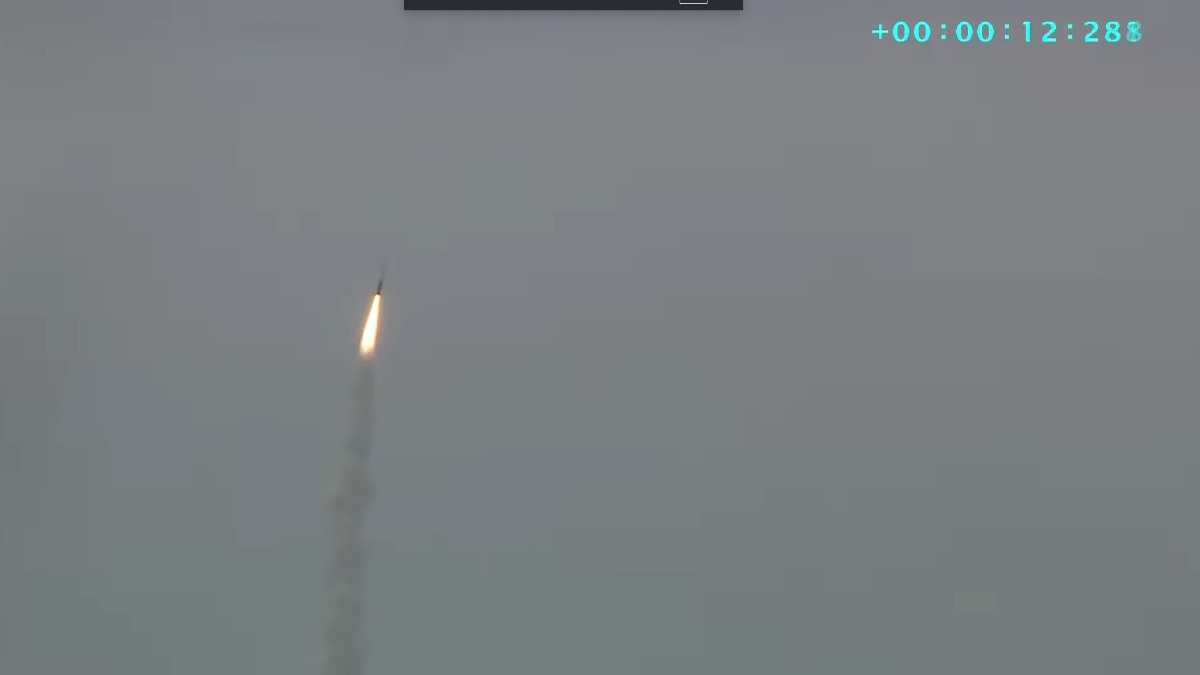
Skyroot's Vikram-1 launched on its maiden test flight into space.
After a planned internal hold, Vikram-1's historic launch has been pushed to 12:05 pm.
The mission continues to be watched closely as India's first privately developed orbital rocket waits on the launch pad.
After a historic launch, Vikram-1 will cross the speed of sound in seconds.
Moments after liftoff, Vikram-1 will rapidly pick up speed, crossing the speed of sound, called Mach 1, just 25 seconds into flight.
By 1 minute and 30 seconds, the rocket is expected to reach Mach 5, or five times the speed of sound, before its first stage separates, according to Skyroot's mission profile.
Launch to last just over fifteen minutes from liftoff to payload deployment.
The mission is completely automated and all the final system checks before launch are being conducted by the computer. Launch in 10 minutes.
The launch gallery looks almost full with students from across schools awaiting the launch.
The automatic launch sequence is progressing smoothly, and launch is set to happen in the next 15 minutes.
The spacecraft team has completed the guidance, navigation and control checks, and all systems look ready for launch. These checks are crucial for flight director to give green light for launch.
Skyroot has set up a mission control at its HQ in Hyderabad, which is coordinating with the team at Sriharikota for the launch.
All systems are ready, tested, and primed for launch. Vikram-1 is now in the final 30 minutes of launch prep.
The Mission Control at Isro has adapted to the Vikram-1 launch architecture with senior officials, former Isro chiefs, and Indian astronauts awaiting the launch.
Indian astronaut Shubhanshu Shukla, who is at Sriharikota to witness the launch of the Vikram-1 rocket, said, "I know a lot of you would be anxious, and a lot of you would be excited. I would urge you to choose excitement. To me, it feels like a defining moment in India's private space ecosystem. I wish the team the very best."
The payload fairing is the rocket’s protective nose cone. During launch, it shields the satellite from scorching heat, strong winds, and vibrations as the rocket blasts through the atmosphere at thousands of kilometres per hour. Once in the silence of space, the fairing must split into two halves and drop away cleanly, so the satellite can be released without any damage or obstruction.
When Vikram-1 reaches space, the payload fairing needs to split apart and fall away cleanly, protecting the satellite on the way up, then getting out of the way when its job is done. The final pre-flight separation test on flight hardware confirms the pneumatic separation⦠pic.twitter.com/uGZQbq3Pbc
View this post on Instagram A post shared by Sibu Tripathi ðª (@that_millennial_maverick)
Skyroot Aerospace announced it had raised nearly $60 million in fresh funding, pushing the Hyderabad-based rocket startup’s valuation to $1.1 billion and making it India’s latest unicorn.
The funding round was co-led by Sherpalo Ventures and GIC, the Singapore-based global institutional investor, with participation from existing backers including the founders of Greenko Group and Arkam Ventures.
Senior Isro officials and former chiefs have said that the opening up of the space sector to include private companies will open the economy up to foreign launch demands. The idea is to have more rockets in the market with quick cadence and reliable buildup, which Skyroot is offering.
Vikram-1 has been modelled, simulated, tested, and qualified. And some questions can only be answered in flight.
Vikram-1 has been modeled, simulated, tested, and qualified. And some questions can only be answered in flight. This episiode follows the team to Sriharikota, where the launch campaign is close to completion and with each passing day, Vikram-1 moves one step closer to flight.⦠pic.twitter.com/E2TZNgUXCU
We have the first view of the Vikram-1 rocket from the launchpad this morning.
As the countdown continues, the chairman of IN-SPACe has joined the chorus of support for Skyroot Aerospace.
Pawan Goenka wished the Skyroot team success in a post on X, calling Vikram-1 a "historic milestone" and saying the nation is eagerly awaiting the outcome of India's first privately developed orbital rocket launch. "Do watch the launch live starting 11:30," he added.
Hon PrimeMinister, the whole nation is anxiously waiting for the success of this historic milestone. The Skyroot team has worked very hard for this day. Best wishes @SkyrootA . #IndiaWithVikram1. Do watch the launch live starting 11-30 athttps://t.co/DincRGyJTk https://t.co/EQPfwrVbrS
Skyroot Aerospace was founded in 2018 by former ISRO scientists Pawan Kumar Chandana and Naga Bharath Daka. Chandana serves as the CEO, while Daka is the COO. The duo launched India's first private rocket, Vikram-S, in 2022 and now lead the historic Vikram-1 orbital mission, marking a new era in Indian spaceflight.
When Skyroot Aerospace's Vikram-1 rocket lifts off from Sriharikota on July 18, it will carry more than technology demonstration payloads into space. Among the mission's most symbolic cargo will be a handwritten postcard by Prime Minister Narendra Modi, bearing the words "Vande Mataram."
The two founders, Pawan Chandana and Naga Bharath Daka, both former Isro engineers, have said that for them, a good liftoff will be a success, and the mission is all about gathering as much data as they can.
For India's rapidly expanding private space sector, Mission Aagaman represents far more than a single launch.
Unlike traditional demonstration missions, Vikram-1 will attempt to place multiple technology payloads into a 450-kilometre Low Earth Orbit at a 60-degree inclination.
The rocket is capable of carrying payloads weighing up to 350 kilograms and has been built using an all-carbon composite structure powered by in-house developed propulsion systems, including 3D-printed engines and high-thrust solid rocket motors.
Skyroot is launching a series of tech demonstrators aboard Vikram-1 to space.
Vikram-1 stands 22 metres tall and measures 1.7 metres in diameter.
The four-stage launch vehicle is designed to carry up to 350 kg of payload into a 450-km Low-Earth Orbit.
If all goes as planned, the rocket is expected to reach its target orbit in about 16 minutes, marking India's first privately developed attempt to place satellites into orbit.
Minister for Human Resources Development of Andhra Pradesh, Lokesh Nara is on his way to Sriharikota with his son, calling the Vikram-1 launch a dream years in the making.
Nara said on social media that today's mission reflects the belief that a private Indian company could build rockets and help shape the country's future in space.
Heading to Sriharikota with Devaansh today for what promises to be a memorable father-son day. Every great spacefaring nation began with a dream - of daring to build, to innovate, and to push the boundaries of what seemed possible. Today is about celebrating that spirit. What⦠pic.twitter.com/G19Oy7IYxU
Prime Minister Narendra Modi has wished Skyroot Aerospace success ahead of the Vikram-1 launch, calling it "a historic new frontier for India's space journey."
PM Modi said the mission showcases the talent and entrepreneurial spirit of India, while highlighting how space sector reforms are creating new opportunities for innovation and enterprise.
A historic new frontier for India’s space journey! At 11:30 AM today, Skyroot Aerospace will undertake the maiden orbital launch of Vikram-1, India’s first privately developed launch vehicle. This four-stage rocket is designed to provide rapid and on-demand launch services.⦠pic.twitter.com/1qFVTwNOuZ
Just hours before today's big launch, the entire Skyroot team signed their names on the Vikram-1 rocket. Every engineer and technician who built India's first private orbital rocket has prepared to send a piece of themselves into space on Mission Aagaman.
Signed by the people who built it. ð Every signature on Vikram-1 belongs to an engineer, technician, or teammate who helped make this mission possible. Now, they’re all headed to space aboard Mission Aagaman.#Vikram1 #MissionAagaman pic.twitter.com/BEeHn7OiIM
Vikram-1 is India's first privately developed orbital rocket, built by Hyderabad-based Skyroot Aerospace. Flying under Mission Aagaman, the four-stage launch vehicle is designed to carry small satellites into low-Earth orbit.
This maiden mission will test the rocket's performance while deploying multiple payloads, paving the way for future commercial launches by India's growing private space industry.
India is set to witness a major milestone in its space journey as Hyderabad-based Skyroot Aerospace prepares to launch Vikram-1 from Sriharikota today.
Named Mission Aagaman, the flight aims to become the first privately developed Indian rocket to place satellites into orbit, marking a significant step in opening the country's space sector to private players.
Original Source
This content was distilled for a focused reading experience. All rights belong to India Today.
Read original publication