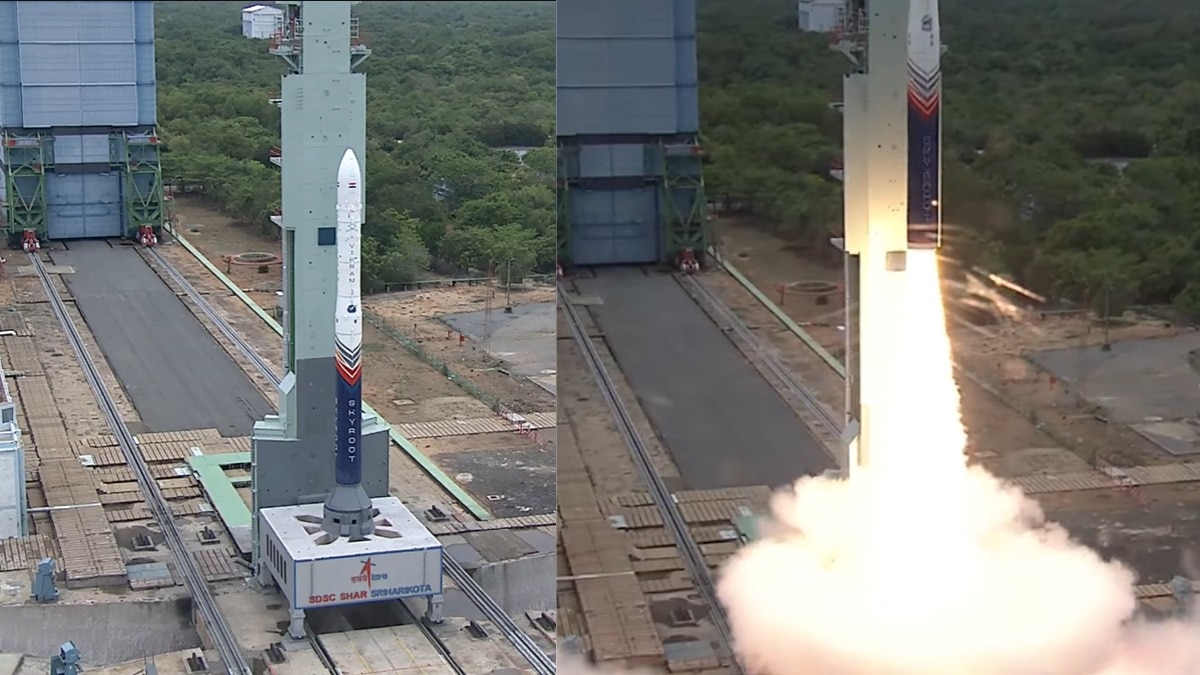
Video: Moment India's first private rocket Vikram-1 launched into space Skyroot Aerospace
The mission is named Aagaman, and is the first attempt by an Indian private company to place an indigenously built rocket into orbit from Indian soil.
Mission Aagaman is primarily a technology demonstration flight.
According to Skyroot, the objective is to achieve a successful liftoff, safely clear the launch tower and gather flight data throughout the ascent.
The mission will validate the rocket's propulsion, telemetry, avionics, guidance, navigation and control systems under real launch conditions.
Controllers will be closely monitoring key factors, including pitch manoeuvre, Mach 1, Max-Q, which is the point of maximum aerodynamic stress, stage separations, payload fairing separation, ignition of the Orbit Adjustment Module (OAM), orbital injection and payload deployment.A historic new frontier for India’s space journey!At 11:30 AM today, Skyroot Aerospace will undertake the maiden orbital launch of Vikram-1, India’s first privately developed launch vehicle.This four-stage rocket is designed to provide rapid and on-demand launch services. pic.twitter.com/1qFVTwNOuZ— Narendra Modi (@narendramodi) July 18, 2026The complete mission timeline extends to just over 15 minutes after liftoff, when the rocket will reach orbit, travelling at a speed faster than sound, and is expected to inject the payloads into orbit.
The rocket can eventually carry up to 350 kg to low-Earth orbit, making it suitable for launching small satellites.BEGINNING OF INDIA'S PRIVATE SPACE INDUSTRY
Founded in 2018 by former Isro engineers Pawan Kumar Chandana and Naga Bharath Daka, Skyroot first made history with Vikram-S in 2022, which became the first privately developed Indian rocket to reach space on a suborbital flight.
It is India's first all-carbon-composite orbital rocket and features the country's first 100% 3D-printed liquid engine on an orbital launch vehicle. Officers stand guard near the Vikram-1 rocket in Sriharikota. (Photo: PTI)
The mission is also carrying multiple customer payloads and technology demonstrations from India and overseas, including satellites, in-orbit experiments and robotic technology demonstrators.
A successful mission would validate years of development and highlight the impact of India's space-sector reforms, opening the door for more frequent commercial launches by private Indian companies.- EndsPublished By: Aryan Published On: Jul 18, 2026 12:27 IST
Original Source
This content was distilled for a focused reading experience. All rights belong to India Today.
Read original publication