From the Editor-in-Chief
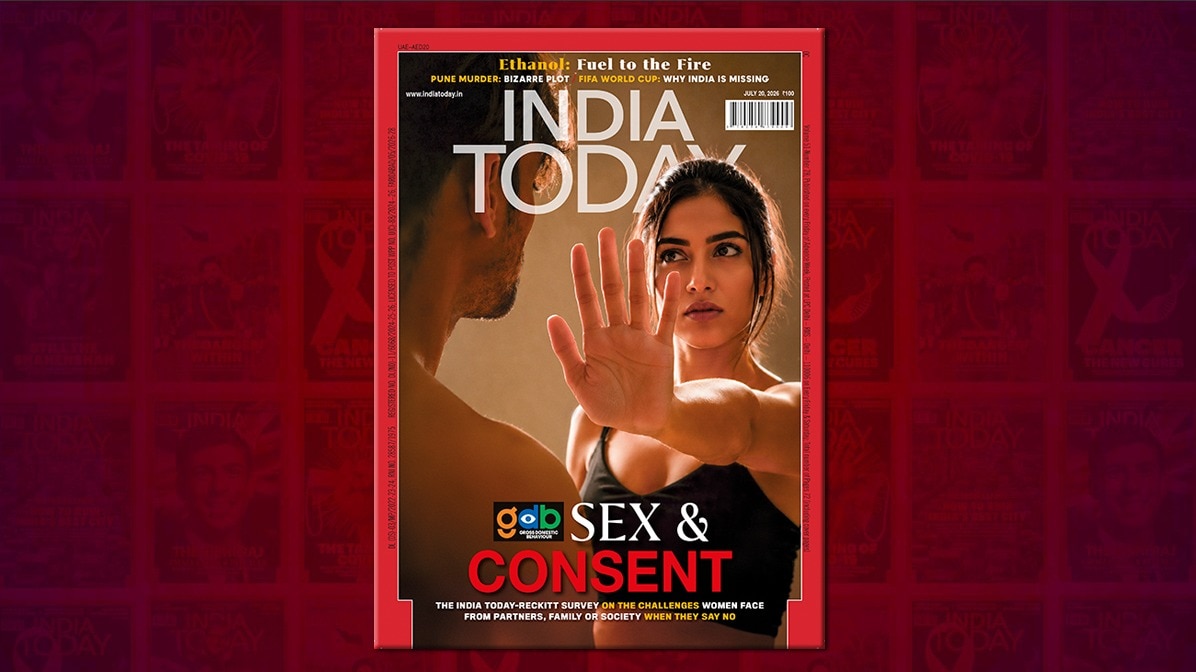
Last year, we initiated a pioneering survey of India’s ‘Gross Domestic Behaviour’, an attempt to reveal aspects of ourselves that we rarely talk about plainly. This week, we take that to a territory obscured by shame and silence: the contours of power within everyday gender relations. It centres around the concept of ‘consent’. We asked 6,379 adult Indian women across every region, class, religion, marital status and age group questions about the right to consent. What do they think about it? What happens when they try to exercise it? How do they negotiate the simple act of saying ‘no’ to partners, elders, bosses and strangers? Our objective was simple. It was to attempt a first draft of India’s code of sexual politics, the unwritten directive principles that govern how intimate encounters pan out across millions of interpersonal contexts. It’s a complex subject, with infinite traces of social, psychological and legal dimensions. But we ventured forth in the belief that the very nuances and ambiguities would be revealing. The results prove our intuition right: they are by turns reassuring, uncomfortable, sometimes startling, but always revealing.
The first India Today Consent Survey, conducted by CVoter, sketches a changing country—one that has learned the vocabulary of consent but still struggles to live by it. Across our sample, women’s awareness of their right of refusal scores about 59 out of 100. There is expected variation along categories, but the data pool broadly tends towards convergence. The real gap lies in its comparison with lived experience. Those who report an ability to control sexual encounters trail at 44; some sub-categories dip below 35. So actual autonomy lags behind awareness by a full 15 points. This divergence shows up in subtle ways across practical scenarios. An overwhelming 79 per cent are in no doubt that ‘no means no’, yet only 56 per cent directly refuse when they are unwilling. Many simply go along, rationalise their passivity and endure discomfort in silence ‘to keep the peace’. The right to change one’s mind is even more fragile: only 36 per cent say a withdrawn ‘yes’ is respected. Women who stop mid-situation are popularly slotted in the same set as women who articulate desire: too aggressive.
The most unsettling numbers relate to conjugality. About half the respondents say partners honour their refusal. Before that is read as reassuring, consider what it implies for the other half. Across categories, about 17 per cent report being physically forced into intercourse by a husband or partner. In public and professional spaces, violation is routine: 48 per cent have faced unwanted touching in buses and bazaars, 36 per cent have had a figure of authority ignore their refusal. In closer social spaces, that figure of authority is a family elder: only 38 per cent say their refusal is respected.
The most encouraging numbers relate to the domain of belief. A clear majority, 66 per cent, believe rape can take place within marriage. Three-fourths support legal recognition of marital rape, even if with safeguards. About 44 per cent say the judiciary’s refusal to do this is patently violative of women’s rights. What Indian women believe, it turns out, is considerably ahead of what the law has been willing to acknowledge.
I want to be clear about what this survey is and what it is not. It is not a comprehensive account of Indian womanhood. No single survey of 6,379 respondents can be that. It is a first draft, an attempt to give quantitative shape to a subject that resists easy measurement precisely because it lives in the space between what people say and what they do, between what is acknowledged in public and what is endured in private.
The concept of consent is, at its most fundamental, the smallest unit of freedom. How freely it can be exercised tells you something essential about how free a society actually is, as opposed to how free it believes itself to be. As India moves through the last stretch of its first century of Independence, that question deserves a serious, unsentimental answer.
This survey is a beginning. Four eminent essayists, each bringing a different perspective on sexual politics, deepen the statistical picture in the pages that follow. Read them. This conversation is long overdue.
Original Source
This content was distilled for a focused reading experience. All rights belong to India Today.
Read original publication