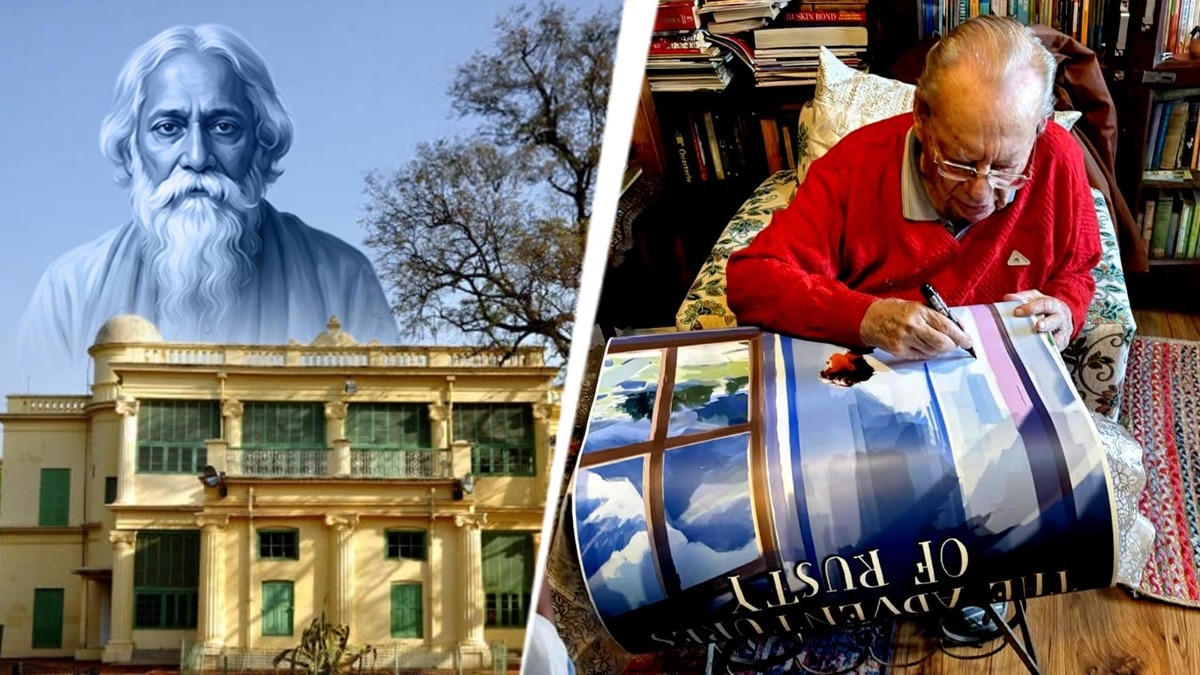
We're home to Tagore and Ruskin Bond. So why is literary tourism missing in India?
Now, I want to follow those stories back to where they were born – to the mansions, lanes and landscapes that shaped them. Turns out, I'm not alone. The world calls it literary tourism.
According to Skyscanner's travel trend report 2026, 84 percent of travellers have booked, or would consider, a trip inspired by literature. It is shaping the way people travel: from book-inspired itineraries, reading retreats to iconic bookstores and libraries.
However, the conversations almost always begin with Jane Austen's guided tours, The Lord of the Rings-inspired landscapes or Harry Potter experiences. But where are India's literary landscapes in this global reading travel map? Left hidden in folded corners of a page.
At a time when pop culture draws travel itineraries, the landscapes behind India's greatest stories remain largely unread. For many, books are simply inevitable travel partners. (Photo: Getty)
"It's a nice way to travel. Instead of just doing sightseeing of the principal cities – which is always important – following a book, doing readings, makes travelling a much more holistic and fulfilling experience," Mandip Singh Soin, founder of Ibex Expeditions, tells India Today. Books teach you to notice details ordinary tourists often walk past.
"I remember once we were in Chile, visiting Pablo Neruda's house. While we were doing all the sightseeing, a simple idea came – "we should buy a book of his poems". We sat down inside the house and each of us read paragraphs before passing the book around. It was like doing a deep dive into the author's spirit."
Literature helps you explore the same place in a different manner is what Kartik Chauhan, a commissioning editor at a reputed publishing house shares. "I know a lot of people who travel and deliberately read books about the places they're visiting. I myself do it. I recently visited Darjeeling and read the excellent book No Path in Darjeeling Is Straight." He shares how a book published a decade ago still holds relevance. It's one thing to know the name of a place. It's another thing to comprehend through words weaved in a book. (Photo: Getty)
Just as Zindagi Na Milegi Dobara inspired Indians to travel to Spain, and Yeh Jawaani Hai Deewani made trekking with friends a bucket-list experience, books, too, leave us with places we long to visit. The only difference? Instead of following a video, you're following an author's imagination.
So, how about we take you through some of those places that exist beyond the pages?Ready for a literary detour?
RK Narayan's stories captivated generations before they were adapted into the television series, much of which was filmed in Agumbe and Arasalu, Karnataka. Today, the restored Arasalu station lives on as the Malgudi Museum – a nostalgic tribute to a fictional town that still feels wonderfully real. View this post on Instagram A post shared by Sneha (@sne_captures)
And then comes the Bard of Bengal. Tagore's literary trail extends far beyond Santiniketan in Bolpur, Wets Bengal. His Gouripur House in Kalimpong is being restored as a museum and heritage stay, while Mungpoo (a village in Kurseong, West Bengal) - where he spent several summers – and Jorasanko Thakurbari, his ancestral home, still attracts visitors. Tagore's Gouripur Mansion in Kalimpong is reportedly where he spent a few of his birthdays in the 1900s. In 2026, the mansion is still under restoration by the West Bengal Heritage Commission. (Photo: West Bengal Heritage Commission website)
And you cannot miss out on Ruskin Bond's world! The scent of deodars, whispering rhododendrons and the winding lanes of Dehradun and Landour have long-lived through his writing. Today, his Ivy Cottage in Landour remains a stop for readers. Rusky still finds peace in the mountain lanes. (Photo: Ruskin Bond/Isnatgram)
Similarly, writers like Mamang Dai have also painted a word picture of North-east India for readers.
Clearly, there are destinations inspired by literature. There's also Manto, Rudyard Kipling, Ghalib and countless others too.Niche market and unfinished business
Experts suggest that there is a subtle rise in literary tourism, thanks to rising literary fests, but it's very niche. Soin shares how they got a request from the US to curate Indian literary trails around Arundhati Roy's writing of South India.
Last year, Kerala Tourism proposed India's first Literary Tourism Circuit as a tribute to Malayalam's literary legends like Thunchath Ezhuthachan, Vaikom Muhammad Basheer, M.T. Vasudevan Nair and more. Envisioned for a mid-2025 launch, the trail remains, for now, a story waiting to be written.
Arguably, some literary landmarks may get attention via walks and tours, but many remain forgotten.
George Orwell's ancestral home in Motihari, Bihar, is one such example. Despite the author's global legacy, reports until last year suggested the house was still languishing in disrepair. Missed opportunity much?Why Indian literary tourism remains unread
Chauhan first points out the popularity of literature. "The way the English canon has been built, the world has always consumed books like Jane Austen, Harry Potter and The Lord of the Rings with a lot of approval from the West. So when we think about these places, even when they are high fantasy, they become destinations. More recently, whenever a movie comes out based on books, the places become viral. Those films become cultural icons, the actors become cultural icons, and that changes the way we consume literature."
"In India, it's difficult to find writers who have that kind of presence internationally—writers whose appeal cuts across generations, countries and cultures – except perhaps Tagore or Arundhati Roy. First, we have to familiarise travellers with Indian writers and do more to promote them."
And it's not just the ones who write in English. India has great works of literature in regional languages too. While there are few river cruises up the stream, Parimal Bhattacharya suggests having a better experimental journey through the ripples of literature that are more commonplace. (Photo:Unsplash)
Bhattacharya, who has written extensively about Darjeeling, adds another challenge:"You have to showcase the landscapes and package them properly. You have to give potential tourists a deep, immersive experience. It's important to sell the history and lifestyle of communities settled along these places."
His suggestion? Have more experiential river cruises. A legion of writers has written about the Hooghly river, the vivid backwaters of the south and more. He also thinks that one can purely build a route around hill stations too!
Chauhan believes India's literary tourism story begins with its readers.
"I also think there are logistical challenges. Income inequality and broader socioeconomic factors create barriers for people to travel to places they've read about," he adds. Accessibility is another problem. Several areas lack libraries even for regional writers to sell.
"To develop literary tourism, we need the guidance and intellect of writers, historians, travel designers and scholars," says Soin.
Interpretation is everything. "The quality of interpretation has to be pretty good as well. Otherwise, if you just rely on the average monument guide, that's not always a good fit. They're very good as far as the monument is concerned, but a lot of times they may not be able to engage in the kind of discussion these travellers are looking for," Soin highlights.The epilogue
As Bhattacharya puts it, "After all, what is literature? Literature is stories engraved on places. Stories engraved on landscapes." And you don't have to be a literary buff to embrace this travel trend and go in search of those stories.
Maybe pick up Malgudi Days, a generational cult classic, and book a trip down South. Or pick up a short story by Ruskin Bond and head for the hills.
We've long travelled for films and viral Reels. How about picking up a novel and getting "book-ed" the desi way?- EndsPublished By: Jigyasa SahayPublished On: Jul 18, 2026 11:43 IST
Original Source
This content was distilled for a focused reading experience. All rights belong to India Today.
Read original publication