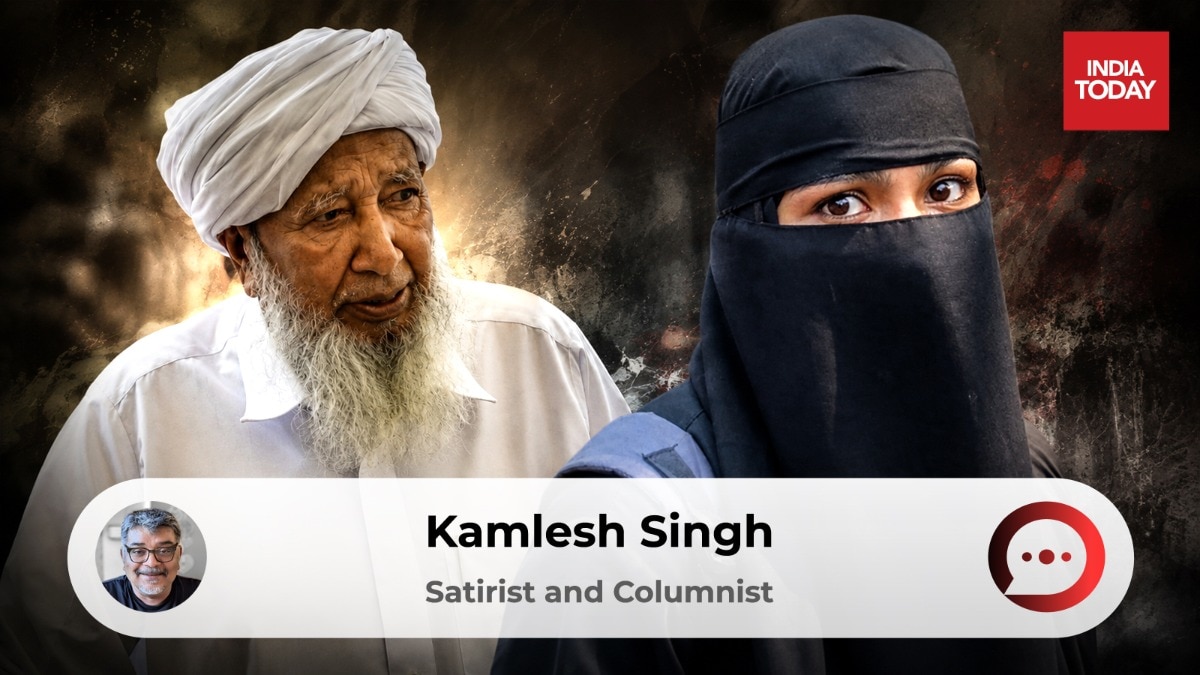
Grand mufti: Smash the patriarchy, keep women at home
This followed a circular from his outfit instructing that women must not share a stage with men or appear in public spaces beside them. He offered, as consolation, that this is all done out of respect.
This is the same gentleman who once informed us that gender equality is un-Islamic and against humanity, that women are fit only to deliver children, and that you will not find them doing the big surgeries because they lack the himmat and can manage only paediatrics.
Now here is where it gets instructive. In 2022, when Karnataka moved to keep the hijab out of classrooms, the very same Grand Mufti was a champion of choice. He called the ban discrimination and demanded the state keep its hands off, backing "hands off my hijab". Choice, when a woman covers up as instructed. No choice, when she wants to step out of the door. The Constitution as a shield for the veil, and the same Constitution on casual leave when she wants to feel the breeze in her hair. That is the cleric. Consistent in his inconsistency, at least honest about the destination.
But people saying that's not religion are taking the matter too far. The Mufti knows his subject. He has spent a lifetime contemplating the verses you quote from Google and Sunnah.com. He has the authority, being the religious beacon, to show the light to the faithful.
The argument that he is misinterpreting the message falls flat. The argument that the Constitution guarantees women to interpret the verses the way they want holds. So defenders should do the latter, but the professionally secular also want validation of the verses in the scripture when the validation of an Article in the statute will do. They invent harmony between the two where nothing like that exists.
Watch the professionally secular, the ones who would deliver a 40-minute lecture on my-body-my-choice when the imposition is one they find aesthetic, and then develop a sudden, lovely laryngitis when the same establishment declares women fit only for breeding. When it is the confinement of the hijab, it is agency, resistance to a majoritarian government. When it is the confinement of four walls, it is, well, misinterpretation by the Mufti. The principle was never the point. Choice is not a value they hold but a costume they change based on where they spend their evening. At the India Habitat Centre, they are in a gown with a strategic slit, and a hijab magically appears when among the protesters demanding the right to reject a uniform in a school.
And then comes the sweetest sleight of hand. When the confinement gets too naked to defend, the apologist reaches into history and produces the Prophet, the Messenger of Allah, as the first feminist, the man who handed women their rights. It survives neither the history nor the circular.
Reforming some customs of 7th-century Arabia, an inheritance share, a curb on burying daughters, all of it was real, but it was not the modern-day feminism some make it to be, and never a ceiling for a community to still crouch under 14 centuries later, mistaking a floor for a roof. The holy Prophet built the foundation, operated and transferred it to a new world. The men who came centuries later and controlled the message, like Mufti Musaliyar here, did not build on it. Instead, the clerics chose to differ among themselves to derail any later reform even when the followers reached near unanimity.
The Hazrat Khadija they parade as proof of their honour is a woman this Mufti's fatwa would send straight home, barred from the very platform where they chant her name. She is not their evidence. She is exhibit A for the prosecution.
Exhibit B is Hazrat Aisha (RA), who rode into battle and became a leading authority on the Prophet's sayings. Within a few generations, women like her were quietly reclassified as glorious exceptions, useful for quoting and impossible to imitate. The key had passed to the ulema, who sell salvation and hold the key.
And before the saffron corner claps too hard at Kanthapuram being "medieval seclusion", a reminder. This is Kerala, the same state where, when the court opened Sabarimala to women, an entire ecosystem rediscovered the sacredness of keeping them out. Different god, same door, identical instinct: a woman is a problem best managed by keeping her somewhere else. The saffron sadhus have issued their own versions of the decree that the Mufti issued in Kerala. Outrage that runs on the fuel of who the patriarch prays to is not feminism. Many will reject this by labelling it monkey-balancing. Blissful avoidance of uncomfortable truth is a choice the Constitution guarantees everyone.
The truth is that religions originated when women were property. Since men developed a sense of ownership and property, women needed to be protected to produce the progeny. Women were weak and violable. They were stolen like cattle. Hence the protection network. These were codified in different religions as books were written. And the rules changed with time. Some societies saw this change slower than others. In this century, since the nation states came into being and constitutional morality emerged as the guiding principle, most countries have increasingly made religious edicts irrelevant. Some have been struggling to strike a balance. Some remain in the darkness of the Middle Ages. Afghanistan is an example. Women have been pushed into the confines of their home and the men of the world pretend to not see the injustice. Because, well, we have to respect the sovereignty of a nation and the faith of that nation.
When it comes to feminism, everybody is negotiating terms. But largely, it's her body, his choice. Her home, his farmaan. Her rights, guaranteed, subject to availability.
The man in his 90s is just the excuse. His detractors today will defend him the next time he takes a stand that's politically useful and convenient for the professionally secular.
Original Source
This content was distilled for a focused reading experience. All rights belong to India Today.
Read original publication