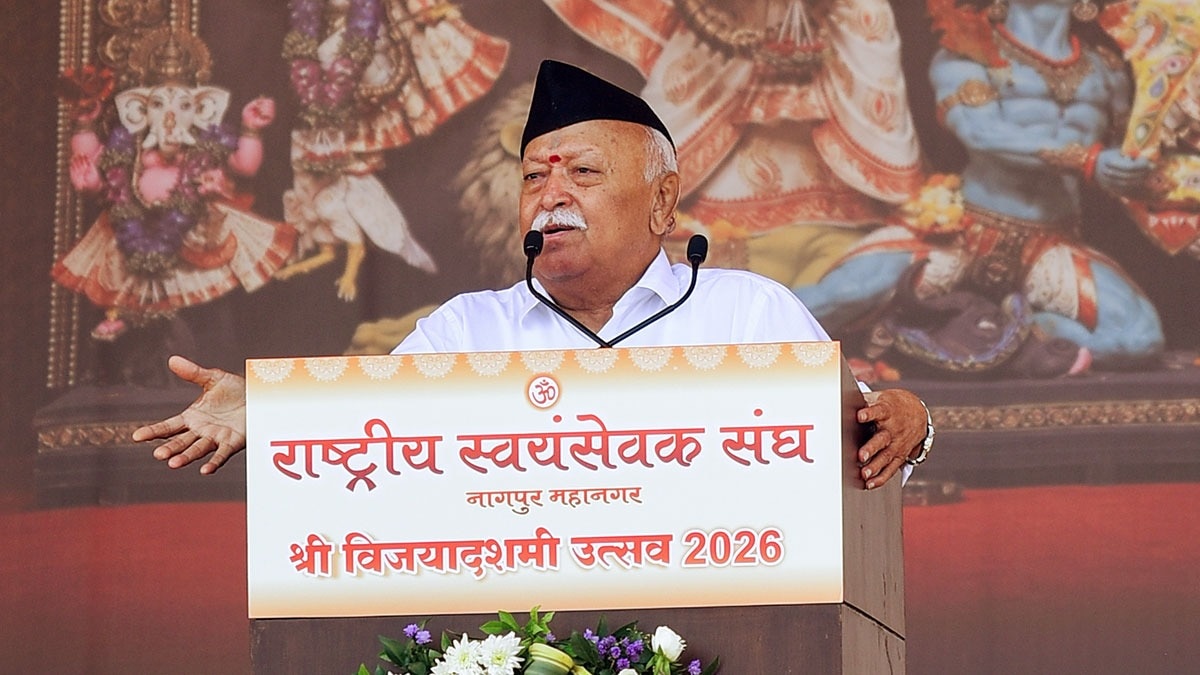
How Mohan Bhagwat asserts that the Sangh is the regime
What lifted the speech above the week’s slanging match was the frame. Agitations, Bhagwat said, belong in a democracy, but they must lead somewhere, stay inside the Constitution, not open “divisions and chasms”, and not chase cheap popularity. He aimed the same caution at the police and at political leaders, which is not how the BJP has been talking. Then he went back a century, to Curzon’s partition of Bengal, the song that answered it, and 1947, when Partition stuck “because we believed we look different and are different”. Nobody, he said, should hesitate to sing ‘Vande Mataram’ in full. That is no antiquarian point: the song’s 150th anniversary last winter got a 10-hour debate in Parliament, and the BJP has been turning the full text, with its invocation of the goddess, into a loyalty test.
The rest was familiar ground with more edge. Diversity of faith, region, caste and language is to be protected, but on a base of oneness drawn from Sanatan philosophy and swa-bodh, awareness of self. Technology is a means, not an end. The government should regulate OTT and social media. The chief guest listening was Sanjay Gupta of Dainik Jagran. Drugs are a national problem. The Nepal floods were partly the bill for “one-sided development” of the Himalayas. The Kolkata hotel fire, too, got a mention. And a great India “will not come as a blessing from God”; society must build it, not the government alone.
Three things the Sangh usually keeps apart were pushed together: a defence of the sitting order, an account of what holds India together and instructions on how Indians ought to live.
The CJP did not exist in April. It began on May 16 as an internet joke about a Chief Justice’s remark, grew through the NEET mess in June, and claimed the education minister’s resignation as its first scalp. Since October it has run alongside the INDIA bloc’s campaign against the SIR, which struck roughly nine million names, about 12 per cent of the electorate, off West Bengal’s rolls before the April election. The Supreme Court refused to suspend the CEC on October 5; MPs marched on Nirvachan Sadan the next day; thousands were detained in Delhi on October 10. Then Bhushan said the quiet part out loud, and a quarrel over voter lists became one over the government’s survival.
The BJP is in an odd position: never stronger in the states, rarely weaker in the House. It won Bengal for the first time with 206 of 294 seats and kept Assam, yet in April it lost a constitutional amendment for the first time in 12 years, the delimitation package falling 54 votes short. A party that could win Bengal but not amend the Constitution has every reason to cast its opponents as a mob rather than a bloc of 230 votes.
The Sangh has its own stake in the party’s house. The relationship bottomed out in June 2024, with Bhagwat’s barb about a true sevak having no ahankar (arrogance) and J.P. Nadda’s boast that the BJP no longer needed the RSS. It has been repaired piece by piece: Modi’s first visit to the Sangh headquarters as prime minister, his Red Fort tribute, and in January the choice of Nabin, a 45-year-old from Nitish Kumar’s cabinet with no Delhi baggage, as party president after a year’s stalemate. Sangh-watchers called him the new Gadkari. Modi called Tuesday’s speech “very motivating” within hours; the Congress said the BJP president was “echoing RSS statements”. Both were saying the same thing: Nagpur is writing the line and Delhi is reading it out. The RSS has not had that hold on the BJP’s messaging since before 2014.
The sentence that matters most for the Sangh itself was not about protestors. It was Bhagwat’s claim that the forces at work were “trying to dismantle India and the Sangh”. For a century the organisation has called itself a social body apart from the state. To name itself a target of regime change is to concede the agitation’s central charge: that the Sangh and the regime are, for practical purposes, one thing.
There is a reason the Sangh takes this personally. The SIR is, in substance, a Sangh project. Purging “infiltrators” from the rolls is a demand Bhagwat has made from this stage since 2012, after the Assam violence, and again in 2024. The Election Commission’s exercise operationalises it; Bengal’s nine million deletions before the BJP’s first win there, and Bihar’s NDA sweep after the first SIR, are in Nagpur’s reading the proof. To the Opposition the agitation is about the integrity of the voter list. To the Sangh it is an attack on the one piece of its demographic agenda the state has actually carried out.
The Opposition has built the equation deliberately. In Chennai on October 10, Rahul listed the “villains” as Modi, Amit Shah, Bhagwat, Gyanesh Kumar and Ajit Doval, in that order. Put the sarsanghchalak between the Home Minister and the CEC, and you are saying the RSS is a department of the government, not a cultural body with a political offshoot. That is harder to shrug off than the old charge of communal sectarianism, because it goes at the self-description on which the whole door-to-door enterprise rests.
The harder problem is who is doing the challenging. The Sangh’s reflexes were built for the Congress, the Left and minority politics. The CJP is none of those: satirical, loosely organised, alive on Instagram with some 19 million followers to the BJP’s nine million, its grievances exam leaks, jobs and voter lists. It draws on exactly the cohort the RSS says it reached in record numbers this year. Bhagwat’s July verdict that Gen Z is “emotional” and goes for whatever looks “visibly authentic” was an admission that shakha discipline was not reaching the crowd at Jantar Mantar. Since then the Sangh has tried to talk to the generation and discredit its leaders at once; Organiser spent the week before the speech cataloguing 16 CJP-linked figures as anti-Hindu. When Neha Bora called Bangladesh’s student uprising an inspiration, the Sangh had the foreign template it wanted.
The least quotable passage may outlast the rest. Over the centenary year, Bhagwat reported, swayamsevaks visited 10.19 crore households in 4.61 lakh villages, held Hindu sammelans in 34,187 mandals and drew 39 lakh young people to youth conventions. No party can claim that reach outside an election. What travels along with it is Panch Parivartan: social harmony, family awakening, environment, swa-bodh (self-awareness) and Swadeshi, civic discipline. Unpolitical on the surface, which is what makes it useful.
He also cited a Sangh study of 1,296 rural schools showing better attendance where swayamsevaks were involved, offered as proof that “society”, not government or agitation, solves problems. The RSS has gone from arguing what Indian identity is, to prescribing how Indians should behave and claiming measurable results. It has, in effect, invited judgement on delivery.
The vocabulary was forged earlier. In 2022 came the population-policy demand and the insistence on calling the Sangh Hindu “for clarity of concept”. In 2023, “cultural Marxists” and “wokes”, and Sanatana recast as the ground of unity to answer Udhayanidhi Stalin. October 2024, after the lost majority, named the “deep state”, read Sheikh Hasina’s fall as a template, told Hindus weakness is a crime and asked for an OTT law. Every one of those themes returned on Tuesday; what 2024 lacked was a domestic agitation to pin them on.
Go further back and the shift is from Hindu to Swa: the 2019 praise for Article 370’s abrogation, the 2021 distinction between swadheenata and swatantrata. Further still, to the 2018 Vigyan Bhawan lectures that made inclusion the Sangh’s self-description, and to 2009-13, when Bhagwat backed the Anna Hazare agitation, insisting governments come and go but society endures. In 2013 that was consolation for being out of power. In 2026 it is a claim of authority over the party that holds it.
The line from 2009 to 2026 is not an ideological shift; the proposition underneath has not moved. What has grown is the ambition hung on it. Three tests will decide whether the second century looks like vision or overreach.
Constitutional pluralism: Bhagwat anchored the speech in “We, the People”, then made Sanatana the foundation of that unity and asked everyone to sing the full ‘Vande Mataram’. Diversity accepted on a Hindu foundation is generous on its own terms and conditional on everyone else’s.
Dissent: Strip the rhetoric and the agitation is a demand that voter lists be accurate and the Election Commission answerable. The Sangh celebrated civic protest when Hazare led it. If Tuesday’s distinction, between agitation that wants solutions and agitation that wants power, cannot survive a movement aimed at its own side, then the Sangh would have defined dissent out of patriotism.
Delivery: Ten crore households, 1,296 schools. By claiming outcomes, the RSS has volunteered to be judged on results.
The first answers will come soon: in the Supreme Court, on Delhi’s streets, in whether delimitation returns to Parliament, in Uttar Pradesh next year, and in whether a BJP led by a Sangh-approved president treats this speech as instruction or as advice.
Original Source
This content was distilled for a focused reading experience. All rights belong to India Today.
Read original publication