The earthquake on the other side of the world
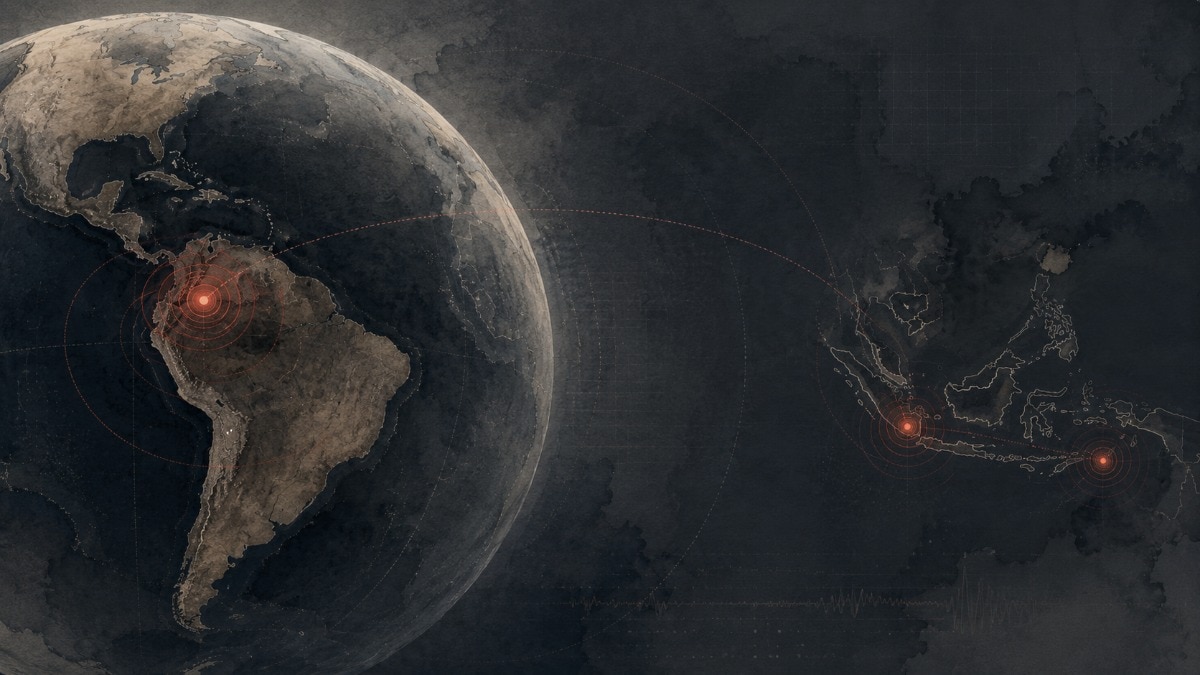
On August 10, a magnitude 7.4 earthquake hit Colombia. Four days later, two more struck Indonesia. Indonesia is almost exactly Colombia's antipode.
Coincidence? A group of scientists says maybe not. So we checked.
The first hit San Jose del Palmar in Colombia at 6:04 pm IST on August 10. It was 110 km underground.
Four and a half days later, at 3:28 am IST on August 15, a magnitude 7.7 struck the seafloor 68 km north-west of Ende, off Flores Island in eastern Indonesia. It killed at least 68 people and drove thousands from their homes. Two days earlier, the count was 53 dead. Death tolls are always provisional. This one rose for three days.
Seven hours later, a magnitude 6.9 shock shook Pematangsiantar in North Sumatra, 173 km down. Nobody died there.
Close up, this is settled. Venezuela was hit twice on June 24. A magnitude 7.2 quake tore the coast west of Caracas. Seconds later, a magnitude 7.5 broke the same fault. A fault is a crack in the rock. When one side slips, it shoves the rock beside it, and a crack already near the breaking point gets the push it needed.
"It's highly likely that the first event triggered the second," Harold Tobin of the Pacific Northwest Seismic Network said.
Those epicentres were 160 km apart. This story asks what happens at 16,000 km. Almost exactly the opposite.
Flores lies 162.2 degrees around the globe from the Colombian epicentre. Sumatra lies at 170.8 degrees. On that scale, 180 is dead opposite.
The far side is meant to be special. Earthquake waves travel through the planet and around it. On the opposite face, they arrive from every direction at once and meet. The idea is that this gives faults there one last push.
A 2018 paper in Scientific Reports tested it. Robert O'Malley and colleagues at Oregon State University said the world gets busier for three days after a big quake. Busiest of all in the band right opposite it. The same paper admits nobody knows how that would work. The physics, it says, “has largely been conjectural and speculative”.
You cannot simply count quakes near the antipode. Earthquakes follow the cracks between plates, so some parts of the world are busy and some are quiet. Japan's antipode is South America; Chile's is China. They are nothing alike.
We took 1,301 big quakes, magnitude 6.5 and above, from 36 years of US Geological Survey records. For each one, we counted what followed in the next three days, ring by ring, out to the far side. Then we counted the same rings at 30 random moments from those 36 years. Divide one by the other and you get a score. A score of 1.0 means the world is doing what it always does.
One step comes first. A big quake sets off hundreds of small ones right beside it, called aftershocks. Leave them in and they drown out everything else. Taking them out is called de-clustering. You draw a box in distance and time around each big quake, and count whatever falls inside as part of the same sequence.
That box is where this story ends up.ONE RULE SAYS THE EFFECT IS REAL
We start with the rule that the 2018 paper used, written by James Gardner and Leon Knopoff in 1974. The ring closest to the source scored 1.38. The middle of the planet scored 0.97. The ring opposite the source scored 1.11.
Neither is right. Both are rough curves drawn from old regional data, and picking one over the other is a judgement call. It never makes the headline.THESE THREE WOULD NOT COUNT ANYWAY
Even at its word, the 2018 paper does not fit August. It covers three days. Flores came 4.4 days after Colombia; Sumatra 4.9 days after. At that gap, our own far-side score is 1.01. Nothing.
Depth kills it too. Surface waves are meant to do the triggering, and a deep quake makes weak ones. Colombia was 110 km down, Sumatra 173 km. Only Flores, at 10 km, was near the surface.
To look at the far side of the world, you first have to decide what counts as an aftershock. That comes down to picking between two formulas, one drawn in 1974 and one in 1986. Pick the first and the effect is there. Pick the second, and it is gone.
Twenty years of papers have argued about this. It looks less like a mystery about the Earth and more like a measuring problem nobody has fixed.
Our own number moved twice for dull reasons. Filling holes in the catalogue took it from 1.17 to 1.11. Swapping the rule took it from 1.11 to 1.02; a result that slides that far does not hold up. That is not the same as saying there is nothing there.
Venezuela had no earthquake warning system in June. Neither does most of the Indian Ocean rim.
Whether a quake in Colombia can nudge a fault in Indonesia may stay open for another twenty years. Whether people get thirty seconds of warning before the shaking reaches them is not a mystery. It is a budget.- EndsPublished By: Pathikrit SanyalPublished On: Aug 18, 2026 20:42 IST
Original Source
This content was distilled for a focused reading experience. All rights belong to India Today.
Read original publication